
True-Up
Last updated on 2026-04-27
Overview
In the annual financial statements, a tax calculation is made, which then serves as the starting point for preparing the tax return. In practice, the tax calculation at the time of the tax return (true-up period) will differ from the tax calculation at the time of the annual financial statements (e.g. due to better insights).
The value difference between the two points in time is also referred to as the True-Up. True-ups regularly arise also in connection with completed tax audits.
This article contains the following sections:
True-Up Concept in Income Taxes
The true-up process in Income Taxes is illustrated in the following figures:
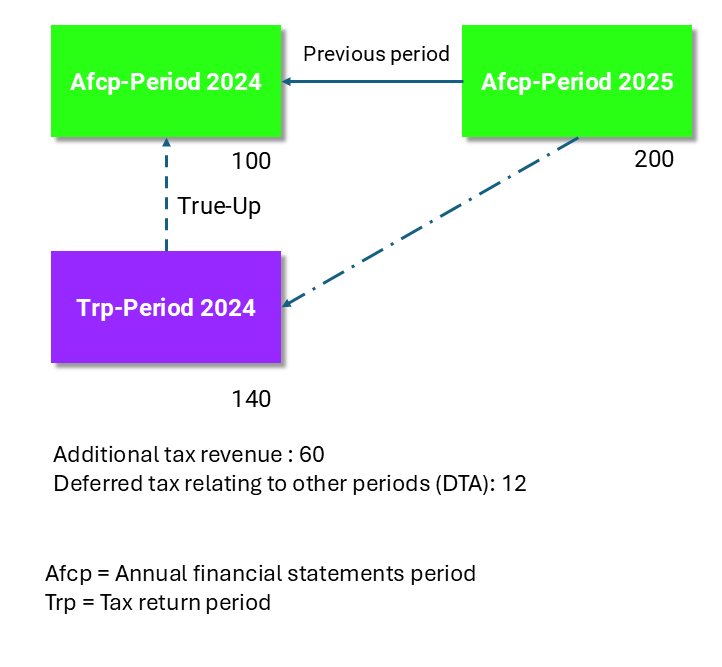
The taxable difference in assets (LB/TB difference) in the annual financial statements period of 2024 is 100. The difference increases by 40 to 140 in the tax return period. In the annual financial statement period of 2025, the difference in assets is 200.
The additional taxable income amounts to 60 (not 100) by taking the true-up period into account. The deferred tax assets related to other periods (DTA) amount to 18 (at a tax rate of 30%).
In the multi-period scenario, the following view applies:
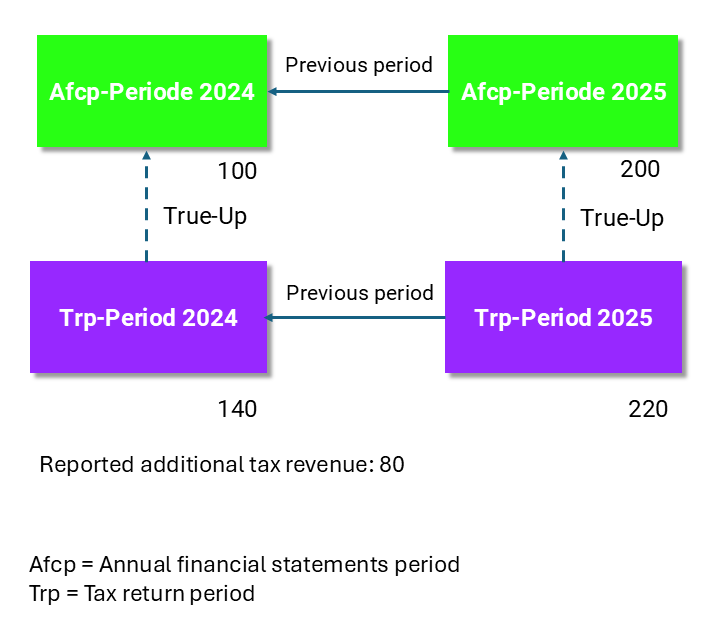
The additional taxable income for the tax return period of 2025 is 80 in the above example. The tax return period of 2024 is specified as the directly previous period. The true-up effect between the annual balance sheet period of 2025 and the tax return period of 2025 is 20 and affects the subsequent annual financial statements of 2026.
Effects of True-Ups
Effects of true-ups must be taken into account in subsequent annual financial statement periods. The following aspects must be considered:
Influence of other periods on the tax surplus/deficit
Influence of other periods on any existing tax losses carried forward
Influence of other periods on deferred taxes (reconciliation items in the TRR)
Other values of the true-up period (or tax return period) have no influence on the subsequent annual financial statements.
In the Related period field, the reference period for the true-up is entered when creating a period (e.g. in the context of a tax return or tax audit). Income Taxes then calculates the true-up effects and displays them as proposed values.