
Corporate Income Tax
Last updated on 2026-01-30
Overview
The corporate income tax return is prepared in the Corporate Income Tax functional area.
You can find the forms that must be completed for electronic tax return purposes in the Corporate Income Tax functional area. Forms that are not visible by default can be activated individually. The individual forms correspond to the forms of the tax authority.
The Current Taxes workspace can be used alternatively for annual financial statements and reporting purposes.
This article contains the following sections:
Navigation
The Corporate Income Tax functional area contains several forms that you can open via Company | Current Taxes | Corporate Income Tax.
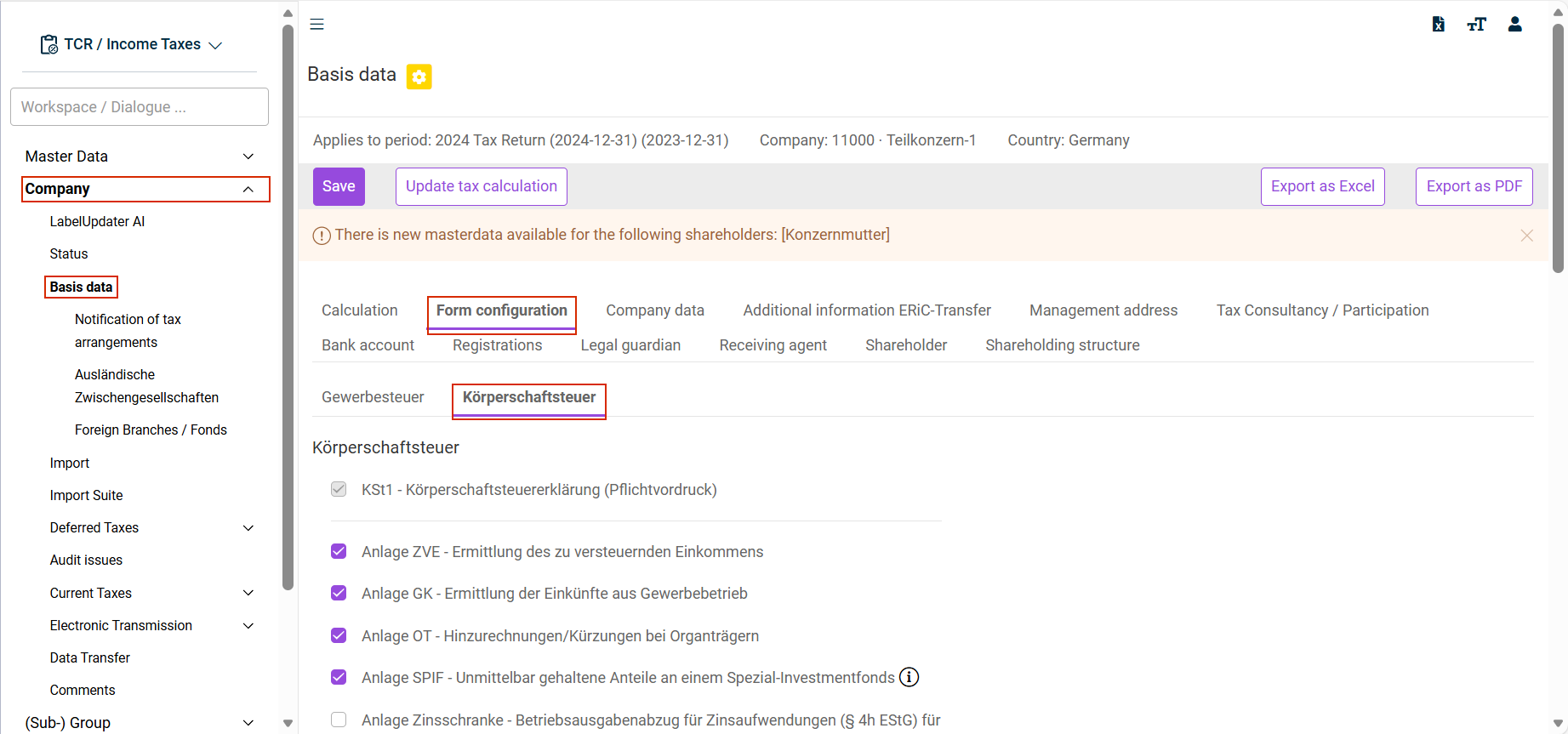
You can define which forms are to be displayed in the Corporate Income Tax functional area on the Corporate Income Tax tab via Company | Basic data | Form configuration.
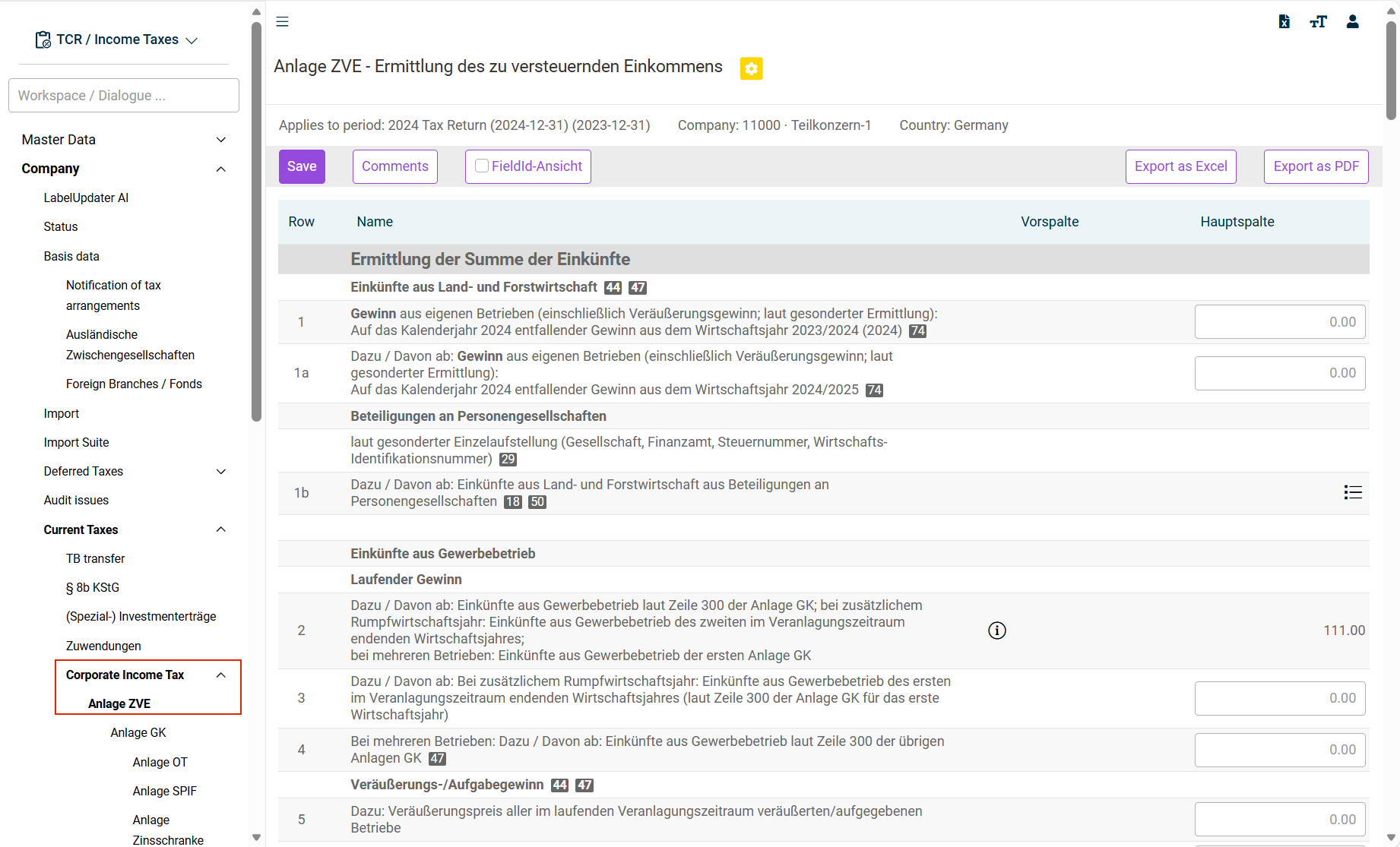
For example, the Anlage ZVE (ZVE Attachment) form is displayed as follows:
Decomposition
You can find a description of the corporate income tax allocation and the KSt-Zerlegung (CIT Allocation) form in the chapter Allocation (Trade Tax Allocation and Corporate Income Tax Allocation).
Forms
The following forms are available for the Corporate Income Tax functional area (as of assessment period 2024):
Option
Description
Anlage ZVE
The taxable income is determined in the ZVE attachment, which leads directly to the tax assessment. It collects all tax-relevant data required for the tax assessment. If the tax bases are determined in other attachments, the result of this assessment will be included in the ZVE attachment.
Anlage GK
The income from commercial operations is determined in the GK attachment. The income determined in the GK attachment is transferred to the ZVE attachment.
Anlage OT
In the event of a tax group, the OT attachment must be completed by the tax group parent. The tax bases of the individual tax group members, determined for the tax group parent, are entered in this attachment. A separate OT attachment is required for each tax group member.
The tax bases of all tax group members attributable to the tax group parent are displayed in the Current Taxes | TB Transfer workspace, where they can be transferred automatically to the OT attachments to the tax group parent's tax return.
Anlage OG
In the event of a tax group, the OG attachment must be completed by the tax group member. The tax bases relevant to the tax group parent are entered in this attachment.
The tax bases for the tax group parent are displayed in the Current Taxes | Transfer zum OT (Transfer to Tax Group Parent) workspace, where they can be transferred automatically to the OT attachment to the tax group parent's tax return.
Anlage SPIF
The SPIF attachment must be completed if the tax payer has invested in a special investment fund (see also (Special) Investment Income). The corresponding amounts are transferred to the GK attachment, where they are included in the calculation of income from commercial operations.
Anlage Zinsschranke
The interest capping rule limits the interest expenses a company may deduct for tax purposes. The data required to determine the interest and EBITDA carried forward are entered in the Interest Capping Rule attachment. The deductible interest expenses, interest carried forward, and EBITDA carried forward are determined in accordance with section 8a of the Corporate Tax Act and section 4h of the Income Tax Act.
For tax groups, only the tax group parent, not the tax group member, must complete the Interest Capping Rule attachment. However, pre-tax group interest carried forward may need to be considered for the tax group member.
For companies with interest expenses below € 3 million, the attachment is normally not required unless an interest carried forward exists.
AESt Attachment
This is where the information required for the consideration of foreign tax is entered. The attachment covers the following case groups:
- Foreign taxes that are creditable pursuant to section 26 (1) in conjunction with section 34c 2, 3 of the Income Tax Act;
- Foreign taxes that are deductible from the assessment basis pursuant to section 26 (1) in conjunction with section 34c (1) of the Income Tax Act (EStG).
AEV Attachment
This is where the information required to assess the tax exemption of negative foreign income related to third countries in accordance with section 2a of the Income Tax Act is entered.
The results from the AEV attachment are included in the corporate income tax return.
Anlage SPIFA
This is where income from special investment funds that is achieved indirectly via a partnership company or tax group member is entered.
The SPIFA attachment supplements the SPIF attachment with the information required to credit or deduct foreign taxes for investment income if the investment is held via a partnership company or tax group member.
Anlage SAN
The SAN attachment is a form used to calculate the tax-exempt recapitalization gains pursuant to section 3a of the Income Tax Act.
Anlage Verluste
The remaining loss carried forward is determined for the assessment of losses in the Losses attachment.
The deductible loss for the current assessment period determined in the Losses attachment is transferred to the ZVE attachment.
Anlage Invest-Verluste
The uncompensated negative income for investment funds is determined in the Anlage Invest-Verluste (Investment Losses attachment). The form must be completed only by investment funds, not by their investors, as an attachment to the corporate income tax return and loss assessment.
Anlage ZwiG
This is where information relevant to the taxation of foreign intermediate companies pursuant to section 7 of the Foreign Tax Act must be entered (referred to as controlled foreign company taxation).
The data for the controlled foreign company taxation pursuant to sections 7, 8 of the Foreign Tax Act are entered in the ZwiG attachment. These data are transferred if a notice of assessment is already available (standard case). If no assessment has (yet) been made, the information for the ZwiG attachment must be determined separately.
Anlage WA
Additional information for the corporate income tax return is compiled in the WA (Additional Information) attachment. It includes the following content:
- Crediting of withholding taxes pursuant to section 36 (2.2) in conjunction with section 36a of the Income Tax Act (rows 2–7);
- Crediting of tax deductions pursuant to section 50a of the Income Tax Act for tax payers subject to limited tax liability (rows 8 and 9);
- Crediting of foreign taxes pursuant to section 50d (10.5) of the Income Tax Act in conjunction with section (1) of the Corporate Tax Act (rows 10 and 11);
- Information on harmful acquisition of ownership pursuant to section 8c of the Corporate Tax Act (rows 11a–11g);
- Information on loss and/or interest carried forward subject to continuation requirements pursuant to section 8d of the Corporate Tax Act (rows 12–14);
- Contractual agreements with investors and related persons (rows 15–19);
- Supervisory board compensation to tax payers subject to unlimited tax liability (rows 20–20g);
- Country-related report of multinational enterprise groups pursuant to section 138a AO (rows 27–29);
- Compensation in accordance with section 50a (1.1 to 4) and (7) of the Income Tax Act to tax payers subject to limited tax liability (rows 30–37);
- COVID-19 emergency aid, bridging aid, and comparable grants (row 40);
- Research allowance (rows 41–44).
Anlage WA – Aufsichtsratvergütungen (Zeile 20) (Supervisory Board Compensation (Row 20))
You can enter information on all supervisory board compensation paid in the assessment year centrally here.
WA attachment – Vergütung nach § 50 a EstG / § 10 StAbwG (Zeile 30) (Remuneration pursuant to section 50a of the Income Tax Act / section 10 of the Tax Haven Defense Act (row 30))
You can enter the information on compensation to tax payers subject to limited tax liability (e. g. supervisory board compensation, license fees) centrally here.
Anlage ÖHK
The ÖHK attachment is used to divide corporations in which legal persons under public law hold the majority of voting rights into individual sectors.
The division of sectors ensures that losses can be accounted for only within specific business segments. This enables the correct documentation of the compensation and deduction of losses in accordance with section 8 (9) of the Corporate Tax Act.
The form consists of four parts:
- A detailed description of the sectors
- Allocation of the income
- Assessment of the deductible loss
- Development of the loss carried forward
A separate attachment must be completed for each sector to ensure appropriate loss offsetting.
Anlage Kassen
The Kassen (Funds) attachment is a supplementary form to the corporate income tax return, which must be submitted by legally responsible pension, death, health, and relief funds if they are exempt from corporate income tax pursuant to section 5 (1.3) of the Corporate Tax Act.
The ZVE and GK attachments must also be submitted in the event of full or partial tax liability.
The form is divided into ten sections and collects information such as:
- General details
- Fund provider
- Investment of fund assets
- Type of benefits granted
- Beneficiaries
- Use of funds
- Amount of benefits
- Calculation of the endowment
Anlage Gem
The Gem attachment is a form used for the corporate income tax return, which the tax authorities use to verify whether tax-privileged corporations (section 5 (1.9) of the Corporate Tax Act) meet the requirements for tax exemption.
The Gem attachment must be submitted regularly every three years unless extensive economic activities of the tax-exempt corporation require an annual declaration.
In addition, documents such as the balance sheet and profit and loss statement, must be submitted electronically for the entire audit period to allow the tax exemption or partial tax liability to be verified.
Anlage Ber
The Ber attachment is a supplement to the corporate income tax return. which must be completed by professional associations not under public law, including trade unions, to verify the tax exemption pursuant to section 5 (1.5) of the Corporate Tax Act. These associations are exempt from corporate income tax and trade tax unless they operate an economic business that exceeds the tax exemption threshold or supports political parties.
Tax returns are required regularly every three years unless there are relevant economic activities or political support that require an annual declaration. Supplementary documents, such as balance sheets and activity reports, must be submitted for each year of the audit period.
Anlage STG
You can enter information on cross-border tax arrangements here.
Anlage KSt 1 F
The KSt 1 F attachment must be completed by corporations subject to unlimited tax liability (in particular capital companies, cooperatives, mutual insurance associations, economic associations, and enterprises of commercial nature with their own legal personality). It is used to determine and update the tax contribution account and what is referred to as special disclosure pursuant to sections 27 and 28 of the Corporate Tax Act.
The tax contribution account is required to distinguish between taxable dividend distributions and tax-neutral returns of capital contribution when making distributions to investors. The attachment must be submitted for each fiscal year.
In addition, the KSt 1 F attachment provides information on the dividend distributions and services made during the fiscal year to ensure correct tax treatment and monitoring of the capital gains tax deduction.