In the Configure document workspace in Disclosure Management, individual specifications can be configured for each document. These include:

  • Localization
  • Separator
  • Prefix and suffix
  • MS Office settings
  • Word template used
  • Behavior when updating tables
  • Document languages
  • Typography rules (Spacing)
  • Style guide specifications
  • Rules monitored by the Layout Check
  • The settings valid for all documents can be overwritten in the Advanced Settings of an Excel file.
  • In addition, document-wide specifications can be configured, for example the display of user names or specifications for import purposes. More information on this can be found in Disclosure Management Settings.

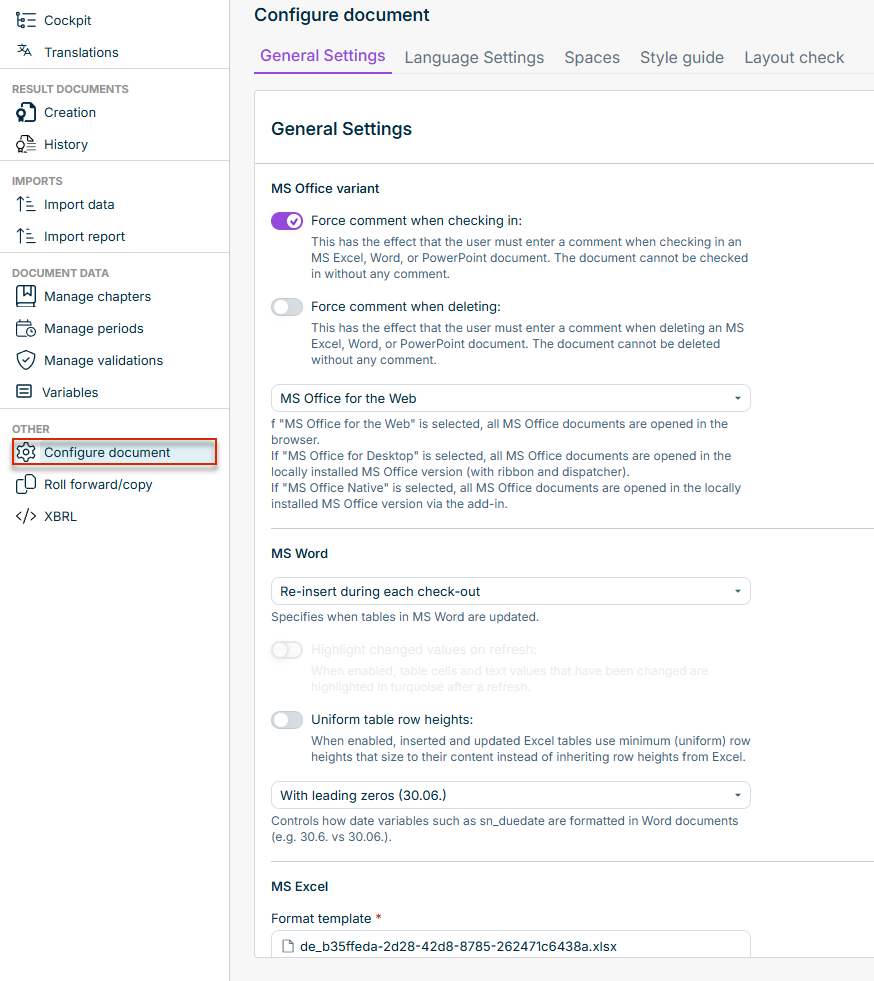
In the overview of a document in Disclosure Management, click Configure document to open the workspace.

Shows the 'Configure document' workspace in Disclosure Management with the tabs 'General Settings', 'Language Settings', 'Spaces', 'Style guide' and 'Layout check', and the 'General Settings' tab with the areas 'MS Office variant', 'MS Word' and 'MS Excel'. Highlighted in red is 'Configure document' in the overview.
Workspace 'Configure Document'

You can set the following options on the General Settings tab in the Configure document workspace in Disclosure Management. Each option is explained in more detail in the user interface.

Settings for MS Office documents:

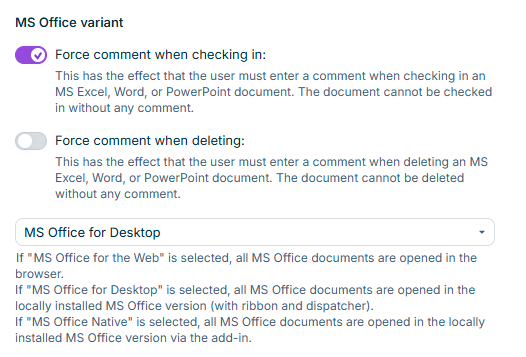
Shows the area 'MS Office variant' on the 'General Settings' tab in Disclosure Management with the options 'Force comment when checking in' and 'Force comment when deleting' and the drop-down list with the selected variant 'MS Office for Desktop'.
Document settings for MS Office

Settings for passing chapter role assignments down to sub-chapters:

Shows the area 'Chapter roles' on the 'General Settings' tab in Disclosure Management with the option 'Inherit chapter roles to sub-chapters'.
Document settings for chapter roles

The Inherit chapter roles to sub-chapters option controls whether a chapter role that is assigned on a parent chapter also applies to the sub-chapters below it. The setting applies to the whole document and behaves as follows:

  • When the option is enabled, a user who holds a chapter role on a parent chapter automatically holds the same role on every sub-chapter below it, across all levels. Sub-chapters that are created later inherit the role as well, without any further assignment.
  • Inherited and explicitly assigned rights accumulate. A user who holds the Chapter Editor role through inheritance and the Chapter Reader role explicitly on a sub-chapter holds both roles on that sub-chapter. If the same role is assigned on both the parent chapter and the sub-chapter, it counts as a single assignment.
  • When the option is disabled, only the roles that are explicitly assigned to a chapter apply. Assignments that already exist on sub-chapters are kept and remain active.

Enabling or disabling the option does not change any existing role assignments. It only changes how the assignments are evaluated when a user opens a chapter.

For more information about chapter roles, see Assigning Document Roles for Disclosure Management.

Settings for MS Word documents:

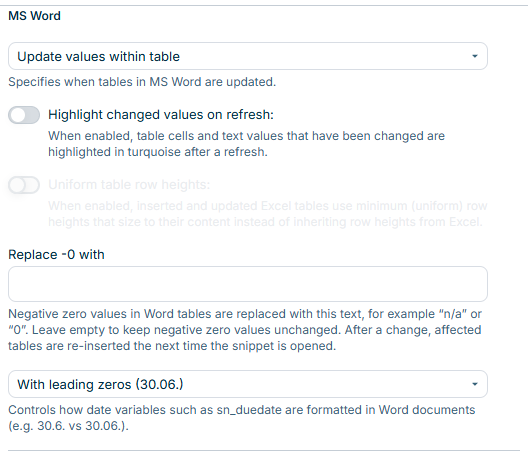
Shows the area 'MS Word' on the 'General Settings' tab in Disclosure Management with the drop-down list 'Update values within table', the options 'Highlight changed values on refresh' and 'Uniform table row heights', the field 'Replace -0 with' and the drop-down list 'With leading zeros (30.06.)'.
Document settings for MS Word

The Highlight changed values on refresh option is only available when the Update values within table insert mode is selected. With the other insert modes, the option is greyed out. If you disable the option, existing table highlights are removed on the next refresh.

Replacing negative zero values in Word tables

Rounding can turn a small negative value into -0, which is usually not the representation you want in a published report. Use the Replace -0 with setting to define the text that Disclosure Management writes instead. The setting applies to the whole document and behaves as follows:

  • It is applied to all tables, regardless of whether a layout template is assigned to them.
  • It takes effect both when an individual Word file is opened and when a result document is generated. You do not have to open or edit the individual Word files beforehand.
  • It recognizes the different minus characters (for example, hyphen-minus and en dash) as well as values with decimal places, such as -0.0 or -0.00, taking the decimal separator in use into account.
  • Cells that contain 0, a negative value other than zero, or text that merely contains -0 remain unchanged.
  • The layout and formatting of the table cell are preserved.

If you change the replacement text, the affected tables are re-inserted the next time the Word file is opened. Word files that have already been stored do not have to be edited manually.

Settings for the format template and number formatting in MS Excel:

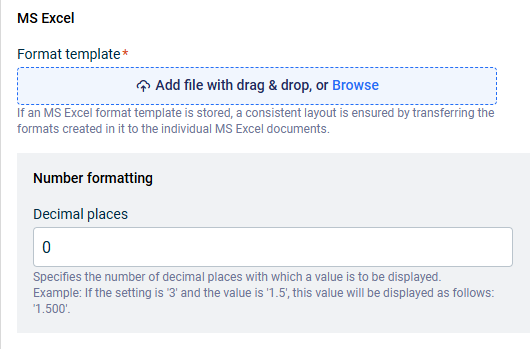
Shows the area 'MS Excel' on the 'General Settings' tab in Disclosure Management with the upload area for the 'Format template' and the field 'Decimal places' under 'Number formatting'.
Document settings for MS Excel (part 1)

Settings for the display and programming of values in MS Excel:

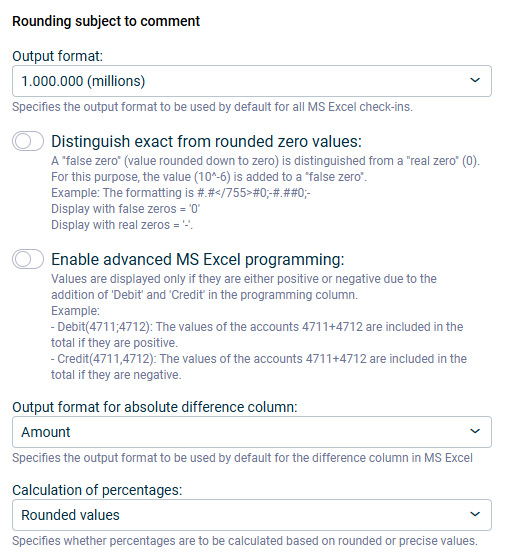
Shows the area 'Rounding subject to comment' on the 'General Settings' tab in Disclosure Management with the drop-down list 'Output format', the options 'Distinguish exact from rounded zero values' and 'Enable advanced MS Excel programming', and the drop-down lists 'Output format for absolute difference column' and 'Calculation of percentages'.
Document settings for MS Excel (part 2)

For more information about MS Excel files in Disclosure Management, see Creating and Editing Excel Files.

Settings for the data view:

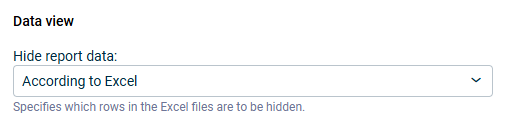
Shows the area 'Data view' on the 'General Settings' tab in Disclosure Management with the drop-down list 'Hide report data' and the value 'According to Excel'.
Document settings for the data view

For more information about the data view, see Using the Data View.

Selecting the layout robot:

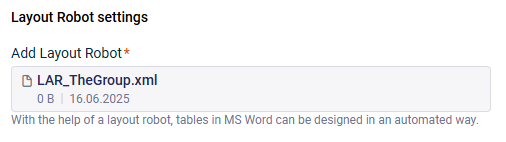
Shows the area 'Layout Robot settings' on the 'General Settings' tab in Disclosure Management with the field 'Add Layout Robot' and the added file 'LAR_TheGroup.xml'.
Document settings for the layout robot

For more information about the layout robot and its tasks, see Using Layouts in MS Excel and Using Layout Actions in MS Word.

Selecting the desired XBRL taxonomy for XBRL tagging.

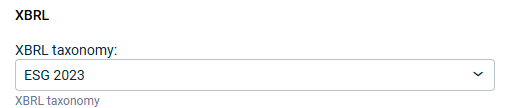
Shows the area 'XBRL' on the 'General Settings' tab in Disclosure Management with the drop-down list 'XBRL taxonomy' and the value 'ESG 2023'.
Document settings for XBRL

For more information about the XBRL tagger, see Editing Documents in the XBRL Tagger.

In addition to General Settings, the Configure document workspace in Disclosure Management provides the following tabs:

TabPurpose
Language SettingsManage the document languages, including the primary language (Default Language) and language-specific format templates for MS Word.
SpacingManage the typography rules that are applied automatically when a Word file is checked out (for example, non-breaking spaces between a number and a unit).
Style GuideDefine which Word styles are available for headings and body text, so that all authors work with the same formatting specifications.
Layout CheckChoose which text and formatting rules are monitored while a report is edited in Word.

This content was generated using AI and reviewed by Lucanet subject matter experts before publication.