Lucanet Disclosure Management works with MS Word and MS Excel in three variants: MS Office for the Web, MS Office Native, and MS Office for Desktop. Which components you need to install on your computer depends on the variant you choose.

In principle, you need to perform the following steps:

1

Choose a variant: First decide which MS Office variant you want to use. You will find the differences between the variants in the MS Office variants chapter.

2

Install the components: Then install the components required for your variant. All components are provided in the Toolbox of Disclosure Management.

The following table shows which components are required for each variant:

VariantRequired components
MS Office for the WebOffice Online Manifest
MS Office NativeManifest files that provide the ribbons as an add-in
MS Office for DesktopDispatcher plus the MS Word ribbon and the MS Excel ribbon

For MS Office for the Web and MS Office Native, there are two ways to configure the variant:

  • The IT department configures the variant centrally for the entire company in Office Management.
  • Each user configures the variant locally.
Before installing locally, clarify whether a company-wide installation is planned and/or feasible.

Jump directly to the right instructions for your variant and installation type:

The installed components are updated regularly. Whenever an update is available, you will be informed automatically once you open an MS Office document in Lucanet Disclosure Management. For more information, see the Updating the components section.

For the MS Office for the Web variant, you activate the Disclosure Management ribbons in the browser via the Office Online Manifest. The manifest is provided in the Toolbox and can be set up either centrally by the IT department for the entire company, or locally by each user.

The IT department can roll out the Office Online Manifest centrally for the entire company via the Microsoft 365 Admin Center. The entire process typically takes 10–20 minutes. Proceed as follows:

1

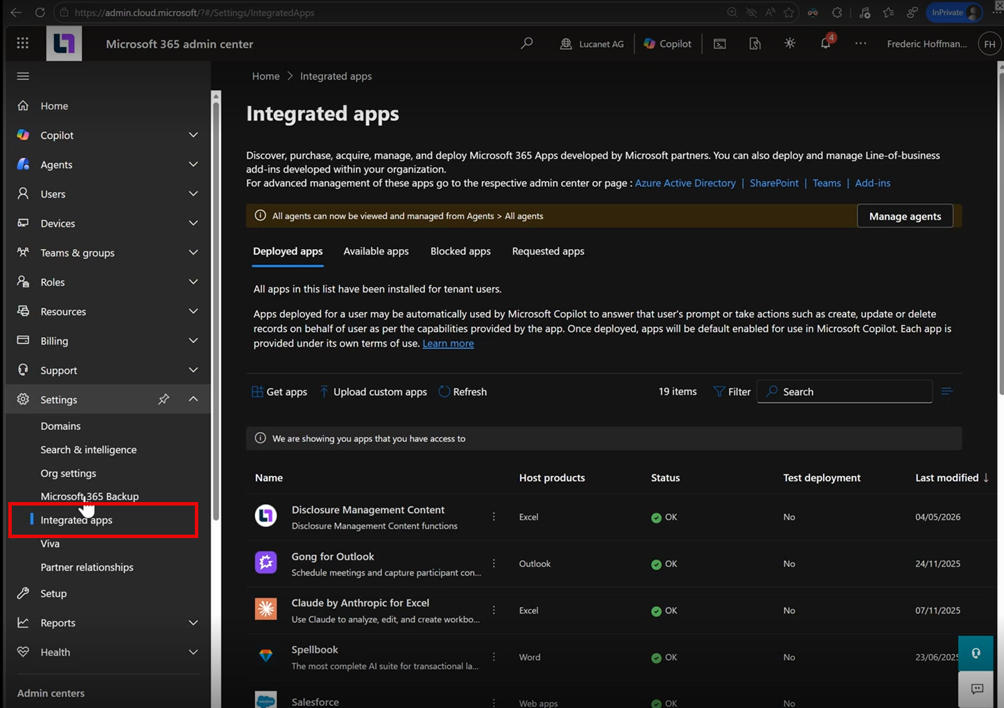
Open the Microsoft 365 Admin Center: Open https://admin.microsoft.com and sign in with your Microsoft 365 administrator account. Then go to Settings | Integrated Apps in the left navigation bar.

Microsoft 365 Admin Center showing the 'Integrated apps' page with the 'Settings | Integrated apps' navigation item highlighted
The Integrated apps page in the Microsoft 365 Admin Center

If the Integrated Apps option is not displayed, click Show all at the bottom of the navigation list to display all menu items.

2

Deploy the add-in: On the Integrated Apps page, click the Add-Ins link near the top and then click Deploy Add-in. Click Next in the wizard.

3

Upload the manifest: In the wizard, select Upload Custom App and the app type Office Add-In. Choose Upload manifest file (.xml) from device, click Choose File, and select the Office Online Manifest from the Toolbox.

4

Define the target audience: On the next page of the wizard, select who should receive the add-in and click Next:

  • Everyone – deploy to the entire organization.
  • Specific users/groups – phased rollout, for example starting with a pilot group.
  • Just me – for initial testing by the administrator.

It may take up to 24 hours until the add-in is rolled out and appears in MS Word and MS Excel on the user side.

Each user can upload the Office Online Manifest locally in MS Word. You first download the manifest from the Toolbox and then upload it in the browser. Proceed as follows:

1

Download the manifest: Click Toolbox in the function bar of Disclosure Management and open the Add-In for Office for the Web area. Download the manifest file there under Office Online Manifest.

2

Open MS Word: Open a Word file from a document for which the Office for the Web variant was selected under Configure document. The file opens in the browser.

3

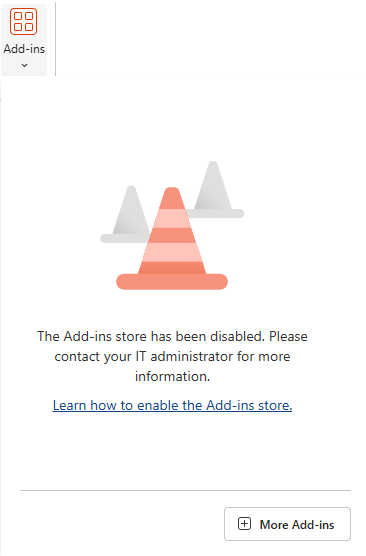
Open Add-ins: On the ribbon, click Add-ins and then More Add-ins.

Word for the Web with the Add-ins pane open and the 'More Add-ins' button
Add-ins pane in Word for the Web
4

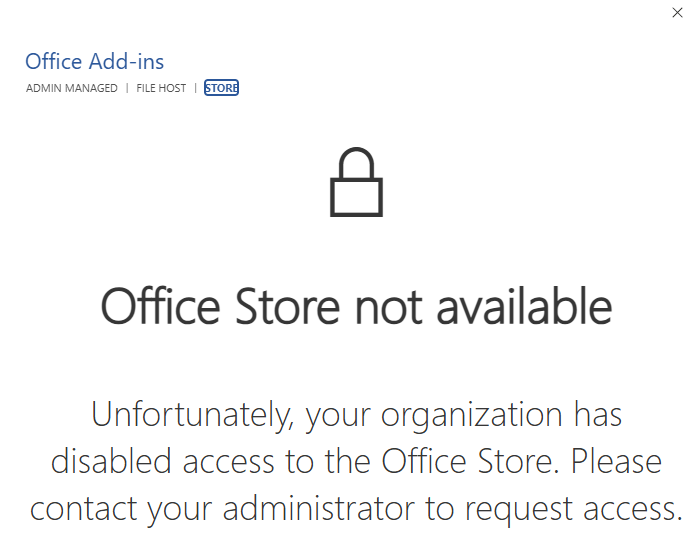
Switch to the admin-managed catalog: The Office Add-ins dialog opens on the Store tab, which is usually disabled. Click the Admin Managed tab.

The 'Office Add-ins' dialog with the 'Admin Managed' tab highlighted and the Office Store disabled
The Admin Managed tab in the Office Add-ins dialog
5

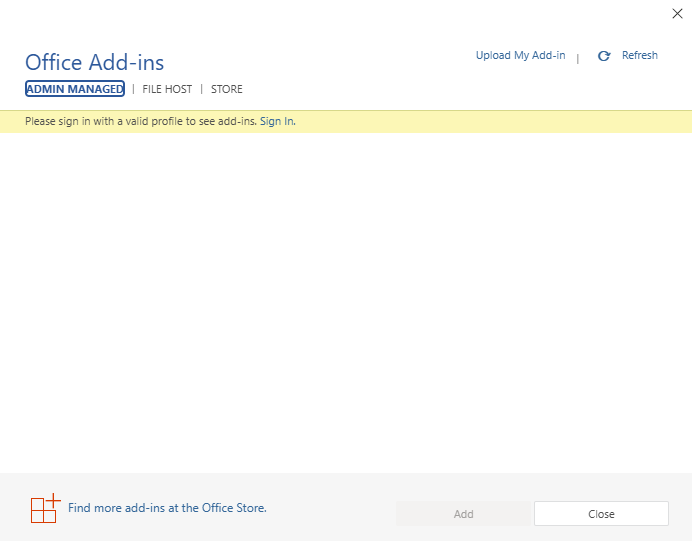
Start the upload: In the top right, click Upload My Add-in.

The 'Office Add-ins' dialog on the 'Admin Managed' tab with the 'Upload My Add-in' link highlighted
The 'Upload My Add-in' link in the Office Add-ins dialog
6

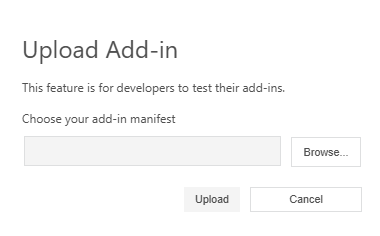
Select and upload the manifest: In the Upload Add-in dialog, click Browse, select the manifest file you downloaded earlier, and click Upload.

The 'Upload Add-in' dialog with the 'Browse' and 'Upload' buttons
The Upload Add-in dialog

After the installation, the Disclosure Management ribbons are available in MS Word and MS Excel, see After the installation.

This section applies to the MS Office Native variant. Here, the ribbons are not provided via the Dispatcher and the MSI ribbons, but as an add-in via manifest files in the locally installed Office application. For more information, see the MS Office variants chapter.

For MS Office Native, Disclosure Management provides two manifest files in the Toolbox: the Word and Excel Desktop Content Manifest and the Word Desktop Layout Manifest. These manifest files provide the ribbons as an add-in in MS Word and MS Excel – either centrally by the IT department for the entire company, or locally by each user.

The IT department can roll out the add-ins centrally for the entire company via the Microsoft 365 Admin Center. The entire process typically takes 10–20 minutes. Proceed as follows:

1

Open the Microsoft 365 Admin Center: Open https://admin.microsoft.com and sign in with your Microsoft 365 administrator account. Then go to Settings | Integrated Apps in the left navigation bar.

Microsoft 365 Admin Center showing the 'Integrated apps' page with the 'Settings | Integrated apps' navigation item highlighted
The Integrated apps page in the Microsoft 365 Admin Center

If the Integrated Apps option is not displayed, click Show all at the bottom of the navigation list to display all menu items.

2

Deploy the add-in: On the Integrated Apps page, click the Add-Ins link near the top and then click Deploy Add-in. Click Next in the wizard.

3

Upload the manifest: In the wizard, select Upload Custom App and the app type Office Add-In. Choose Upload manifest file (.xml) from device, click Choose File, and select the manifest file from the Toolbox. Repeat this step for both manifest files (Content and Layout).

4

Define the target audience: On the next page of the wizard, select who should receive the add-in and click Next:

  • Everyone – deploy to the entire organization.
  • Specific users/groups – phased rollout, for example starting with a pilot group.
  • Just me – for initial testing by the administrator.

It may take up to 24 hours until the add-in is rolled out and appears in MS Word and MS Excel on the user side.

To use the ribbons as an add-in in MS Word and MS Excel locally, you must make the two manifest files available as a trusted add-in catalog via a shared folder. Proceed as follows:

1

Prepare a manifest folder: Download the two manifest files from the Toolbox and place them in a local folder.

2

Create a network share:

  1. Right-click the manifest folder and select Properties.
  2. Go to Sharing | Advanced Sharing.
  3. Enable Share this folder for your user.
  4. Copy the resulting network share path, for example \\YOUR-PC\OfficeAddinManifests.
3

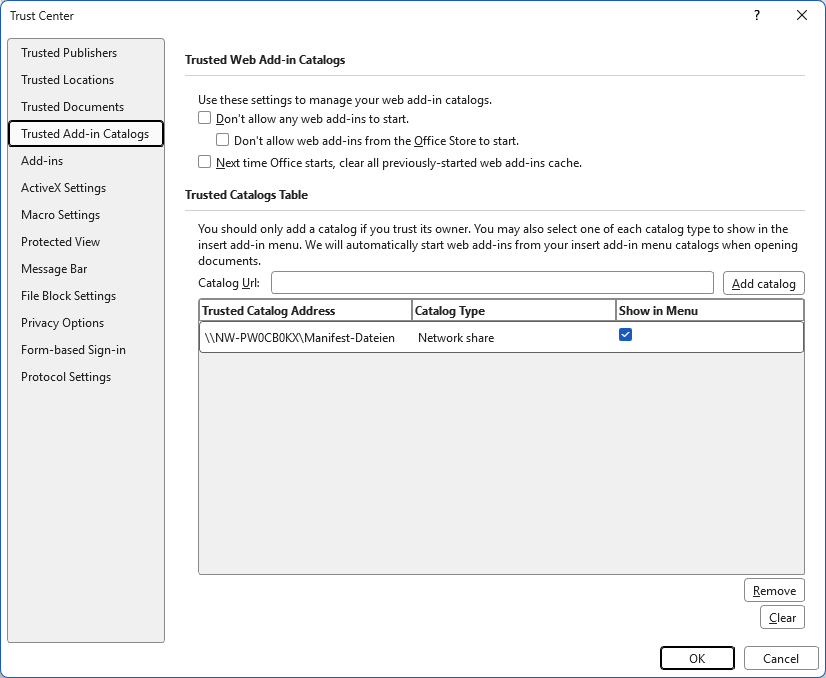
Configure the trusted add-in catalog in MS Word:

  1. Open MS Word.
  2. Go to File | Options.
  3. Select Trust Center.
  4. Click Trust Center Settings.
  5. Go to Trusted Add-in Catalogs.
  6. Paste the network share path into the Catalog URL field and click Add Catalog.
  7. In the Trusted Catalogs table, enable the Show in Menu checkbox and click OK.
  8. Restart MS Office.
The 'Trusted Add-in Catalogs' dialog in the MS Word Trust Center with the catalog URL entered
Trusted Add-in Catalogs in the MS Word Trust Center
4

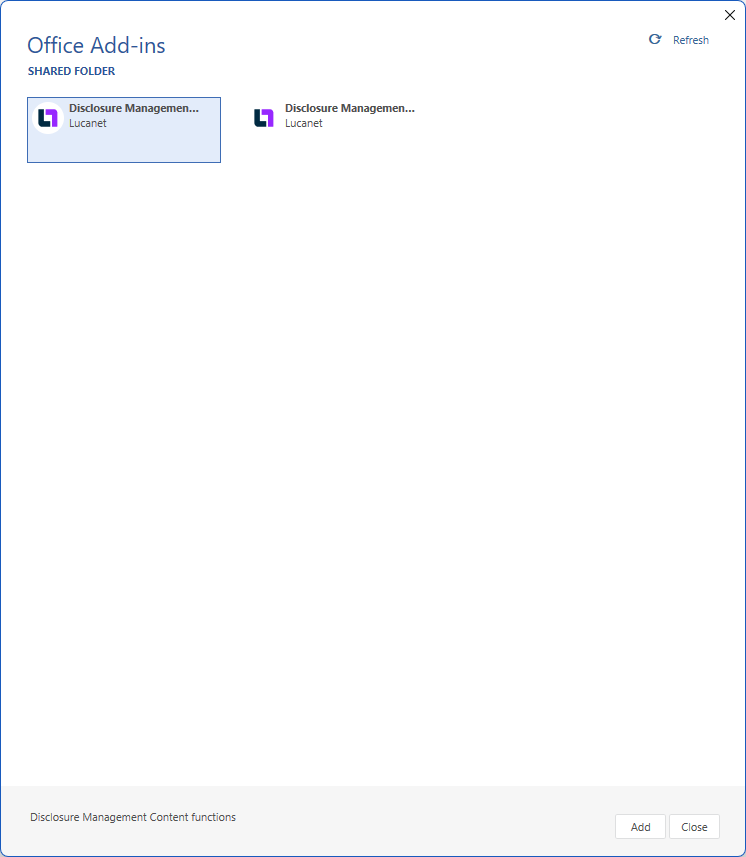
Load the add-in from the catalog: Open MS Word and go to Home | Add-ins | Advanced. In the Office Add-ins dialog, the Shared Folder tab now shows the provided manifest files. Select both add-ins one after another.

The 'Office Add-ins' dialog in MS Word showing the 'Shared Folder' tab with the provided manifest files
The Shared Folder tab in the Office Add-ins dialog

For MS Excel, proceed in the same way. The Prepare a manifest folder and Create a network share steps apply to both programs and only need to be performed once. Because the trusted add-in catalog is configured per application in MS Office, you only repeat the last two steps in MS Excel:

  • Add the shared folder under File | Options | Trust Center | Trust Center Settings | Trusted Add-in Catalogs.
  • Then load the add-in via Home | Add-ins.

If a manifest file contains errors, MS Office ignores it and does not show it under Shared Folder.

After the installation for MS Office for the Web or MS Office Native, the Disclosure Management ribbons are available in MS Word and MS Excel.

In MS Word, two ribbons are displayed, the DM-Content ribbon and the DM-Layout ribbon:

DM-Content ribbon in MS Word
Content ribbon for Disclosure Management
DM-Layout ribbon in MS Word
Layout ribbon for Disclosure Management

In MS Excel, the Disclosure Management ribbon is displayed as follows:

Disclosure Management ribbon in MS Excel

For the MS Office for Desktop variant, you install the Dispatcher as well as the ribbons for MS Word and MS Excel.

The Dispatcher is a program that must be installed on each computer on which you wish to use MS Office for Desktop. This variant does not work without the Dispatcher. The Dispatcher handles the communication between Disclosure Management in the browser and the locally installed MS Office programs.

To install the Dispatcher on your computer, the following is required:

  • Windows 64-bit version
  • Microsoft dotNet 8.0.0

To install the Dispatcher for Disclosure Management:

1

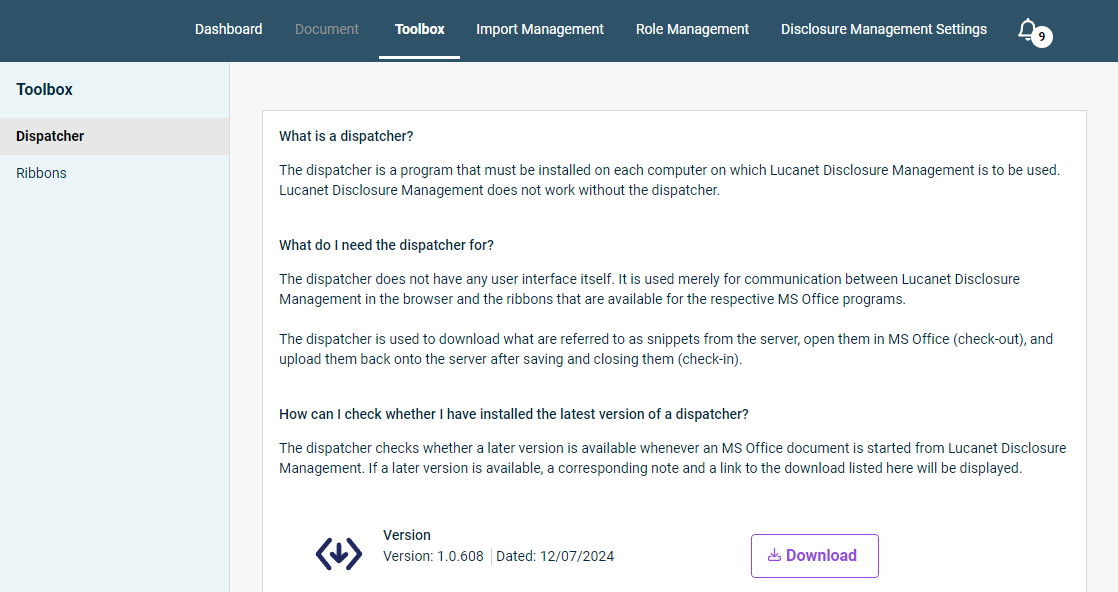
Click Toolbox in the function bar of Disclosure Management and click Dispatcher in the overview. The detail view is displayed as follows, for example:

The detail view of the Dispatcher area is displayed.
Detail view of the Dispatcher area
2

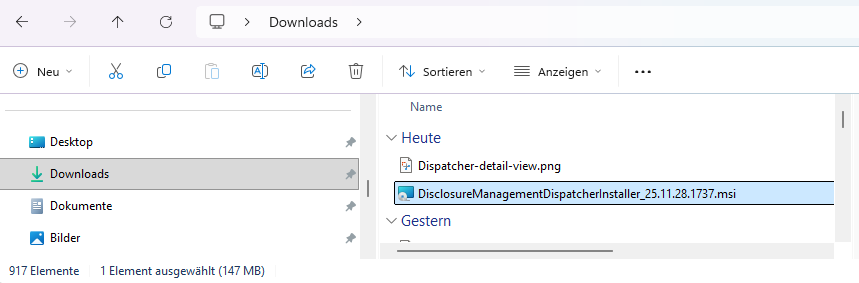
Download the MSI file for the Dispatcher and navigate to your Downloads folder.

3

Double-click the MSI file to execute it.

The MSI file is shown in the Downloads folder
MSI file in Windows Explorer
4

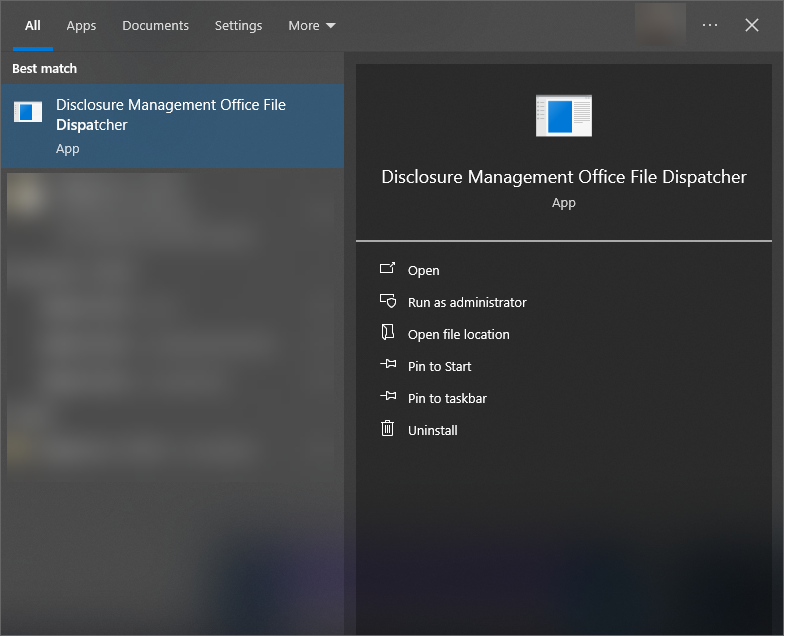
The Dispatcher is installed automatically and can then be found on your computer under Disclosure Management Office File Dispatcher:

The Disclosure Management Office File Dispatcher in the Windows start menu is displayed.
Dispatcher in Windows start menu

The Dispatcher will launch automatically whenever you create a file in Disclosure Management or open an existing file.

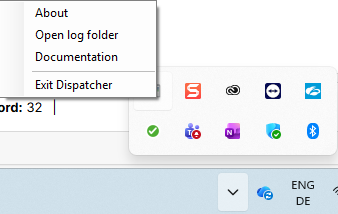
After installation, the Dispatcher is displayed as an icon in the MS Windows system tray. You will receive a message as soon as the Dispatcher is running and as soon as you open an MS Office file. You can stop the Dispatcher and view the log via the context menu of the icon in the system tray:

Context menu of the Dispatcher in the MS Windows context menu

To install the Office ribbons for Disclosure Management:

1

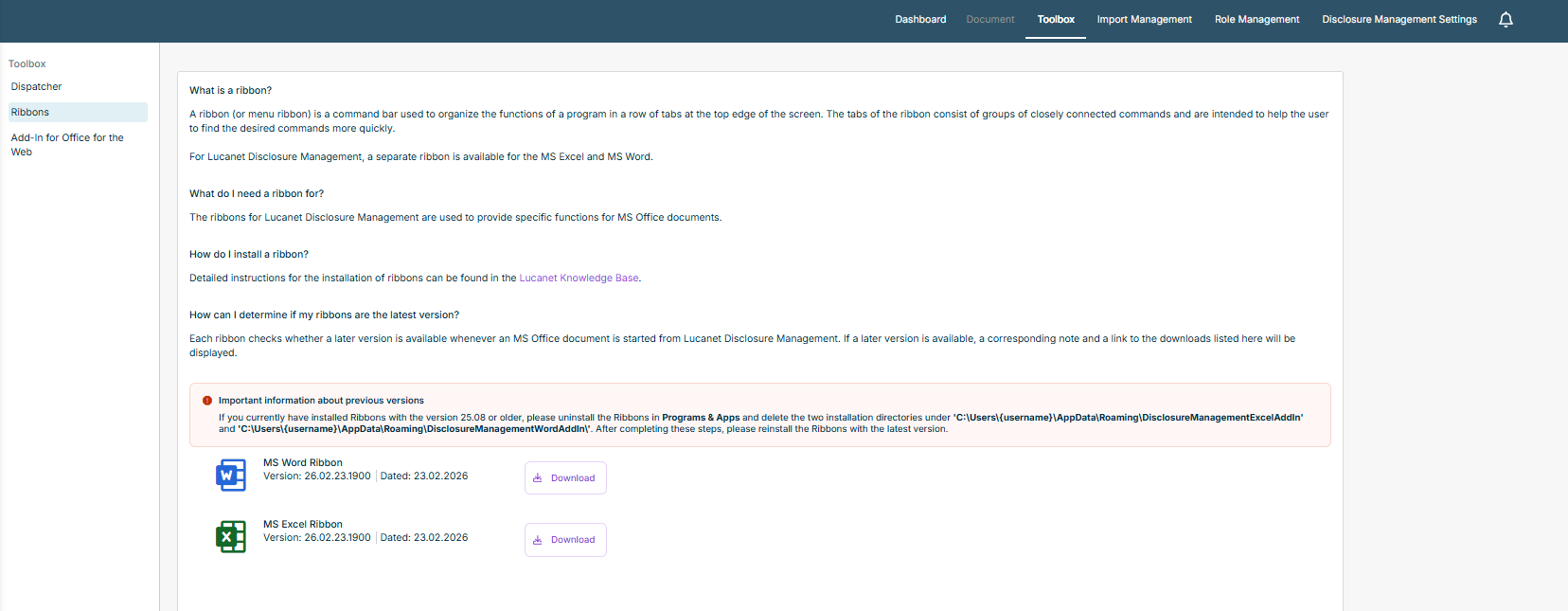
In Lucanet Disclosure Management, navigate to the Toolbox tab and click Ribbons in the tree view. The detail view is displayed as follows, for example:

Detail view of the ribbon area
2

Click Download to download the MSI file for the MS Word ribbon or the MS Excel ribbon and then navigate to your download folder.

3

Double-click the MSI file to execute it.

Die WordInstaller-Datei im Windows Explorer wird angezeigt und ist rot hervorgehoben.
WordInstaller in Windows Explorer

The ribbon is installed automatically and is displayed in MS Word or MS Excel as follows as soon as you open a Word document or Excel document from Lucanet Disclosure Management:

  • In MS Word:

    Ribbon in MS Word

  • In MS Excel:

    Ribbon in MS Excel

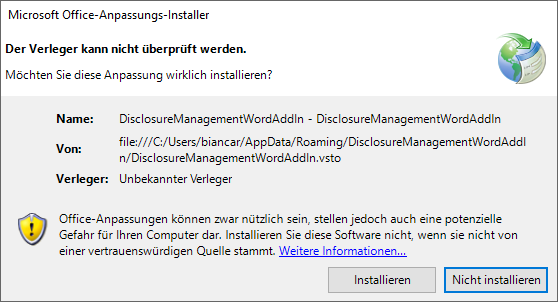
Depending on your security settings, you may have to confirm the installation again as soon as you open MS Word or MS Excel for the first time after installing the ribbons. In the displayed message, click Install.

Displays the confirmation message regarding the Word ribbon in Microsoft Office.
Confirmation message in Microsoft Office

If you currently have installed Ribbons with the version 25.08 or older, you have to uninstall the Ribbons in Programs & Apps and delete the two installation directories under C:\Users\{username}\AppData\Roaming\DisclosureManagementExcelAddIn and C:\Users\{username}\AppData\Roaming\DisclosureManagementWordAddIn, first.

After completing these steps, you can reinstall the Ribbons with the latest version.

Office for Desktop: Opening an MS Office document from Disclosure Management automatically performs a software check for the latest version of the installed components, such as the Dispatcher and Ribbons. If a later version is available, the system displays a corresponding note and a link to the page where the latest version can be downloaded.