
Import
Last updated on 2026-04-15
Overview
The Pillar 2 module includes a variety of options for the import of entity data, both from internal sources, and from external sources such as SAP or Excel files. In addition, it is possible to import allocations, such as tax allocations, FTE & PE allocations, or cross-border adjustments.
The Import folder is divided into the following workspaces:
- Income Taxes
- Allocations
- Questionnaire Value Transfer
- External
- Copy from Questionnaire
This article contains the following sections:
Navigation
The Import folder and its corresponding workspaces can be found at Pillar 2 | Cockpit. The folder and its corresponding workspaces are displayed as follows, for example:
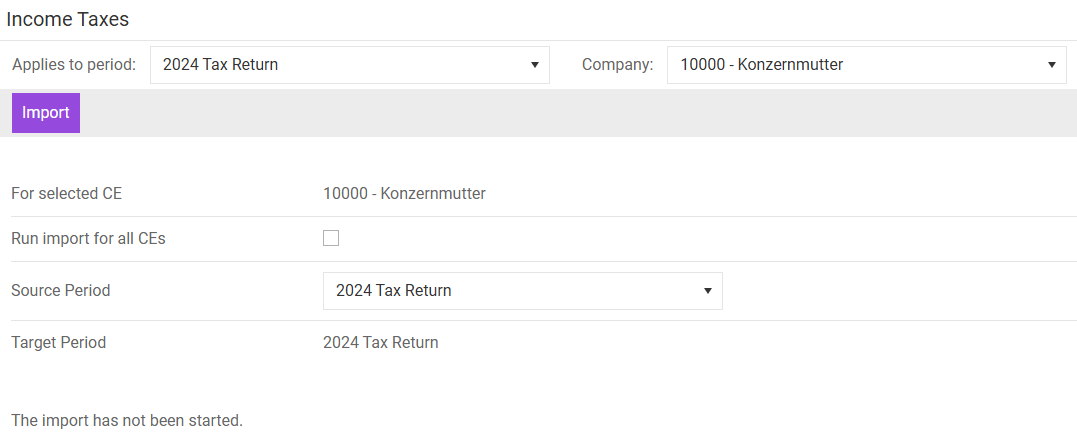
Importing Income Tax Data
To import data from the Income Taxes module into the Pillar 2 module:
- In the Income Taxes workspace, make sure the right target period is selected in the Applies to period drop-down menu.
- Select the source period from whence to import.
- Select a target constituent entity (CE) from the Company drop-down menu.
- Click Import and then Save.
Instead of selecting a single target CE, you can also activate the checkbox Run import for all Constituent Entities.
Importing Allocations
To import allocations:
- If necessary, download a template for the allocations import mapping by clicking Download Template in the Allocations workspace.
- Enter your allocation data in the template.
- Navigate back to the Allocations workspace and click Choose file.
- Select the file with your allocation data.
- Click Import and save your allocations import.
Note: By default, an import adds to the allocations that are already in the Pillar 2 module. To delete existing allocations when importing a full list, activate the Reset allocations checkbox.
Structure of the Allocations Template
The allocations template consists of the following six columns, five of which are mandatory for every entry. Depending on the allocation type, column A must take any of the following values:
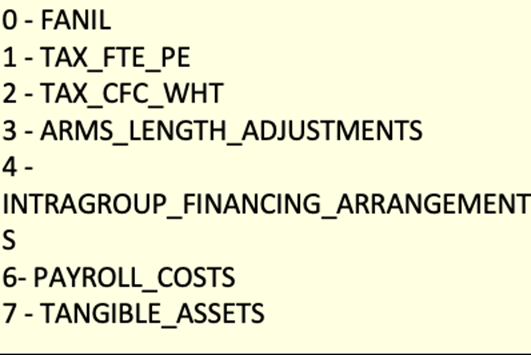
The value in column B further defines the basis for the adjustment.

Columns C and D are used to define the source and target CE, respectively. Column E shows the sum that is being allocated in the local currency of the source CE. Finally, column F allows for an optional description and other comments.
Transferring Questionnaire Values
To transfer values from Questionnaires to the Pillar 2 module:
- In the Questionnaire Value Transfer workspace, make sure the right target period is selected in the Applies to period drop-down menu.
- Select a target CE from the Company drop-down menu.
- Click Transfer values and then Save.
Instead of selecting a single target CE, you can also activate the checkbox to transfer values for all available units.
Importing External Data
To import data from an external source:
- In the External workspace, make sure the right target period is selected in the Applies to period drop-down menu.
- Select a target CE from the Company drop-down menu.
- Select the appropriate interface from the Interface drop-down menu.
- Click Choose File and select an import file (csv, txt, xls, or xlsx).
- Click Import and then save.
Instead of selecting a single target CE, you can also activate the checkbox to run import for all Constituent Entities.
Copying from Questionnaire
The Copy from Questionnaire workspace allows you to copy data from questionnaires in previous periods to the current Pillar 2 module.
To copy data from a questionnaire:
- In the Copy from Questionnaire workspace, make sure the right target period is selected in the Applies to period drop-down menu.
- Define the target CE(s) by doing one of the following:
- Choose a target CE from the Company drop-down menu.
- Activate the checkbox Run import for all Constituent Entities to copy data for all CEs at once.
- Select the source period from which you want to copy data.
- Select the questionnaire from the Questionnaire drop-down menu.
- Choose the data to include:
- Activate Include transaction data to copy transaction-level data
- Activate Include master data to copy master data
- Click Copy and then Save.
Note: This workspace copies data from completed questionnaires in previous periods, while the Questionnaire Value Transfer workspace transfers current questionnaire values within the same period.