
Jurisdictional Data Collection
Last updated on 2026-04-16
Overview
In this workspace, you can enter information pertaining to a qualified domestic minimum top-up tax (QDMTT) for specific jurisdictions.
A QDMTT is a domestic tax imposed by individual jurisdictions to ensure a minimum effective tax rate in line with Pillar 2 regulations. When you mark a jurisdiction as QDMTT-applicable in this workspace, it becomes eligible for QDMTT snapshots in the calculation process.
The data collected here determines:
- Which jurisdictions can create QDMTT snapshots
- Whether jurisdiction-specific adjustments apply to QDMTT calculations
- How the QDMTT calculation differs from the standard GIR (GloBE Information Return) calculation
Note: The jurisdictional data entered here only affects QDMTT snapshots. Global snapshots and limited country snapshots always use general GIR numbers regardless of the settings in this workspace.
This article contains the following sections:
Navigation
The Jurisdictional Data Collection workspace can be found at Pillar 2 | Jurisdictional Data Collection. The workspace is displayed as follows, for example:
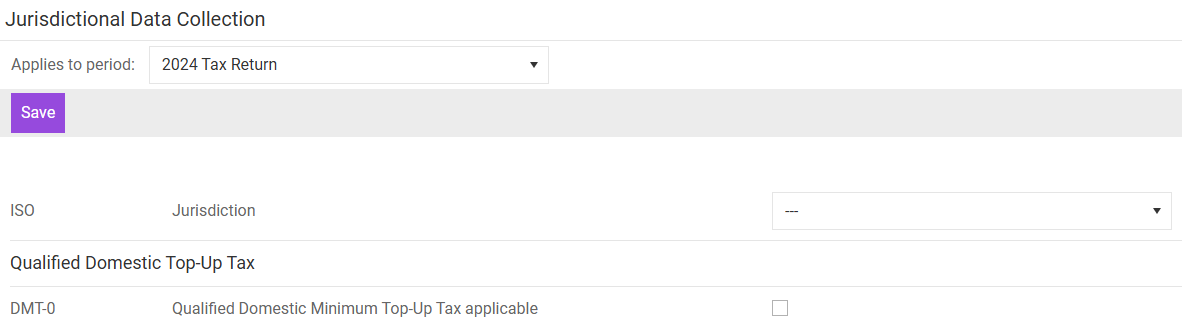 'Jurisdictional Data Collection' workspace
Note: The sections Jurisdiction(s) with Taxing Rights and Qualified Domestic Top-Up Tax are displayed after you have selected a jurisdiction.
Collecting Jurisdictional Tax Data
To gather tax information specific to individual jurisdictions:
- Go to Pillar 2 | Jurisdictional Data Collection and make sure the right period is selected in the Applies to period drop-down menu.
- Select a jurisdiction from the drop-down menu.
- Select the jurisdiction(s) that have taxing rights in respect of the chosen jurisdiction using the JTR-0 drop-down menu.
- Enter the required data for the Qualified Domestic Top-Up Tax area in the fields described below. The fields you need to complete depend on the specific QDMTT requirements of the selected jurisdiction.
- Click Save.
Note: You can enter data for a jurisdiction even if QDMTT does not currently apply. This allows you to prepare for potential future QDMTT implementation in that jurisdiction.
Description of Qualified Domestic Top-Up Tax Fields
Enter or specify the following for the available fields in the Qualified Domestic Top-Up Tax area:
Field
Description
DMT-X
DMT-0
Activate this checkbox if the selected jurisdiction has enacted QDMTT legislation that applies to your group's constituent entities in that jurisdiction. When activated, QDMTT-related data for this jurisdiction will be included in calculations and reports.
DMT-1.x
DMT-1.1: Activate this checkbox to ensure that the QDMTT snapshot calculation will apply jurisdiction-specific adjustments that deviate from the standard GIR calculation methodology.
When activated, the following fields are displayed:
- DMT-1.2: Enter the relevant mark-up percentage for Eligible Payroll Costs.
- DMT-1.3: Enter the relevant mark-up percentage for Eligible Tangible Assets.
DMT-2.x
DMT-2.1: Activate this checkbox if the jurisdiction has deviating thresholds for de minimis exclusion.
When activated, the following fields are displayed:
- DMT-2.2: Enter the GloBE Revenue threshold.
- DMT-2.3: Enter the GloBE Income threshold.
DMT-3.x
DMT-3.1: Activate this checkbox if the jurisdiction has a deviating minimum tax rate
When activated, the field DMT-3.2 is displayed. Enter the Minimum Tax Rate percentage in this field.
DMT-4
From the drop-down menu, choose the local constituent entity to which the top-up tax is allocated.
DMT-5
Use this field when the jurisdiction's QDMTT calculations are based on a specific accounting standard. This may differ from the group's consolidated financial statements standard (specified in Group Data Collection).
Enter the financial accounting standard used as the basis for QDMTT calculations in this jurisdiction, e.g.:
- Local GAAP, such as HGB for German Commercial Code
- IFRS
- US GAAP
- Other jurisdiction-specific standards
DMT-6
DMT-6: defines the principle or basis for determining which currency to use in QDMTT calculations. Select the currency election applicable to QDMTT in this jurisdiction. The available options depend on the jurisdiction's QDMTT regulations, such as Functional currency or Local currency.
When selecting Local, the DMT-6.1 field is displayed. In DMT-6.1, select the specific currency that will be used for QDMTT filing and paying of taxes in this jurisdiction. The drop-down menu displays all currencies configured in your system.
Example: A jurisdiction may allow constituent entities to elect their functional currency for QDMTT calculations, but require that the final QDMTT return be filed in the local currency.
DMT-7
If applicable, enter a detailed explanation if the jurisdiction uses an alternative methodology for blending income and taxes to compute the effective tax rate (ETR) that differs from the standard GloBE Rules.
DMT-8
If applicable, enter the specification of the applicability of elections if different from the GloBE Rules.
DMT-9
Activate this checkbox if the reporting fiscal year is the transition year for the jurisdiction.
Impact on Snapshots
The jurisdictional data you enter in this workspace affects different snapshot types in different ways:
QDMTT Snapshots
QDMTT snapshots use the data entered in this workspace:
- Only jurisdictions with an activated checkbox DMT-0 can be selected for QDMTT snapshot creation.
- When DMT-1.1, DMT-2.1, or DMT-3.1 are activated, the QDMTT snapshot applies jurisdiction-specific adjustments using the values entered in this workspace.
- If none of these checkboxes are activated, the QDMTT snapshot uses standard GloBE Information Return calculation methodology.
For detailed instructions on creating QDMTT snapshots, see Snapshots.
Global and Limited Country Snapshots
Global snapshots and limited country snapshots are not affected by the data entered in this workspace, i.e. these snapshot types always use general GIR numbers, and the DMT-0, DMT-1.1, DMT-2.1, and DMT-3.1 settings do not influence their calculations. Use these snapshot types for standard Pillar 2 GIR reporting
This separation ensures that jurisdictions can calculate both standard GIR results and QDMTT results independently.