
Feststellung (Determination)
Last updated on 2026-05-15
Overview
In the Feststellung (Determination) functional area, you can enter all the data required for the declaration for the separate and uniform determination of tax bases.
The individual Anlagen forms under Feststellung (Determination) correspond to the official forms of the tax authority and must be completed for the purpose of the electronic tax return.
Only the Revenue workspace is used in the annual financial statements or reporting.
The following income types are supported: commercial enterprise, rental and leasing, investment income, and other types of income.
The following types are not supported:
- Self-employment
- Agriculture and forestry
Navigation
The Feststellung (Determination) functional area is opened under Company | Current Taxes | Feststellung. The functional area contains – depending on the configuration – various forms:
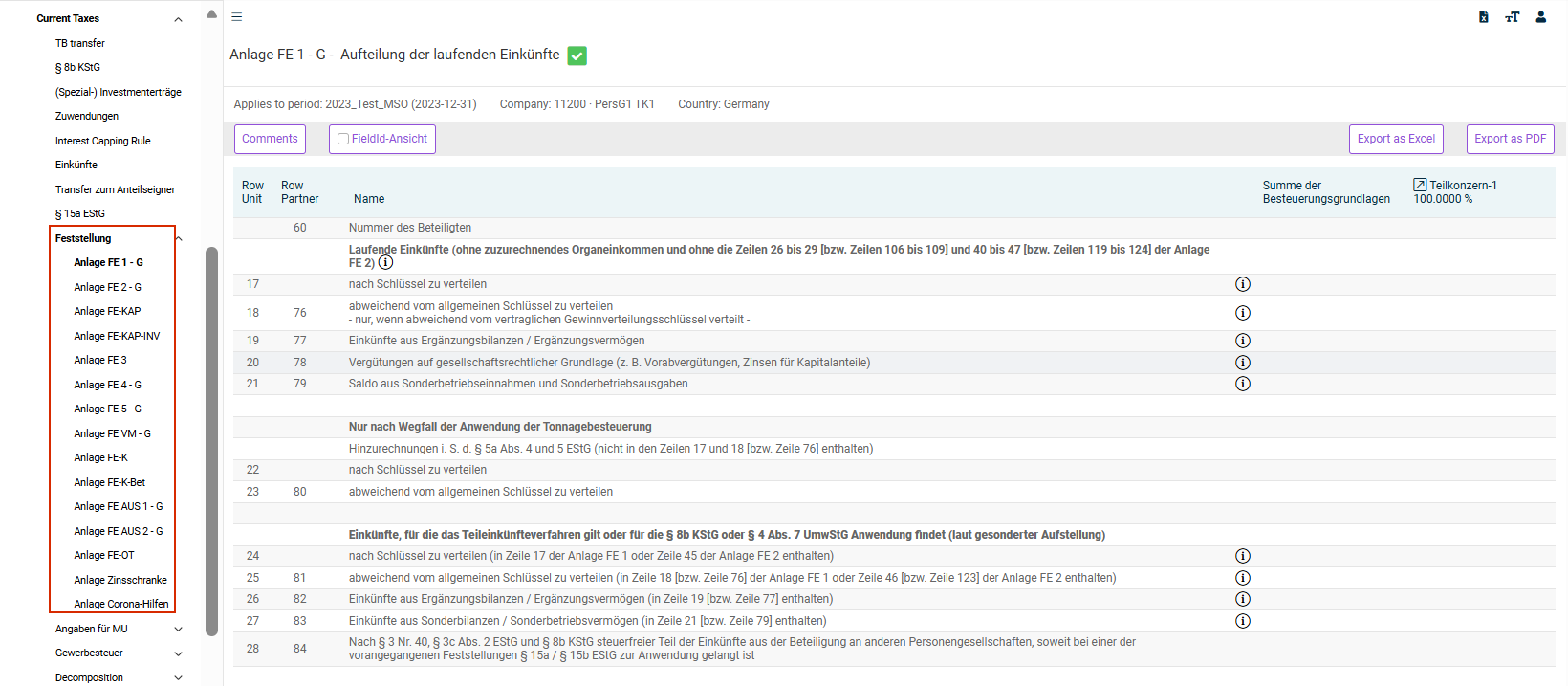
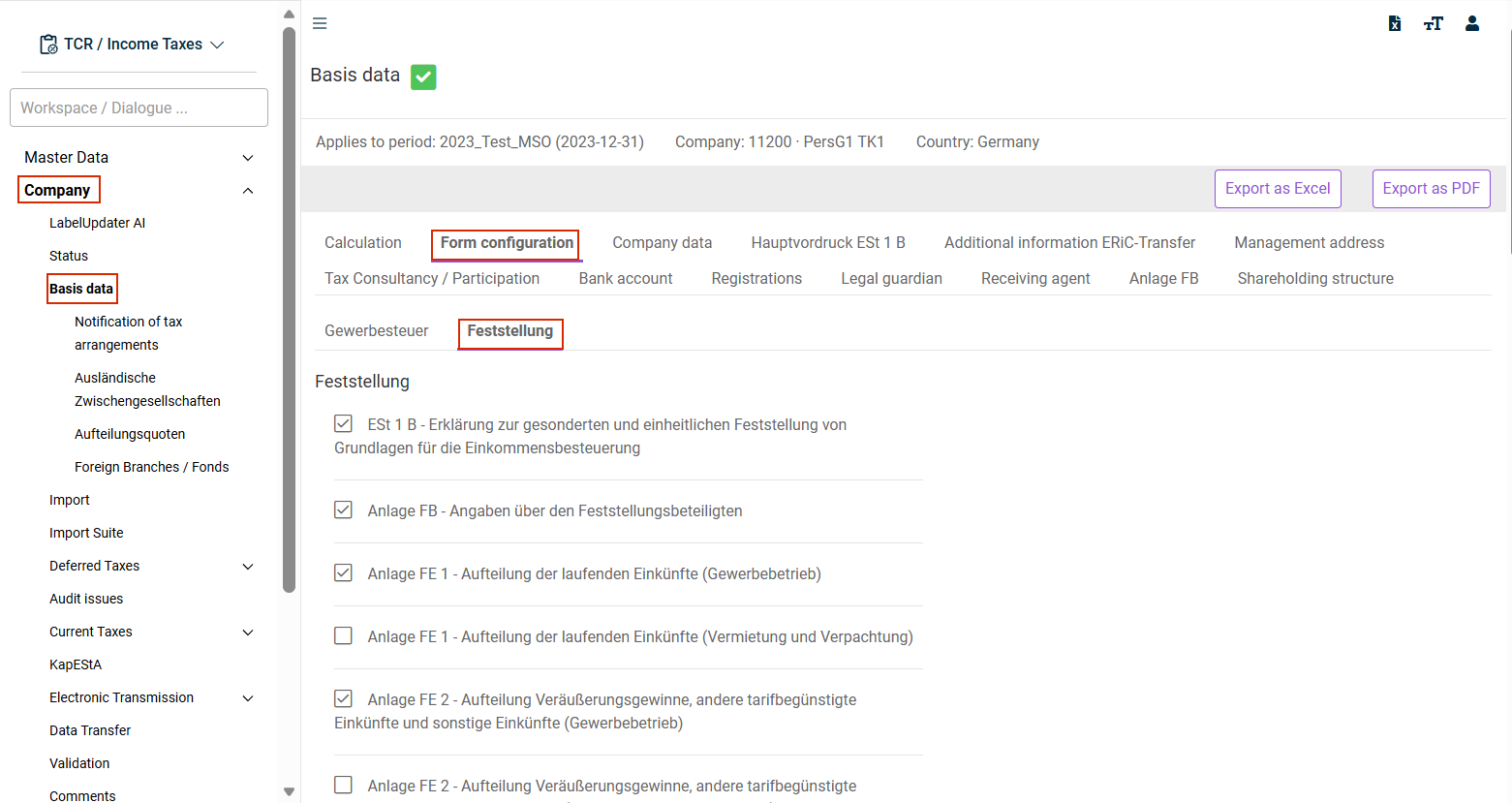
The forms displayed in the Feststellung (Determination) functional area can be specified via Company | Basic data | Form configuration on the Feststellung tab:
Forms in the 'Feststellung’ (Determination) Functional Area
The following forms can be activated for the Feststellung (Determination) functional area (as of assessment period 2024):
Option
Description
Anlage FE 1
Anlage FE 1 must be completed for co-partnerships (e.g. partnership companies). In Anlage FE 1, the total income is determined first and then distributed among the parties involved.
Anlage FE 1 is available for the following income types:
- Commercial enterprise (FE 1 -G)
- Rental and leasing (FE 1 – VuV)
Anlage FE 2
Capital gains, other income subject to preferential tax rates, and other types of income are entered in Anlage FE 2. This income is then distributed among the parties involved.
Anlage FE 2 is available for the following income types:
- Commercial enterprise (FE 2 -G)
- Rental and leasing (FE 2 – VuV)
- Other types of income (FE 2 – SO)
Anlage FE 3
Special expenses and information on de minimis aid and special depreciation for new residential rental construction pursuant to section 7b of the Income Tax Act (EStG), laboratory associations, and cost/auxiliary associations, and information on section 3a of the Income Tax Act are entered in Anlage FE 3. The amounts are then distributed among the parties involved.
Anlage FE 4
You can enter information on the tax relief for retained profits (section 34a of the Income Tax Act (EStG)) and for determining the non-deductible loan interest pursuant to section 4 (4a) of the Income Tax Act in Anlage FE 4. The amounts are then distributed among the parties involved.
Anlage FE 4 is available for the commercial enterprise income type.
Anlage FE 5
Information on non-deductible loan interest (section 4 (4a) of the Income Tax Act (EStG)), losses with limited liability (section 15a of EStG), losses in connection with tax deferral models (section 15b of EStG), and tax relief for retained profits (section 34a of EStG) is entered in Anlage FE 5. The amounts are then distributed among the parties involved.
Anlage FE 5 is available for the following income types:
- Commercial enterprise (FE 5 -G)
- Rental and leasing (FE 5 – VuV)
Anlage FE VM
The tax bases for each party involved in connection with losses with limited liability (section 15a of EStG) and losses in connection with tax deferral models (section 15b of EStG) are entered in Anlage FE VM.
Anlage FE VM is available for the following income types:
- Commercial enterprise (FE VM -G)
- Rental and leasing (FE VM – VuV)
Anlage FE-K
You must complete Anlage FE-K if the partnership or community generates income for which the tax exemption or taxation depends on the legal form and corporations are involved. The tax bases both for the partnership and proportionally for the corporations involved are entered in it.
The form is divided into two parts. The first part concerns the tax bases of the company, and the second one the shares of the corporations involved.
Anlage FE-K-Bet
Anlage FE-K-Bet is to be completed by partnerships whose shareholders include corporate income tax entities if this partnership received distributions in the assessment period that may result in tax-free income from shares in corporations. It covers profit distributions to determine their tax liability specifically and supplements the entries made in Anlage FE-K.
The form must be completed separately for each investment and distribution, in particular if different tax exemptions apply.
Anlage FE-AUS 1 and Anlage FE-AUS 2
Anlage FE-AUS 1 and Anlage FE-AUS 2 are required for tax bases with a foreign reference. FE-AUS 1 covers the foreign taxes attributed to parties involved, while FE-AUS 2 determines tax-exempt but progression-relevant foreign income and add-back amounts.
With investment income, foreign tax is taken into account only if it has not already been settled by the tax deduction. An entry is therefore made in FE-AUS 1 only if the standard income tax rate applies.
Anlage FE-AUS 1 and 2 are available for the following income types:
- Commercial enterprise (FE AUS - G)
- Rental and leasing (FE AUS – VuV)
- Other types of income (FE AUS – SO)
Anlage FE-KAP
Anlage FE-KAP covers the income from investment assets jointly generated by the co-partnership (e.g. partnership) and the corresponding recoverable taxes such as capital gains tax and foreign taxes.
It distinguishes between gains with and without domestic tax deduction and those subject to the standard income tax rate. Furthermore, gains taxed at a reduced rate, various tax reduction amounts, and limited-creditable capital gains taxes, and family foundations are entered.
The amounts are then distributed among the parties involved.
Anlage FE-KAP-INV
The tax bases for investment income not subject to domestic tax deduction are determined in Anlage FE-KAP-INV. Anlage FE-KAP-INV must be completed separately for each investment fund.
Anlage FE-OT
Anlage FE-OT must be completed by partnerships that are the tax group parent of a tax group member.
Anlage FE-OT covers the tax bases of the tax group member attributed to the partnership. They are then allocated to the shareholders by the separate income determination.
Anlage Zinsschranke
The Zinsschranke (Interest Capping Rule) limits how much interest expense a company may deduct for tax purposes.
The data required to determine the interest and EBITDA carried forward are entered in Anlage Zinsschranke. The deductible interest expenses, interest carried forward, and EBITDA carried forward are determined in accordance with section 8a of the Corporate Tax Act (KStG) and section 4h of the Income Tax Act (EStG). For tax groups, only the tax group parent, not the tax group member, must complete Anlage Zinsschranke. However, pre-tax group interest carried forward may need to be considered for the tax group member.
For companies with interest expenses below € 3 million, Anlage Zinsschranke is normally not required unless an interest carried forward exists.
Anlage Corona-Hilfen
Whether the co-partnership (e.g. partnership) received COVID-19 emergency aid, bridging grants, and comparable grants is entered in Anlage Corona-Hilfen (COVID-19 emergency aid form).