
Recording Losses Carried Forward
Last updated on 2026-05-15
Overview
The balance of tax losses carried forward and the corresponding valuation (i. e. the recoverability of deferred tax assets) are administered in the LCF (Loss carried forward) workspace. Various categories of tax losses carried forward (or future tax benefits) are available for selection, depending on the tax law and legal form:
- Tax losses carry forward corporate tax
- Tax losses carry forward local tax
- Interest capping rule
- LCF § 15a EStG *
- Others *
- Tax credits [only foreign countries]
- Capital losses [only foreign countries]
The categories marked with must, if applicable, be set up under Master Data | Administration on the Miscellaneous tab in the LCF table.
This article contains the following sections:
Navigation
The LCF workspace can be found under Company | Deferred Taxes | LCF.
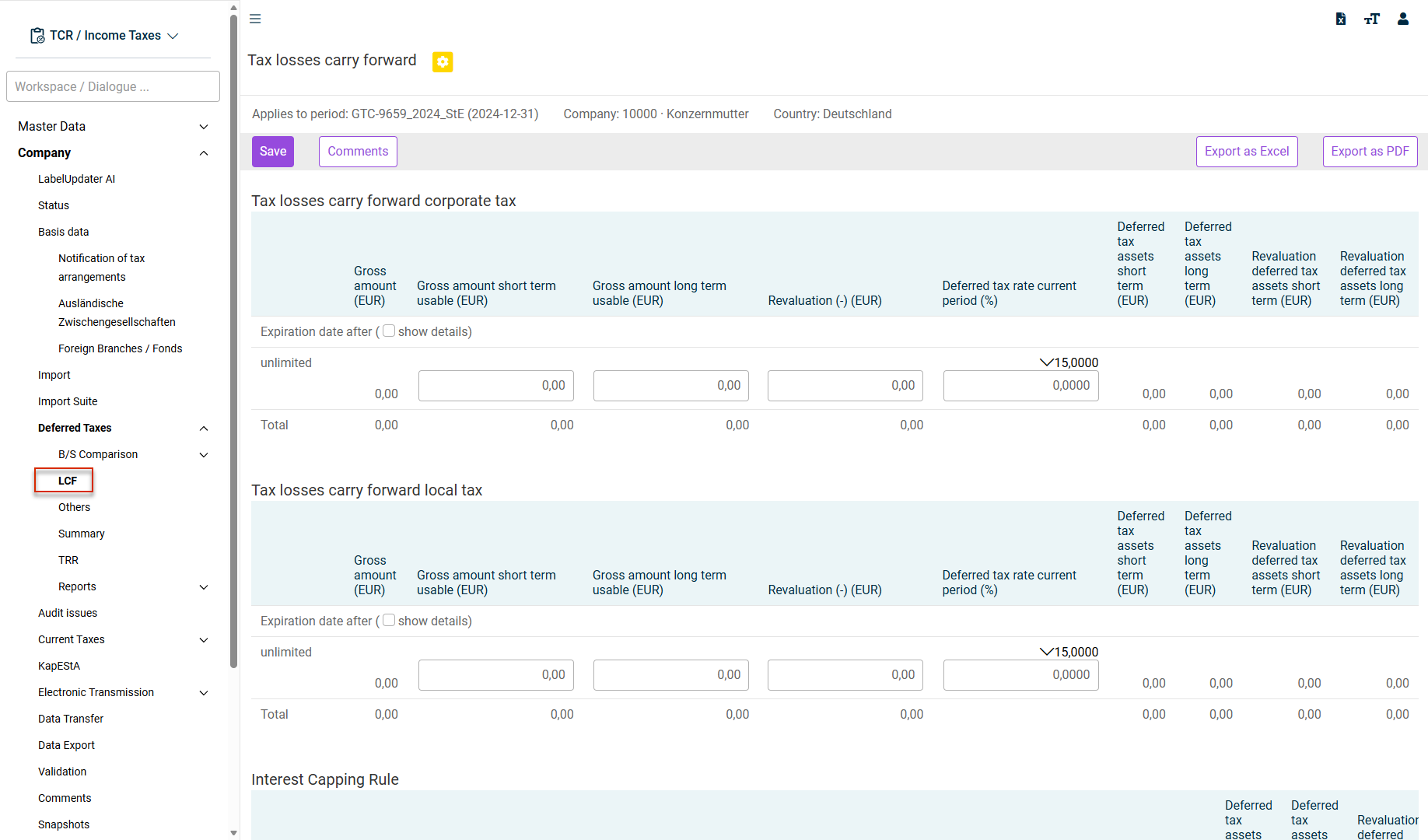
The LCF workspace is displayed, for example, as follows:
Columns in the 'Tax losses carry forward' Workspace
The following columns are displayed in the Tax loss carried forward workspace:
Gross Amount
The Gross amount column contains losses carried forward of the current period and previous periods. Activate the check box show details to record restrictions regarding possible expiration dates.
No deferred taxes are added to the gross amount.
Gross Amount Long-Term/Short-Term Usable
The assessment of the recoverability of losses carried forward [impairment test] is reflected in the Gross amount short term usable and Gross amount long term usable columns. A time horizon of 12 months is used for the short-term portion. The gross amount can also be split into short-term and long-term portions.
The amount of usable losses carried forward serves as the assessment basis when determining the deferred tax assets attributed to them. If an allocation to expiration dates is made, the usable amount must be allocated to each year accordingly.
If there are no restrictions regarding the expiry dates, the entry could look like the following figure: EUR 10,000,000 gross amount – including EUR 7,000,000 that are long term usable.
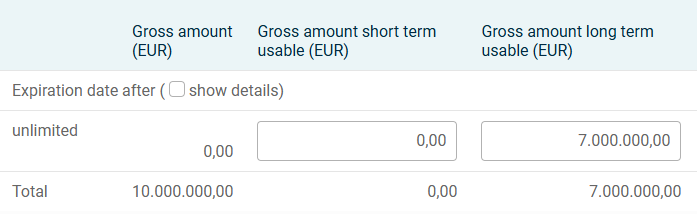 Gross loss carryforwards available for long-term use
Revaluation [-]
Valuation allowances for the balance of losses carried forward must be entered with a negative sign. The assessment basis, not the tax effect, must be entered.
No details regarding the maturity are required for the valuation allowance. The allocation is made automatically based on the proportional shares in the Gross amount short term usable and Gross amount long term usable columns.
Deferred Tax Rate Current Period
The tax rate used to assess the loss carried forward must be entered by the user. A proposed value from the master data is displayed (15% in the figure above). The tax rates for the different types of losses carried forward (corporate income tax loss carried forward or local tax loss carried forward) must be taken into account.
Workspace 'Rollforward LCF'
From the LCF workspace, you can open the Rollforward LCF workspace using the Rollforward LCF button. In this workspace, the opening balances of the fiscal year are rolled forward to the closing balance for each type of loss carried forward. For details, see Rollforward LCF.
Technical Notes on the 'Loss Carried Forward' Workspace
Under IAS 12, deferred tax assets are recognized only if the requirements of IAS 12.24 and IAS 12.34 are met. The impairment test must be conducted on each balance sheet date.
Under IAS 12, a distinction must be made between non-recognition and revaluation when assessing the recoverability of losses carried forward. The non-recognition of deferred tax assets only applies to losses carried forward that arose during the reporting period. An allowance is applied when losses carried forward that have already been recognized as deferred tax assets are subsequently classified as not recoverable.
Under US-GAAP [SFAS 109], the approach is different: Deferred tax assets on loss carryforwards are always recognized first, and an allowance is made only in a second step if necessary. This also applies to losses carried forward that arose in the current period. Both approaches can be implemented with Income Taxes.
Non-Recognition of Deferred Tax Assets
This criterion applies to losses carried forward that arose during the current reporting period. For such losses carried forward, an assessment must be made in the year they arise as to whether the recognition of deferred tax assets is permitted or not.
Allowance for Deferred Tax Assets
Under IAS 12, allowances concern deferred tax assets recognized in past reporting periods. Therefore, allowances for losses of the current period are not applicable under IAS 12, unlike under US-GAAP.