Currency settings and currency translation in Lucanet xP&A (Extended Planning & Analysis) allow you to flexibly set up your planning in multiple currencies.

As a first step, currency translation in Lucanet xP&A must be set at organization level.

If you wish to use different currency translation behaviors in Lucanet xP&A at model, variable, or dimension level, you can adjust the settings for these levels individually.

  • Currency settings at model level can be used to either display the data in the local currency or in the display currency.
  • Currency settings at variable level can be used to edit the local currency and exchange rate for individual variables or dimensions.
  • Currency settings at dimension item level can be used to define a default currency for the dimension items used in variables. If needed, the default can be changed for certain dimension items in variables.
  • In addition, you can set a currency on data sources for the data to be pulled in.

The translation of the different currencies is always based on the configured exchange rates.

  • Users who are also working with Lucanet Consolidation & Financial Planning (CFP) automatically use the exchange rates configured in CFP.
  • For users who do not work with CFP, currency translation is based on Auto rates from an external provider.
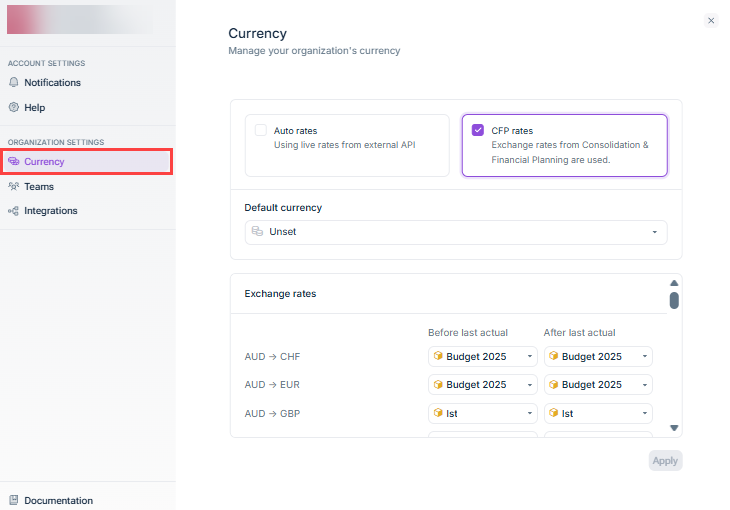
As a first step for automatically translating currencies between different variables and data sources in xP&A, you have to set the currency for your organization. Proceed as follows:

1

Open the Settings workspace and navigate to the Currency organization settings. Currency translation is enabled by default.

Shows the 'Currency' settings page in the Settings workspace of Lucanet xP&A, with the 'Enable currency translation' toggle, the 'Auto rates' and 'CFP rates' options, and the 'Default currency' drop-down list set to 'Unset'. Highlighted in red is the toggle to enable currency translation.
Enabling currency translation at organization level
2

Based on whether you use the Lucanet solution Consolidation & Financial Planning (CFP) or not, the source of the exchange rates used for currency translation will be set by default:

  • Auto rates if you do not have CFP enabled as a solution - this uses live rates from the external provider Open Exchange Rates.

  • CFP rates, if you have CFP enabled as a solution - this uses exchange rates configured in Consolidation & Financial Planning.

To change this pre-setting, please contact our Customer Support.

Please note that these organizational settings apply for all models, variables, and dimensions and cannot be changed at a lower, individual level. I.e., if you choose CFP rates for your organization, you cannot select Auto rates for a model, a variable or a dimension, but CFP rates will always apply.

Important

Switching between Auto rates and CFP rates after you have set up currencies in your model may result in loss of information. If the system is not able to map a currency when changing the type of exchange rates, the affected variables will be converted to plain numbers and lose their currency formatting.

Example: If you created a custom currency called "ZZZ" while using CFP rates, switching to Auto rates will convert any variables using "ZZZ" to numerical variables (without currency settings), since "ZZZ" is not a recognized currency code in Auto rates and can therefore not be mapped.

3

Choose the default currency of your organization.

This default currency will be used for all newly created models and can be adjusted individually in the currency settings at model level.

4

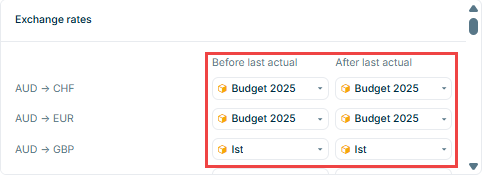
If you use CFP rates for currency translation, configure the additionally displayed Exchange rates section by choosing for each currency relation the data level in CFP to be applied to the exchange rate table in xP&A.

Shows the 'Exchange rates' section in the currency settings of Lucanet xP&A, listing currency relations such as 'AUD -> CHF' and 'AUD -> EUR', each with a data-level drop-down list. Highlighted in red is the drop-down list for the 'AUD -> CHF' relation, open to show the options 'Unset', 'Ist', 'Budget', 'FC 9+3 2024', and 'Budget 2025'.
Selecting the exchange rates from CFP
5

Click Apply.

By default, each new model in Lucanet xP&A will use the currency translation settings configured at organization level.

If you want to use different currency translation behavior in a model, you can adjust it in the model settings. These model-level settings determine how the model interprets and translates values throughout all variables (unless you configure individual translation behavior at variable level.)

1

Click the gear icon to open the Model Settings:

Shows the currency options in the 'Model Settings' panel of Lucanet xP&A, including the 'Exchange rates' section with currency relations such as 'AUD -> CHF', the 'Edit in CFP' link, the 'Default currency' field set to 'USD', and the 'Default exchange aggregation type' drop-down list set to 'Average exchange rate'.
Currency options in the model settings
2

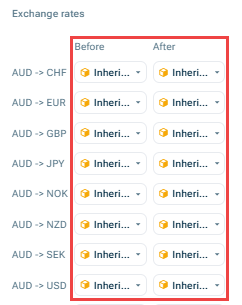
Under Exchange rates, assign for each exchange rate relation the exchange rates from CFP to be used.

All exchange rates for which an exchange rate table has been defined in Consolidation & Financial Planning are available for selection.

If necessary, you can update the selection using the sync button or edit the available exchange rates in Consolidation & Financial Planning using the link Edit in CFP.

3

Select the Default currency for the model.

4

Select the Default exchange aggregation type:

  • Average exchange rate
  • Closing exchange rate
5

Click Apply changes.

By default, a variable in Lucanet xP&A uses the same default currency and currency translation settings as the model it is used in.

However, you can change the currency settings for each variable, e.g., to set a variable to USD even if the model is EUR.

To individually set the currency of a variable:

1

Click the Edit icon icon or the icon to the left of the variable name.

2

Click the Currency icon icon to set the Currency data type for the variable.

3

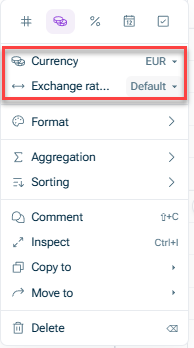
Choose the currency and the exchange rate aggregation type from the drop-down lists:

Shows the variable settings menu in Lucanet xP&A with the 'Currency' field set to 'EUR' and the 'Exchange rat...' (aggregation type) field set to 'Default', alongside 'Format', 'Aggregation', 'Sorting', 'Comment', 'Inspect', 'Copy to', 'Move to', and 'Delete' options. Highlighted in red are the 'Currency' and 'Exchange rate' fields.
Currency settings for a variable

The variable is then displayed with the Currency data type icon and all values of the variable are displayed in the set currency and with the corresponding currency symbol:

Shows a spreadsheet view in Lucanet xP&A with two currency variables, 'Sales - Revenue Line 1' set to 'AUD' and 'Sales - Revenue Line 2' set to 'GBP', each showing values with their currency symbol, e.g. 'A$1,205,016' and '£1,064,448'. Highlighted in red are the currency icon, the 'AUD' currency badge, and the currency-formatted values.
Variables with a set currency

The following constraints apply when setting the currency for a variable in Lucanet xP&A:

  • Only those currencies for which an exchange rate table has been defined in the model settings are available for selection.
  • If a variable in EUR uses a variable in USD, automatic conversion occurs using the model’s currency settings.

For variables with dimensions (e.g., Region, Entity, Country) in Lucanet xP&A, different currencies can be assigned per dimension item.

Example:

  • Revenue [US] uses USD
  • Revenue [France] uses EUR
  • Revenue [UK] uses GBP

Totals always use values converted into the variable’s currency before aggregating.

You can set a default currency for each dimension item in the Dimension Settings. This saves time when you have many variables using the same dimension item, as the variables by default use this currency then.

If needed, you can also specify individually for each variable, if the dimension items used therein use a different currency.

You can set a default currency at the dimension item level in the Dimension Settings which will be used by every variable using this dimension item as default.

1

Open the dimension details by clicking the dimension name.

2

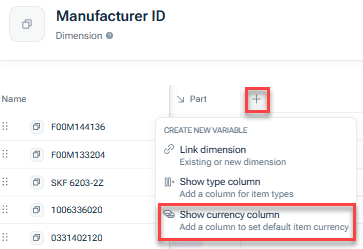
Click the + icon in the column header and choose Show currency column.

Shows the menu that opens when you click the '+' icon in the column header of a dimension's details in Lucanet xP&A, with options 'Link dimension', 'Show type column', and 'Show currency column'. Highlighted in red are the '+' icon and the 'Show currency column' option.
Show currency column
3

In the currency column, click the currency cell and select the default currency. Choose one of the following options:

  • Choose the default currency from the list of available currencies.
  • Choose Unset if no default currency is needed.
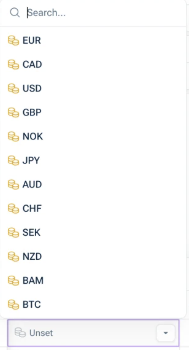
Shows the currency drop-down list for a dimension item in the currency column of Lucanet xP&A, with a searchable list of currencies including 'EUR', 'CAD', 'USD', 'GBP', 'NOK', 'JPY', 'AUD', 'CHF', 'SEK', 'NZD', and 'BAM', and the current selection set to 'Unset'.
Choosing the default currency

Keep the following in mind after setting a default currency for a dimension item in Lucanet xP&A:

  • Once a default has been set, new currency variables using this dimension will automatically use the set currency as default.
  • Existing variables are not automatically changed but they keep their current settings.

If you want a certain dimension item in a variable to use a different currency than the default currency set in the dimension settings, you can assign an individual currency in the model:

1

Open the Spreadsheet view of the model.

2

Navigate to the desired variable and expand the list of dimension items under a dimension.

3

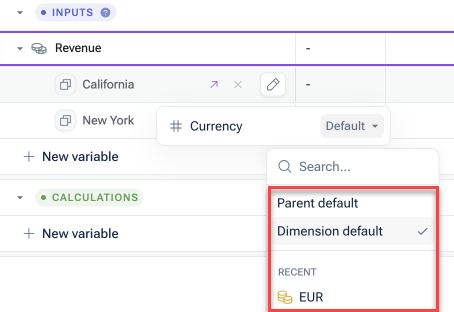
Click the currency icon on the right of the dimension item name and choose one of the following options from the menu:

  • Parent default, if the dimension shall use the variable's default currency or the parent dimension's currency
  • Default currency, if the dimension item shall use the default currency set for this dimension item in the dimension setting (only available if a default is set as described in the previous sub-heading).
  • Choose a specific currency and the exchange rate aggregation type from the drop-down lists.
Shows the currency menu for a dimension item ('California') under the 'Revenue' variable in a Lucanet xP&A model, with the 'Currency' field set to 'Default' and the options 'Parent default', 'Dimension default' (checked), and a 'RECENT' list showing 'EUR'. Highlighted in red are the 'Parent default' and 'Dimension default' options and the recent currency list.
Currency options for a dimension item in a variable
4

The variable using this dimension item is then displayed with the corresponding currency symbol.

Understanding Currency Inheritance

The system uses the following hierarchy in Lucanet xP&A to determine which currency applies to a dimension item (from highest to lowest priority):

1

Explicit currency set on dimension item in the model (variable-level override)

2

Dimension default currency (from dimension settings)

3

Parent dimension's currency (if a variable has multiple dimensions)

4

Variable's default currency (the currency set on the variable itself)

Example scenario:

Variable Revenue has USD as its default currency

Dimension Region has EUR set as default for France

  • If you select Dimension default for Revenue [France], the dimension item will use EUR
  • If you select Parent default for Revenue [France], the dimension item will use USD(the variable's default)
  • If you select GBP individually, the dimension item will use GBP regardless of any defaults

The following behaviors apply in Lucanet xP&A when you change currency settings for dimension items:

Non-Currency Variables

  • If a variable is not a currency type (e.g., count, percentage), dimension item currency settings are ignored
  • Currency settings only apply to variables with a currency unit type

Changing Defaults

  • If you update a default currency in the dimension settings, only dimension items set to Dimension default will be affected
  • Dimension items with explicit currency selections remain unchanged

Removing the Default Currency

  • If you remove a default currency from the dimension settings, all dimension items using Dimension default will fall back to Parent default (the variable's currency)
  • A confirmation warning will appear before this change is applied

Scenario: You have a Revenue variable broken down by Country(US, UK, France, Germany).

1

Set up the default currency in the dimension settings:

  • US → USD
  • UK → GBP
  • France → EUR
  • Germany → EUR
2

Create your revenue variable and set its unit to Currency with USD as the variable default.

3

In the model, each country row will automatically use the Dimension default:

  • Revenue [US] shows in USD
  • Revenue [UK] shows in GBP
  • Revenue [France] shows in EUR
  • Revenue [Germany] shows in EUR
4

The Total row converts all values to USD (the variable's default) before summing.

5

To override a specific dimension item, click the currency icon and select a different currency or Parent default to use the variable's currency instead.

By default, a model in Lucanet xP&A displays all currencies in the local currency that has been configured for them.

You can change this setting so that the variables and dimensions are displayed in another display currency, converting all the currencies based on the configured exchange rates.

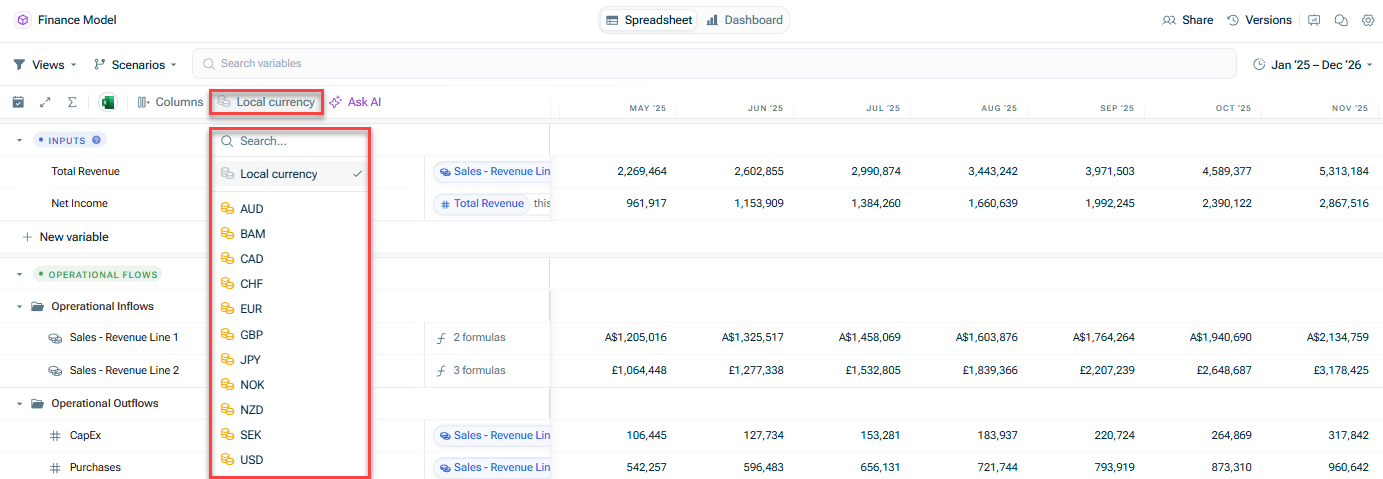
To do so, open the currency options in the top ribbon of a model and choose, if you want to display the local currency or any other currency for which an exchange rate has been defined:

Shows the 'Finance Model' spreadsheet view in Lucanet xP&A with the 'Local currency' button open, showing a drop-down list of currencies including 'Local currency' (currently selected), 'AUD', 'BAM', 'CAD', 'CHF', 'EUR', 'GBP', 'JPY', 'NOK', 'NZD', 'SEK', and 'USD'. Highlighted in red are the 'Local currency' button and the currency drop-down list.
Options to change the display currency of a model

Please note that the editing of values occurs in the local currency that is set on the variable or dimension.

You can set a currency for every data source used to integrate data into Lucanet xP&A from a source system.

General Behavior

When connected data that has a currency set is connected to a variable in a different currency, xP&A will automatically convert all values pulled in from a data source to the currency set for the variable:

  • e.g. if your variable is in AUD, but you connect data that is in USD, xP&A will convert the USD data values to AUD
  • e.g. if your data is in USD but you want to see how that converts to EUR, set the variable to EUR and xP&A will convert USD to EUR
Behavior With Multiple Data Sources

If more than one data source is connected to the same variable, all data sources are automatically converted into one target currency.

By default, the first added data source’s currency becomes the initial target currency.

You can override this behavior in the variable’s currency settings. All other data sources connected to this variable will be converted into that variable's target currency.

How you set the currency for a data source in Lucanet xP&A depends on the type of data source.

For CFP data sources

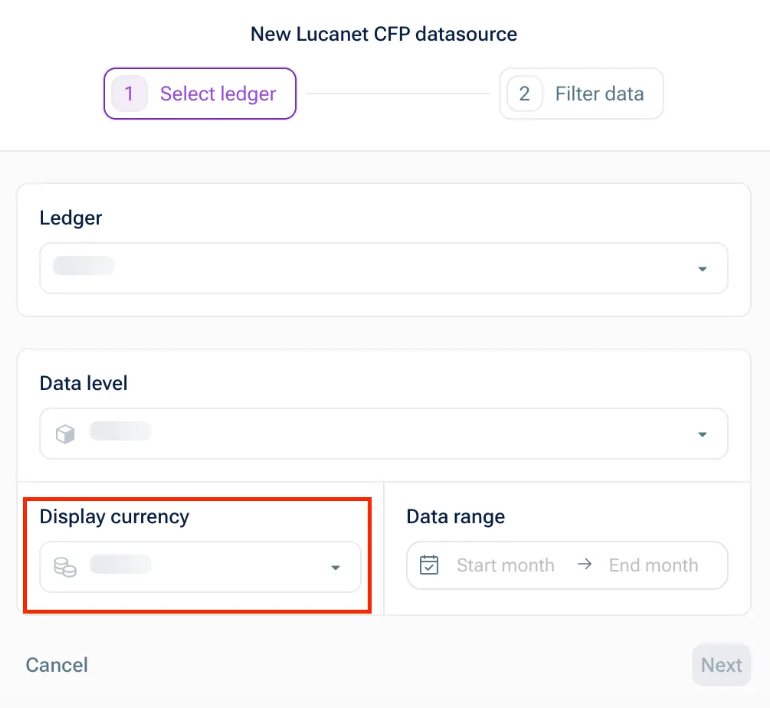
For CFP data sources, the currency is assigned during the set-up process in the Select ledger step under display currency:

Shows the 'Select ledger' step of the 'New Lucanet CFP datasource' dialog in Lucanet xP&A, with fields for 'Ledger', 'Data level', 'Display currency', and 'Data range'. Highlighted in red is the 'Display currency' field.
Currency settings of a CFP data source

For all other data sources

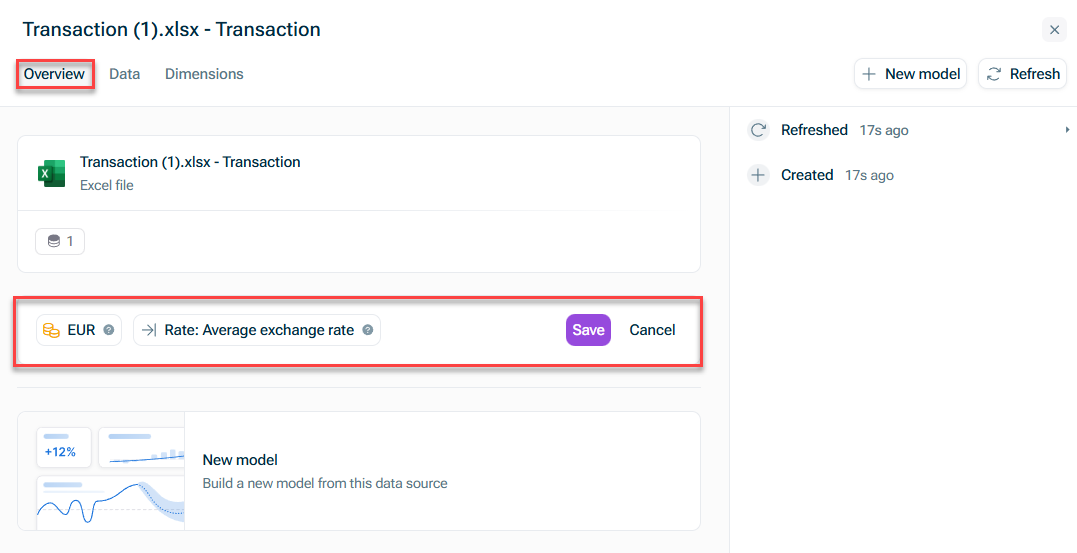
For all other data sources, the currency is set after the data source has been created. To do so, go to the Overview tab of the data source and choose the currency and if you want to use the average exchange rate or closing exchange rate for conversion.

Shows the 'Overview' tab of a data source named 'Transaction (1).xlsx - Transaction' in Lucanet xP&A, with the currency set to 'EUR' and 'Rate: Average exchange rate', plus 'Save' and 'Cancel' buttons. Highlighted in red are the 'Overview' tab and the currency and exchange-rate settings.
Currency settings for a data source

Keep the following in mind about currency settings for data sources in Lucanet xP&A:

  • Only the user that created the data source can update the currency settings.
  • For common data sources, currency settings are automatically detected and set by xP&A.
  • For other data sources where xP&A cannot auto-detect the currency (e.g. Google Sheets), currency can be manually set (but currency settings are completely off by default).

This section answers frequently asked questions about currency translation in Lucanet xP&A.

You can see the exchange rates for each period used by drilling-down into the cells of the converted variable.

Example:

From MXN to EUR through MXN to CHF and from CHF to EUR(if there is no exchange rate table for MXN to EUR)?

Answer

No, xP&A does not perform currency triangulation across multiple exchange rate tables. If a direct MXN–EUR rate is missing, the system will only use the inverse of an existing rate. E.g. if you have MXN to CHF configured, xP&A will know the rate from CHF to MXN but not to other currencies.

In Lucanet xP&A, Payroll/HRIS data sources do not have currency set because often different employees are paid in different currencies. Our Headcount wizard shows how to translate all employees into one common currency using a Currency dimension, and a user-populated exchange rate variable. We do not recommend setting a data-source level currency for this data source, unless every employee is paid in the same currency.

For any periods where xP&A cannot access an historical exchange rate, xP&A will carry the latest historic rate forward, and convert "future" data values at that rate. For example, in a monthly model, if there are historical exchange rates until November 2023, but you have data available and connected for December 2023, xP&A will convert the December 2023 value using the latest rate from November 2023 (depending on whether data source is set to Average or Closing exchange rate).

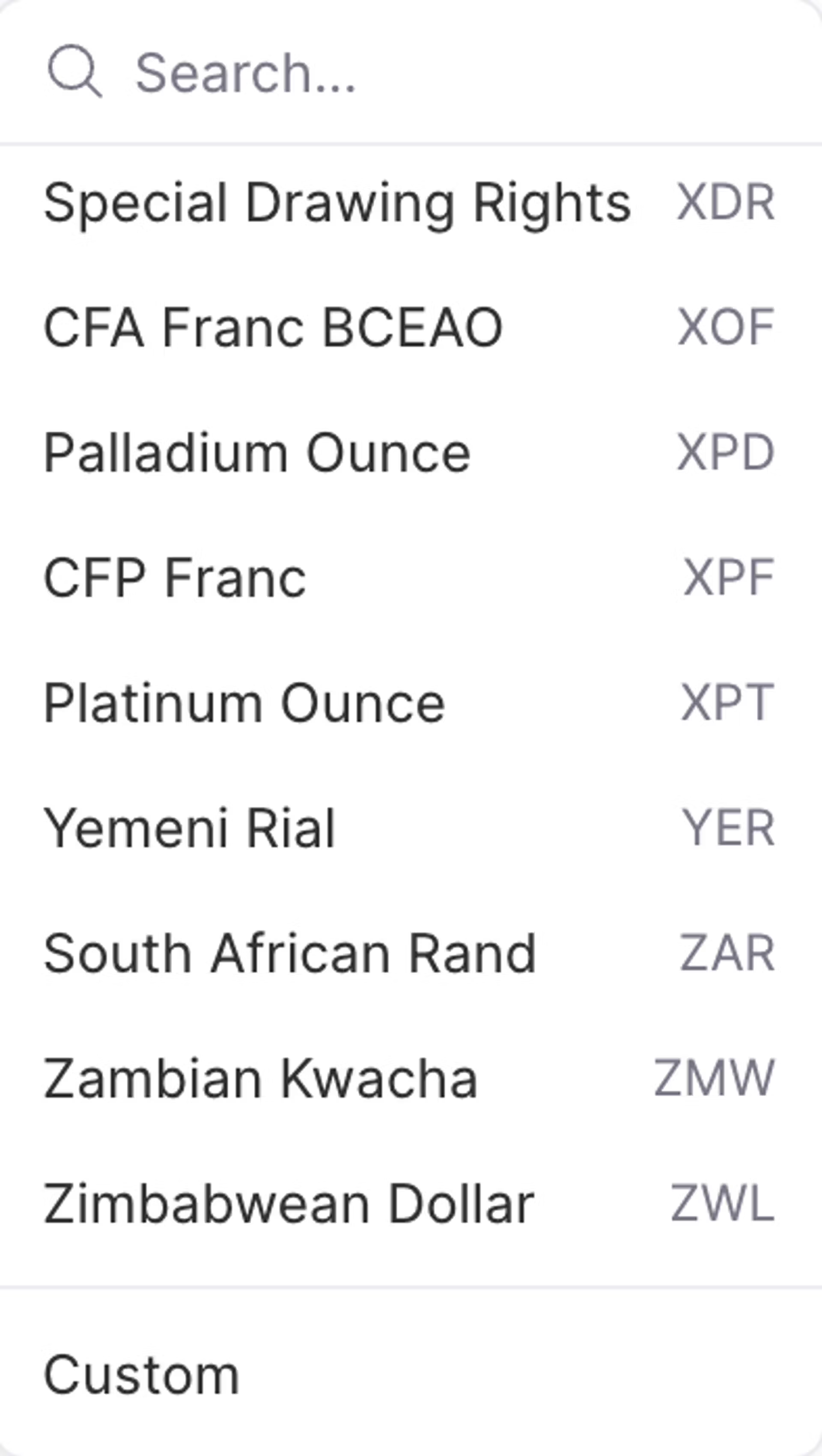
If you use a currency that is not on our list (e.g. a certain cryptocurrency), you can select Custom (at the very bottom of the list) and set your own prefix/suffix to reflect the currency.

Shows the bottom of the currency selection list in Lucanet xP&A, including currencies such as 'South African Rand (ZAR)', 'Zambian Kwacha (ZMW)', and 'Zimbabwean Dollar (ZWL)', with the 'Custom' option listed at the very bottom.
Working with custom currencies

If you have a Custom currency set, xP&A will not be able to do any auto-translation.

If you don't want to use currency translation, you can switch off the feature on your organization level (see Configuring Currency Translation at Organization Level).

For any data items that are constant (i.e. non-time-varying), xP&A will convert these at the latest completed period's rate. For example, in a monthly model, if there are historic FX rates until November 2023, but the current date is 15th December 2023, xP&A will convert the constant value using the latest rate from November 2023 (depending on whether data source is set to Average or Closing exchange rate).

Lucanet xP&A uses the same logic for data connected to models without a time dimension (i.e. granularity of None).

There are many ways you can set up your consolidation in Lucanet xP&A.

You can either have no entity breakdown (in which case you would drill-down to see detail at the entity level), or you can use dimensions to break down by entity (see below) which means you can easily visualise historics by entity, and forecast by entity, too.

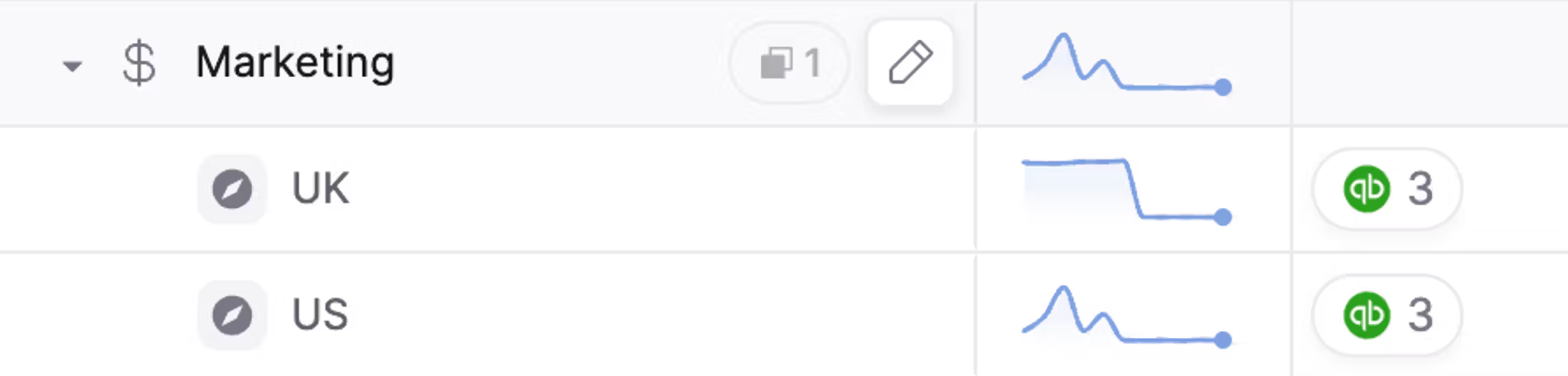
Shows the 'Marketing' category in a Lucanet xP&A model broken down by the 'Entity' dimension into 'UK' and 'US' rows, each connected to a data source shown by the green 'qb' (QuickBooks) badge.
'Marketing' is broken down by Entity (UK, US), and data is connected at the entity level

To set up entity-level breakdown in Lucanet xP&A:

You can also have separate models for each entity, and then have a linked consolidation model that combines them together.

Note, however, that we do not recommend this, as (1) you will not be able to take advantage of our automatic currency translation (unless you also connect the consolidated model to data from each entity), (2) adding extra entities would be manual (building an extra model, vs. simply adding an extra dimension item in the Entity dimension as per above).

This content was generated using AI and reviewed by Lucanet subject matter experts before publication.

Last updated on May 1, 2026