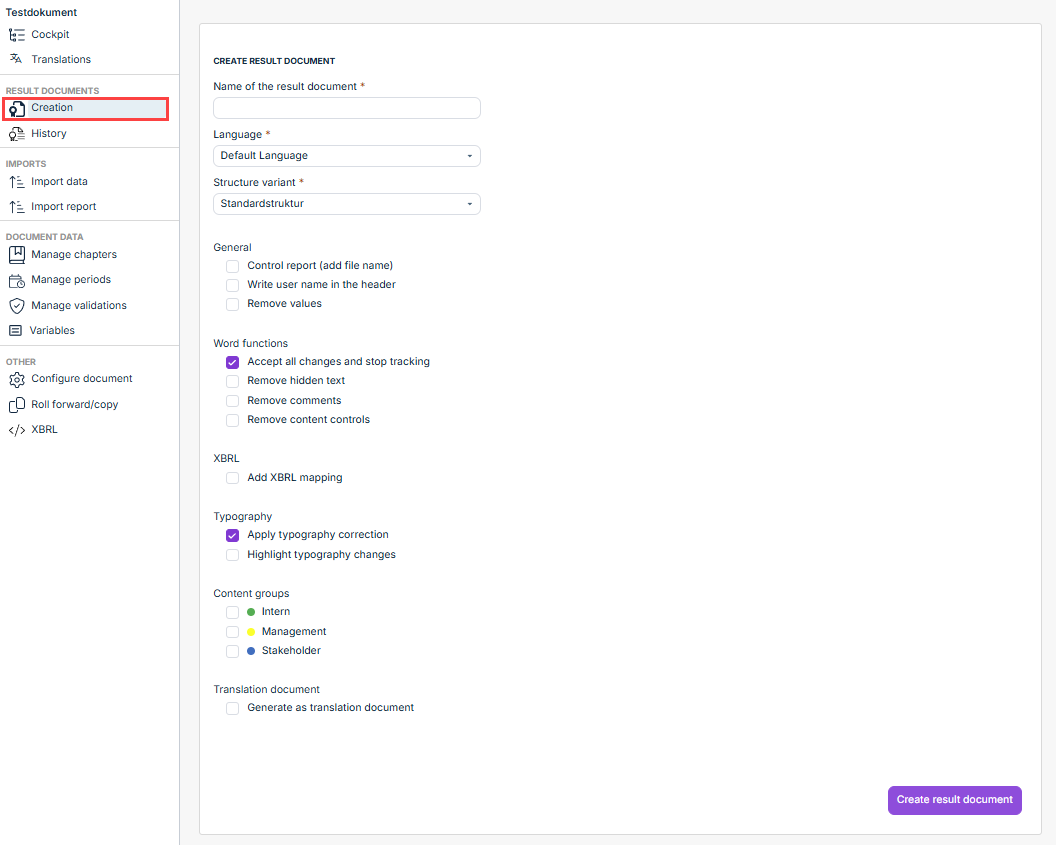
A complete or partial result document can be generated at any time in Disclosure Management. A result document contains the current status of a document stored in Disclosure Management.
The following options are available for the result document:
Option
Description
Result document name
Name of the result document.
Language
Language of the result document. All languages defined in the Configuring Documents workspace are offered.
Structure variant
Version of the result document
Note:Structures are a named selection and arrangement of chapters, including their own section breaks, which is used to generate a specific report version from a document. A single source document can contain several structures, e.g. standard structure, short report, management report, notes, etc., from which different Word result documents can be generated.
General
Control report (add file name): The combined elements of the result document are labeled with the name of their chapter of origin. This allows you to quickly see from which chapter and therefore from which Word or Excel file a particular element of the result document originates.
Write user name in the header: The name of the creator and the time of creation are written in the header of the result document.
Remove values: All values under the control of Disclosure Management are replaced by a zero.
Word functions
Accept all changes and stop tracking: All tracked changes in the Word files are accepted and change tracking is then ended.
Remove hidden text: The hidden texts contained in the Word files are not included in the result document.
Remove comments: The comments contained in the Word files are not included in the result document.
Remove content controls: All content controls are removed from the generated result document. The content within them (text, values, and so on) is preserved—only the control wrapper is removed. This option applies to Word result documents only and does not affect the source documents.
XBRL
Add XBRL mapping: Adds XBRL mapping to the created result document. The Word file can then be loaded into the XBRL tagger.
If this check box is not activated, no XBRL tags are transferred to the result document.
Typography
Apply typographic correction: Applies typographic corrections to the result document, for example correcting quotation marks and dashes.
Highlight typographic changes: The typographic corrections made are highlighted in the result document.
Content groups
Defines which content groups the result document is created for. Select the check box of a content group so that all sections assigned to that content group are included in the result document. A section is included in the result document as soon as it is assigned to at least one of the selected content groups.
Highlight with group color: Displayed when a content group is selected. Highlights the sections assigned to that content group in the result document using its color.
Note: If no content group is selected, all sections are included in the result document regardless of their content group assignment. Sections that are not assigned to any content group are always included.
Translation document
Generate as translation document: The result document contains the content in the language defined above, while the out-areas for tables and charts are switched to the selected target language. This makes the document suitable for external translation; afterward, the translated document can be reimported into the target language via the history.
Output area language
Target language for the output areas (tables and charts) in the translation document. This drop-down list is displayed when Generate as translation document is selected.
Creating a result document automatically also runs the Layout Check for the included Word chapters. No separate option is required for this.
You can generate a partial result document from any chapter of a document at any time. To do this, you must switch to the cockpit and follow the steps described here.