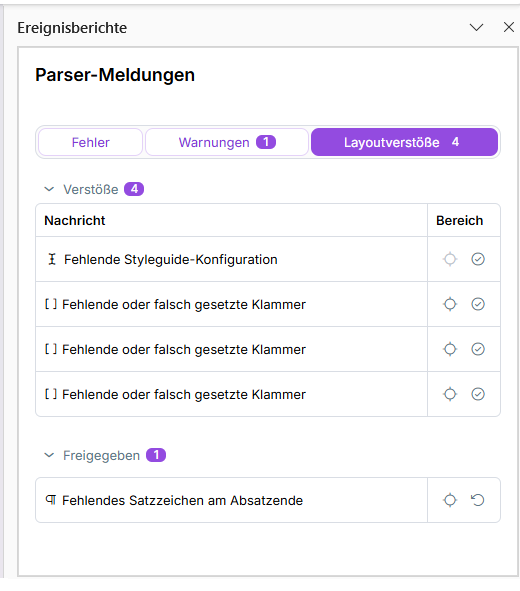
When you check out or update a Word chapter in Lucanet Disclosure Management, or when you create a result document, the Layout Check automatically checks the content for text and formatting deviations. Violations found (layout violations) are shown to you directly in Word in the events report, so you can review them without interrupting your workflow.

This feature is only available in Office Native and Office for the Web.

Open the Messages window using the Event Reports button in the Word ribbon (see Ribbons for Disclosure Management). The Layout violations tab is divided into three areas:

  • Layout violations: Shows the active layout violations in the order they occur in the document.
  • Approved: Contains the violations you have approved (see Approving Violations).
  • Information: Contains notices about changed values, styles from the System styles group, and detected firesys content (see Migrating firesys Content to Content Groups). These entries are navigable but do not count as layout violations and cannot be approved.
The 'Layout violations' tab in the event reports, with the 'Layout violations', 'Approved', and 'Information' areas
The 'Layout violations' tab in the event reports
  • If no violations were found, the tab shows the notice: No layout violations were found.
  • Hovering the mouse over an entry (tooltip) shows a description of the rule and a suggested resolution.
  • Clicking an entry's navigation icon jumps directly to the corresponding spot in the Word document.

If a reported violation is intentional (for example, a deliberately different formatting), you can approve it. This requires permission to edit the document settings. Proceed as follows:

1

On the Layout violations tab, click the Approve checkmark icon at the relevant entry.

2

The entry is removed from the active list and shown in the Approved area. The approval applies only to that specific occurrence in the current chapter. The underlying rule remains active and continues to flag other occurrences. If you change the content at that spot, the approval no longer applies. If the deviation still exists, the spot is flagged as a violation again the next time the Layout Check runs.

To revoke an approval, proceed as follows:

1

On the Layout violations tab, expand the Approved area.

2

Click the Revoke arrow icon at the relevant entry.

The entry is removed from the Approved area. If the deviation still exists, the spot is flagged as an active violation again the next time the document is checked out or updated.

When you open the Layout violations tab in the event reports, Disclosure Management checks the document for the five fixed firesys colors for dynamic content: blue, turquoise, red, green, and orange. It detects text passages with the corresponding firesys font shading as well as table cells with the matching diagonal firesys marker. Other, individually formatted text passages are not detected as firesys content.

You can access detected occurrences in the Information area. Detected occurrences do not count as layout violations and therefore cannot be approved. Each entry shows the detected firesys color and the number of occurrences. For migration, the following options are available to you:

  • If the color is already assigned to a content group in the Style Guide, you can migrate every occurrence of that color in the document to the assigned content group in one step. You can navigate to text occurrences via the entry. Navigation is not available for markers detected only in tables.
  • If the color is not yet assigned to a content group, the entry is flagged accordingly and migration is disabled. In the Style Guide, first assign the corresponding firesys color to a new or existing content group.

The migration is applied immediately to every occurrence of the selected color. It permanently removes the original firesys markers and cannot be undone. This also removes the original firesys behavior for keeping or deleting content at the chapter level. After the migration, you can still include or exclude the affected content groups when creating a result document.

The Layout Check runs automatically:

Which rules are monitored is defined on the Layout Check tab in the Configure document workspace.