The users that have been assigned as editors fill out the ESRS, ESRS 2.0, or VSME questionnaire entirely or only the parts that have been assigned to them. For the data collection, users can attach files, and mark questions as completed to indicate the questions as ready for final review.

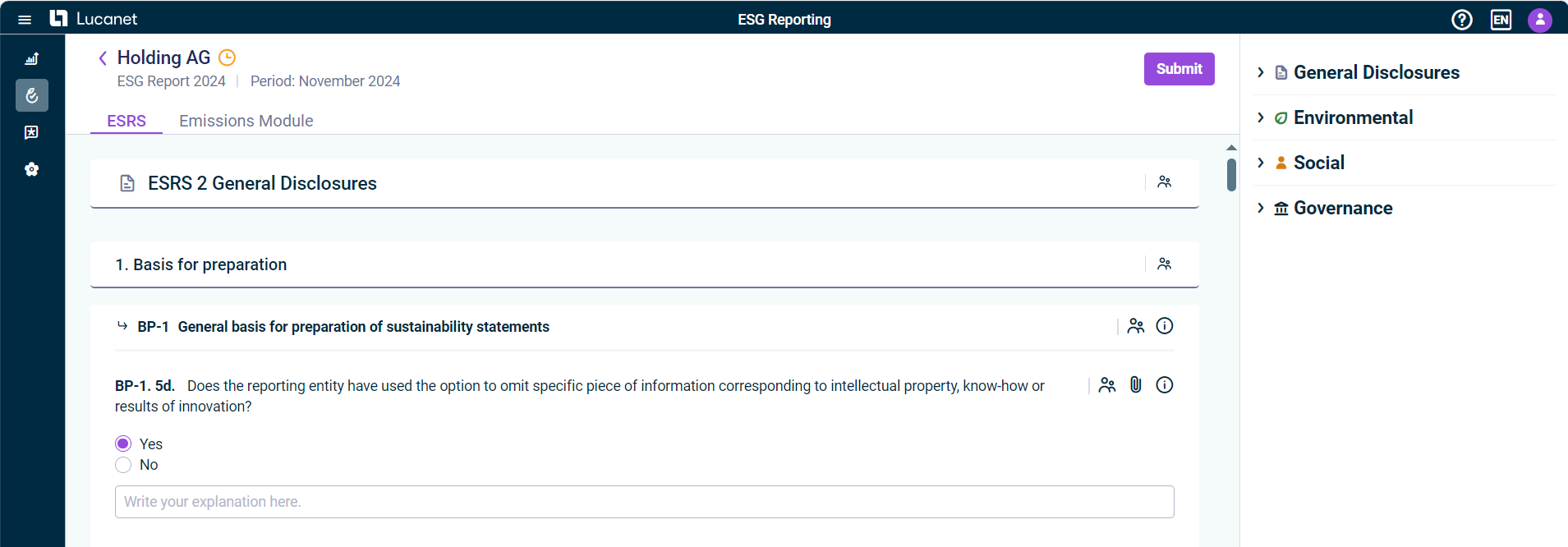
The ESRS, ESRS 2.0, or VSME questionnaire is split into four sections respectively and is displayed as follows, for example:

Displays the user interface of an ESRS questionnaire.
User interface of the ESRS questionnaire

Note for editors with the user role 'ESG Data Collector':

The scope of the categories or questions visible to you as an ESG Data Collector depends on two aspects:

  • The ESG Administrator can configure the questionnaire for the reporting entity to which you are assigned, i.e. assign this reporting entity to the whole questionnaire or to certain parts of it (see Using the Questionnaire Builder).
  • During data collection, the ESG Administrator can assign you to certain parts of the questionnaire as editor or reviewer (see Assigning Users as Editors or Reviewers).

For those reasons, you may not see the whole questionnaire, but only parts of it.

Note for editors with the user role 'ESG Administrator':

The status at the top of the data collection page indicates your access to the questionnaire:

  • Read-only — you have not been assigned as editor to any part of the questionnaire. All answer fields are disabled.
  • Partially editable — you have been assigned as editor to certain parts of the questionnaire. Only the questions assigned to you can be edited; the remaining questions are displayed as read-only.

In the questionnaire, enter the data required for your reporting entity. While doing this, please note the following information:

  • All the data you enter will be saved automatically.
  • The ESG Administrator may have added additional guidance to support data collection, e.g. company-specific instructions, examples, or internal references. The icon indicates that additional guidance has been added for a question (see Viewing Guidance and Notes below).
  • You can use the side panel on the right of the screen to navigate between the individual categories and the questions relating to them (see Navigating with the Side Panel below).
  • The questions in the questionnaire are available in English, French, and German and will be displayed in the selected user language accordingly. If you select any other language, the questions will be displayed in English.
  • To get an overview about all users assigned to specific categories or other parts of the questionnaire as editors or reviewers, click the users icon .
  • If you have marked a question as Completed, the question is displayed as read-only. If a reviewer is assigned, the question becomes available for the reviewer to review. If the reviewer has marked the question as Reviewed, you cannot provide answers for this element anymore (see also Marking Questions as Completed).
  • You can attach files or download attached files (see below).
Note: Besides the standard framework questions, the ESG Administrator may have added custom questions to a disclosure requirement (see Adding Custom Questions). Custom questions appear inline together with the standard questions and are answered in the same way, depending on their question type.

The ESG Administrator may also have added formula-based KPIs to the questionnaire (see Adding Formula-Based KPIs). A KPI is a calculated value: you do not answer it. It is calculated from the answers to other questions of the questionnaire and is updated automatically as soon as you save an answer that the formula uses.

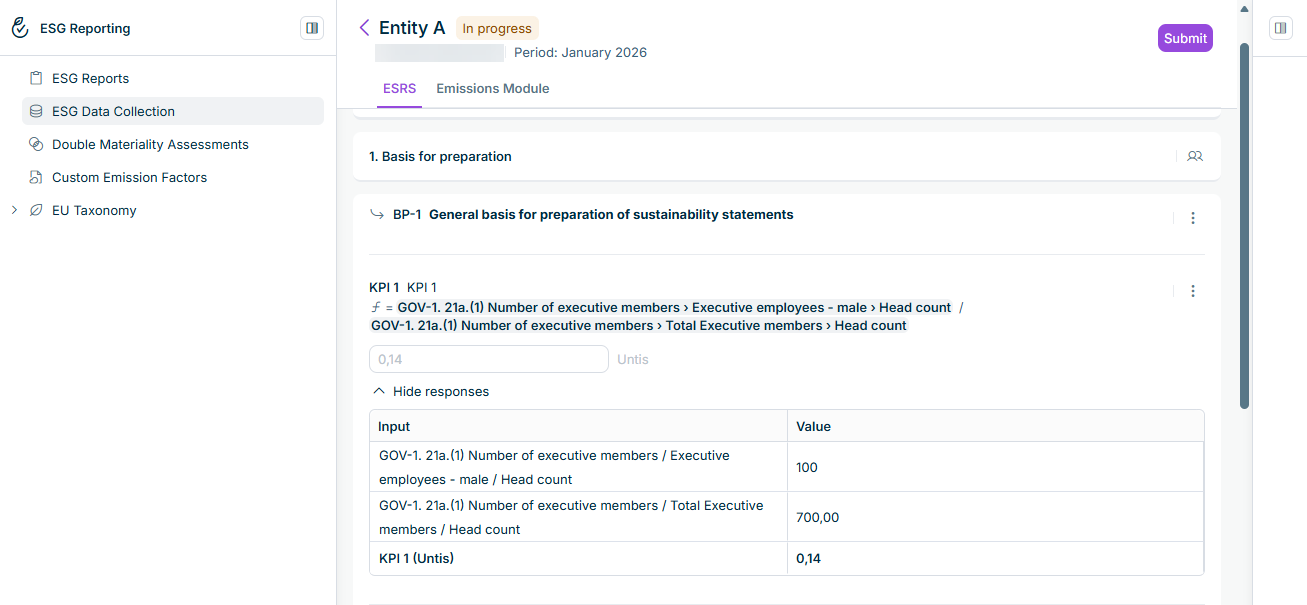
You recognize a KPI by the formula icon next to its number and by the KPI badge. Below the number and the name, the formula is displayed in full, and below it the calculated value together with its unit:

A KPI in the questionnaire, showing the formula icon, the formula with both input values, the read-only value field with its unit, and the 'Show responses' option.
A calculated KPI with its inputs displayed

For a KPI, note the following:

  • The value field is read-only. Nobody can enter or overwrite a KPI value — neither an ESG Data Collector nor a reviewer nor the ESG Administrator.
  • A KPI has no Mark as completed check box, and it is not reviewed separately. It follows the answers it is calculated from.
  • Each input in the displayed formula is a link. Click it to jump directly to the question that provides that input.
  • Click Show responses to open a table of all inputs with their current values and the resulting KPI value, so you can see how the value is calculated. Click Hide responses to close the table again.
  • As long as an input is still missing, no value is calculated. Instead, the KPI indicates that it is still waiting for inputs, and names the questions concerned, so that a partially calculated and therefore misleading figure is never displayed.
  • You only see a KPI if you have access to all the questions used in its formula.
For each question, you can open the guidance provided for it by the reporting framework and by your ESG Administrator.

1

Click the three-dot icon next to the question.

2

Select Guidance and notes.

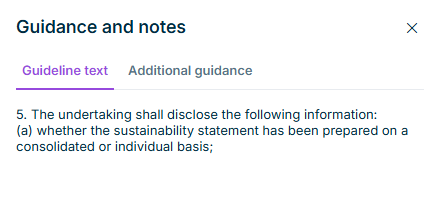
The Guidance and notes panel opens on the right of the screen.

The 'Guidance and notes' panel is displayed on the right of the questionnaire, with the tabs 'Guideline text' and 'Additional guidance'.
The 'Guidance and notes' panel of a question
3

Select the tab you need:

  • Guideline text: The guideline text of the reporting framework or, for a custom question, the guideline text entered by the ESG Administrator
  • Additional guidance: The company-specific instructions, examples, or internal references added by the ESG Administrator
4

Click the Close icon to close the panel.

Note: The panel is read-only for editors and reviewers. Only the ESG Administrator can change the additional guidance, in the questionnaire builder.

If no additional guidance has been added for a question, the Additional guidance tab displays the following text:

Additional guidance has not been added to this element yet.

The side panel on the right of the screen contains a Search box and the structure of the questionnaire, so that you can navigate to any category or question directly.

By default, the side panel is collapsed to a narrow bar. Click it to expand it. In the header of the expanded panel, the following options are available:

  • Keep side panel expanded — pins the side panel so that it remains expanded while you work. The pinned state is remembered: when you reload the page or switch between the ESRS and Emissions Module tabs, the side panel is still expanded.
  • Collapse side panel — collapses the side panel back to the narrow bar.

You can attach files to certain answers in the questionnaire. Uploading documents can provide supporting information and evidence for prior data input.

1

Navigate to the desired question, click the three-dot icon next to it and select Attachments.

The attachment area opens below the question.

2

Attach a file by drag and drop into the attachment area, or click browse and select the file.

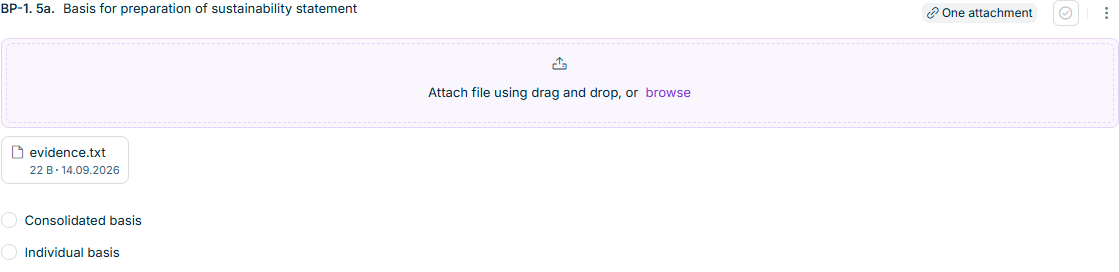
The attachment area of a question, with the drop zone 'Attach file using drag and drop, or browse' and an attached file below it.
Attaching a file to a question

Each attached file is displayed below the drop zone as a tile showing the file name, the file size, and the date on which it was attached.

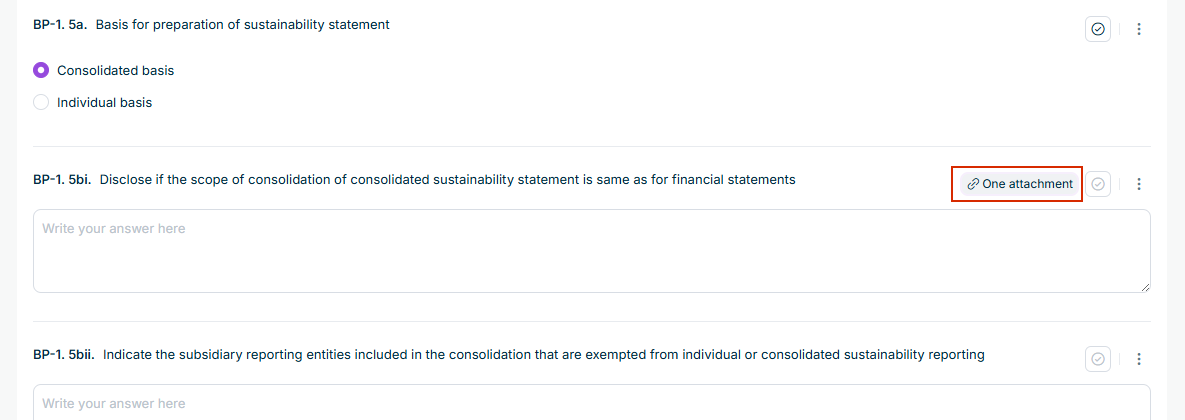
When a question has one or more attachments, the question header displays an attachment indicator (e.g. One attachment). This lets you identify documented questions at a glance, without opening each one — which is especially helpful for review and audit tasks in larger reports.

Several questionnaire questions where only one displays the 'One attachment' indicator on the right of its row, making documented questions easy to spot.
Attachment indicator marking a question that has an attached file

After a file is attached, you can download it to your local device at any time, or delete it from the question.

1

Click the three-dot icon next to the question and select Attachments.

2

Hover over the tile of the file you need.

Two icons appear on the tile:

  • The download icon — downloads the file to your local device.
  • The delete icon — removes the file from the question.

Note: As a reviewer, you can only access the files attached to questions that are assigned to you.

After having provided an answer for a question, you can explicitly indicate that a question is ready for final review by activating the Mark as completed check box. The Mark as completed check box is displayed for each question in the questionnaire. The behavior of this check box depends on whether a reviewer has been assigned to the question:

  • Question without an assigned reviewer: The question is displayed as read-only for the data collector.
  • Question with an assigned reviewer: The question is displayed as read-only for the data collector and becomes available for the reviewer to review.

Proceed as follows to mark a question as completed:

1

Ensure that the question contains at least a partial answer.

2

Activate the Mark as completed check box for the question.

Once a question is completed, you can hover over its Completed icon to see who completed it and when. The tooltip displays Completed by user name and the date and time.

A completed question showing the tooltip 'Completed by *user name*' with the date and time when hovering over the 'Completed' icon.
Tooltip on the 'Completed' icon showing who completed the question and when

Notes:

  • The Mark as completed check box is disabled if no answer has been provided yet. Its tooltip then reads Content is required to mark answer as complete.
  • If you need to change the answer to a question that has already been marked as completed, deactivate the Mark as completed check box for the question. If a reviewer has been assigned to the question, the question will no longer be available for review until you mark it as completed again.
  • When a question in the questionnaire displays data that is automatically copied from the Emissions Module and you mark this question as completed, the corresponding footprints in the Emissions Module become read-only. You cannot create or edit the related footprints until you deactivate the Mark as completed check box for the question.
  • The Mark as completed check box is only available in ESG reports that are created as of December 8, 2025.
  • Formula-based KPIs have no Mark as completed check box. They are calculated automatically and follow the answers they are based on (see Working with Calculated KPIs above).

This content was generated using AI and reviewed by Lucanet subject matter experts before publication.