In the Tax code form workspace in Lucanet VAT (Value Added Tax), you manage the forms of tax codes. VAT already contains standard forms, for example MWS for output tax and VST for input tax, which you can supplement with your own forms.

VAT identifies each tax code form via a three-character abbreviation that corresponds to the designation in the ERP system. You assign each form either to input tax or to output tax.

For transactions in which input tax and output tax arise at the same time, for example for intra-Community acquisitions or reverse charge cases, you assign a counter tax code form to a tax code form. In VAT, for example, the forms ESA and ESE are assigned to each other as counter forms.

Each tax code belongs to a tax code form.

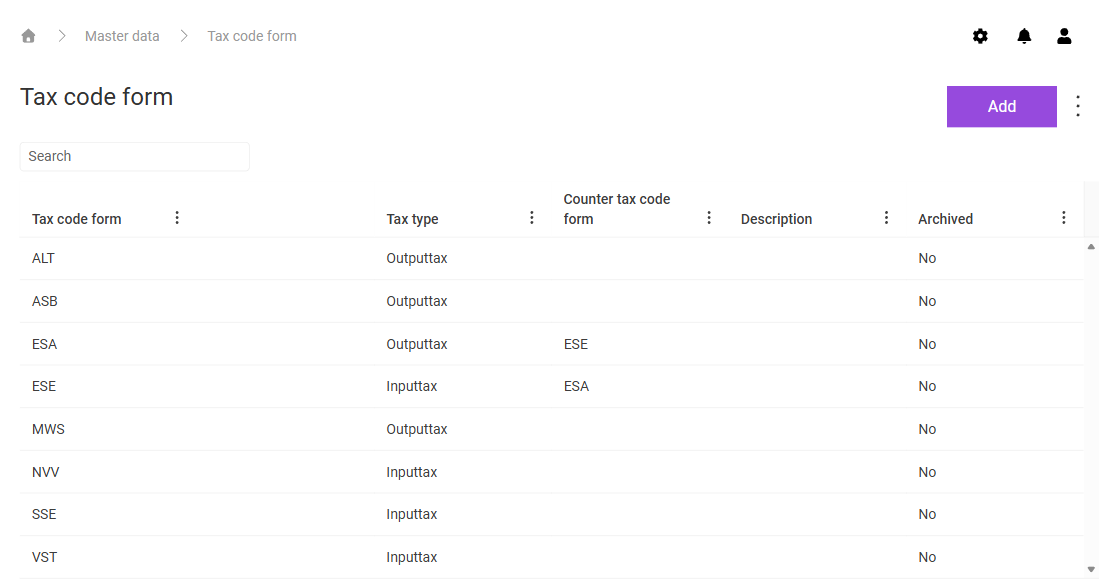
The Tax code form workspace can be found under VAT | Master data | Tax code form and is displayed as follows, for example:

Shows the 'Tax code form' workspace in VAT with the 'Search' field, the 'Add' button, the three-dot icon, and the columns 'Tax code form', 'Tax type', 'Counter tax code form', 'Description', and 'Archived'. The table shows, for example, the tax code forms 'ESA' with the tax type 'Outputtax' and the counter tax code form 'ESE', 'ESE' with the tax type 'Inputtax' and the counter tax code form 'ESA', 'MWS' with the tax type 'Outputtax', and 'VST' with the tax type 'Inputtax'.
'Tax code form' workspace

Proceed as follows to create a tax code form in VAT:

1

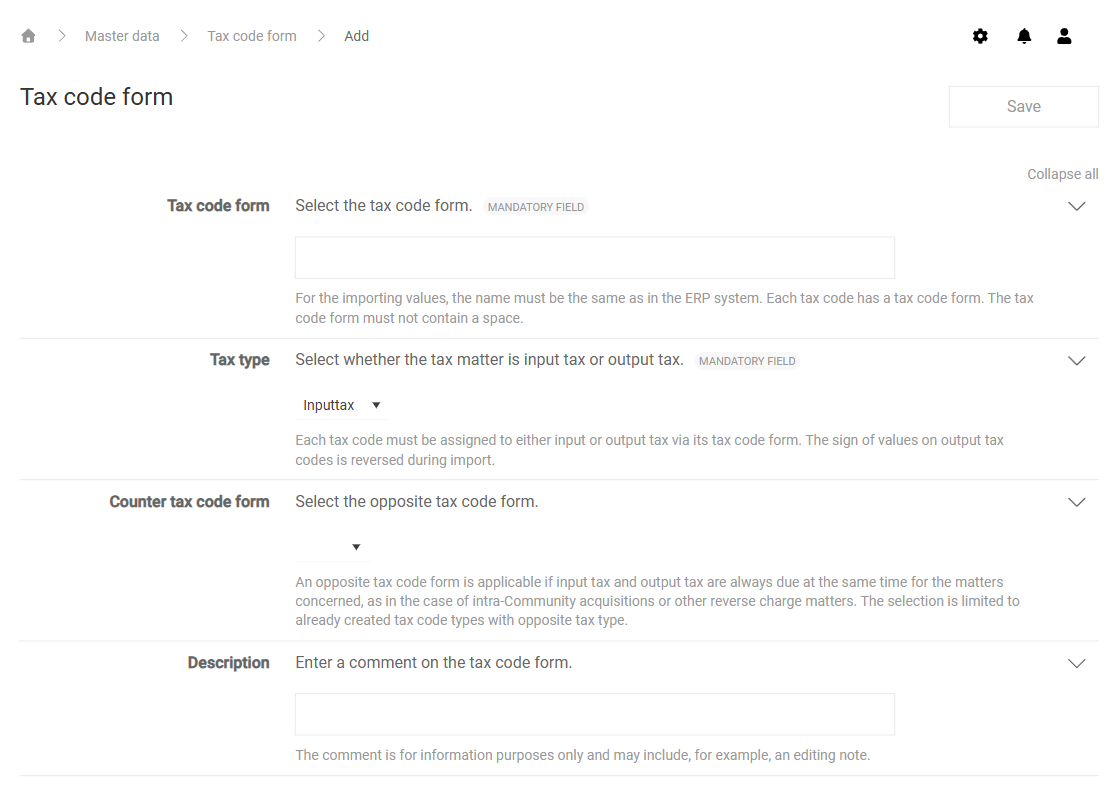
In the Tax code form workspace, click Add. The page for creating a tax code form is displayed:

Shows the page for creating a tax code form in VAT with the 'Save' button and the fields 'Tax code form', 'Tax type' with the value 'Inputtax', 'Counter tax code form', and 'Description'. The 'Tax code form' and 'Tax type' fields are marked as mandatory.
Page for creating a tax code form
2

Fill in the fields. For a description of the fields, see the following table.

3

Click Save.

The following fields are available when you create and edit a tax code form:

FieldDescription
Tax code formSpecifies the abbreviation of the tax code form. The abbreviation must match the identifier in the ERP system exactly so that VAT imports the declaration values correctly. Exactly three characters without spaces are permitted. The field is mandatory.
Tax typeAssigns the tax code form to Inputtax or Outputtax. For tax codes of the output tax, VAT inverts the sign of the values during the import. The field is mandatory.
Counter tax code formAssigns an already created tax code form with the opposite tax type. You only need the assignment if input tax and output tax always arise at the same time for the same transactions, for example for intra-Community acquisitions or reverse charge cases.
DescriptionRecords additional notes on the tax code form as free text. The description is for information purposes only.

To edit an existing tax code form, click the tax code form in the Tax code form workspace. Adjust the fields and click Save.

In addition to the general functions, the Show archived function is available in the three-dot menu (⋮) in the top right corner of the Tax code form workspace in VAT. Use this function to display only the archived tax code forms in the table. To return to the active tax code forms, select Show active.

This content was generated using AI and reviewed by Lucanet subject matter experts before publication.