Before you can execute the consolidation wizards of Consolidation 1, you must create Configurations on the basis of which the consolidation wizards are executed.

To create a configuration:

1

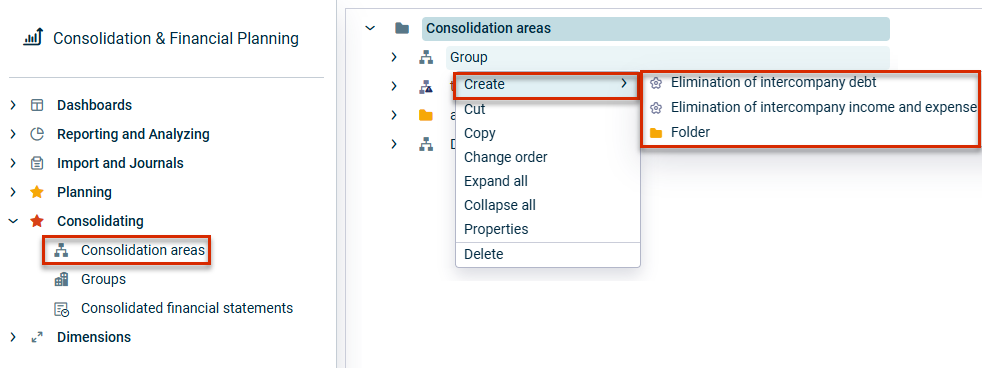
Open the Consolidation areas workspace in the Consolidating folder.

2

Select the desired consolidation area for which you want to create a configuration and select the desired configuration from the Create context menu:

Create configuration
3

Enter a name for the configuration.

4

Select the desired consolidation type (Only for Elimination of intercompany debt and Elimination of intercompany income and expense).

5

Click Save or press Enter.

6

In the detail view of the configuration, click Edit and configure the configuration (see section Editing Configuration)

The following configurations are available:

ElementDescription
Paired elimination of intercompany debtPaired elimination of intercompany debt allows you to configure a wizard-supported elimination of debts between affiliated companies of a consolidation area. Pair combinations are formed of all reporting entities or cost centers that are assigned to the consolidation area (see section Paired elimination of intercompany debt).
Lump sum elimination of intercompany debtLump sum elimination of intercompany debt allows you to perform a wizard-supported elimination of debts and accounts receivable between affiliated companies. The accounts defined in the wizard configuration are offset against one another on a lump sum basis. By contrast to paired elimination of intercompany debt, no partner information is required for lump sum elimination of intercompany debt (see section Lump sum elimination of intercompany debt)
Paired elimination of intercompany income and expensePaired elimination of intercompany income and expense allows you to perform a wizard-supported elimination of income and expenses between affiliated companies of a consolidation area. Combined pairs of accounts are formed between reporting entities or cost centers based on pre-assigned partner information as well as the settings made in the configuration (see section Paired elimination of intercompany income and expense).
Lump sum elimination of intercompany income and expenseLump sum elimination of intercompany income and expense allows you to perform a wizard-supported elimination of income and expense between affiliated companies. The accounts defined in the wizard configuration are offset against one another on a lump sum basis. By contrast to paired elimination of intercompany income and expense, no partner information is required for lump sum elimination of intercompany income and expense (see section Lump sum elimination of intercompany income and expense)
Elimination of intercompany income and expense based on group-internal revenueElimination of intercompany income and expense based on group-internal revenue allows you to perform a wizard-supported elimination of income and expenses between affiliated companies. The group-internal revenue accounts defined in the wizard configuration are offset against one or more expense accounts stating a percentage (see section Elimination of intercompany income and expense based on group-internal revenue).
Inventory consolidationInventory consolidation allows you to configure a wizard-supported elimination of intercompany profit or loss contained in stock (inventory) between affiliated companies of a consolidation area. Pair combinations are formed of all reporting entities or cost centers that are assigned to the consolidation area (see section Inventory consolidation).

The options for the configurations depend on the selected configuration and the selected consolidation type:

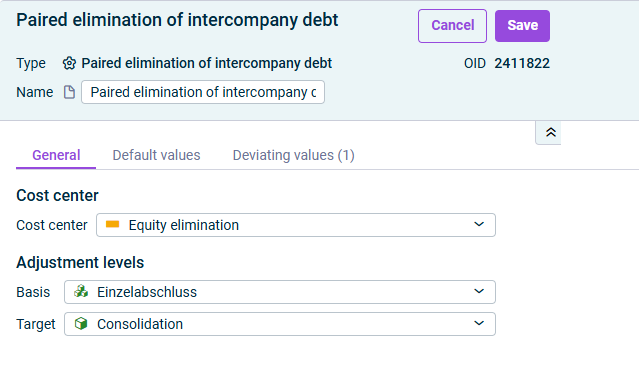
The configuration for the paired elimination of intercompany debt is displayed as follows, for example:

Paired elimination of intercompany debt: 'General' tab

The following options must be configured:

Name of the configuration

In the General area, edit the general properties of the paired elimination of intercompany debt:

OptionDescription
Cost centerCost center for the postings

Note: Cost centers can be created for the individual consolidation steps below the consolidation reporting entity (see section Creating a Consolidation Reporting Entity).
BasisAdjustment level with the data for the generation of the consolidation postings
TargetAdjustment level on which postings are to be made

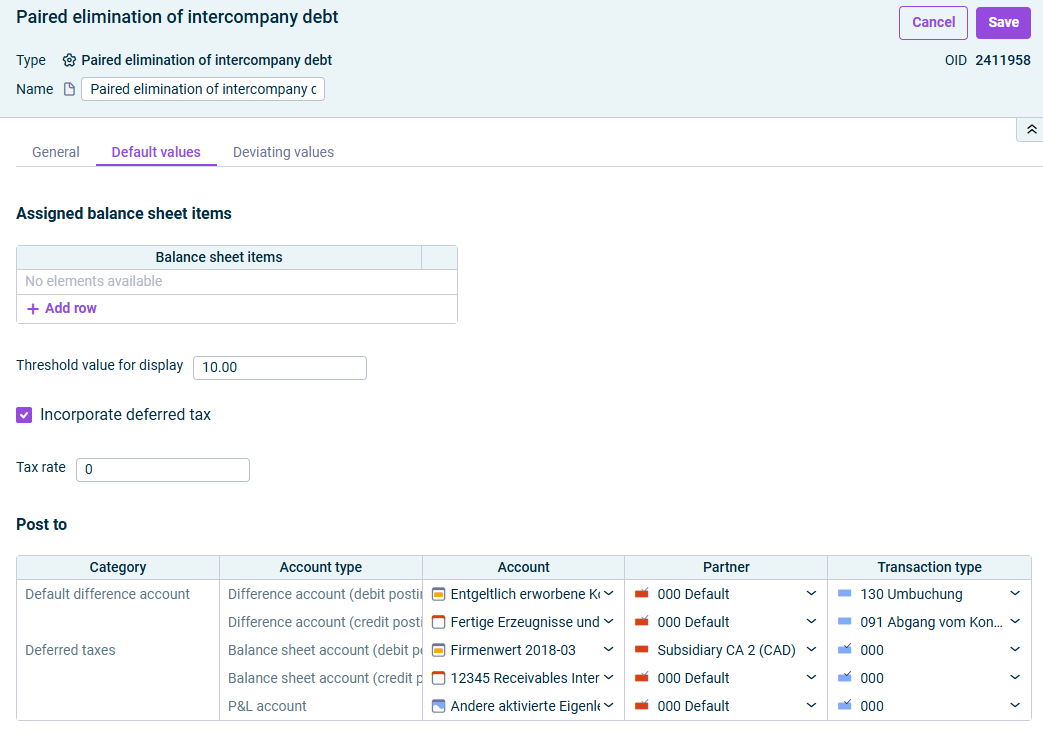
The default configuration for all pair combinations of the consolidation area is performed on the Default values tab:

Paired elimination of intercompany debt: 'Default values' tab

Area 'Assigned balance sheet items'

The following options are available in the Assigned balance sheet items area:

OptionDescription
Balance sheet itemsBalance sheet items to be consolidated.

Click + Add row to add balance sheet items.
Threshold value for displayIf a difference exceeds the entered value, the difference is displayed in red.
Incorporate deferred taxActivate the check box if deferred tax should be incorporated.
Tax rate (in percent of the profit/loss)Tax rate for deferred tax. Displayed when the Incorporate deferred tax check box is activated.

Area 'Post to'

The following categories are available in the Post to area:

CategoryDescription
Default difference accountDefault difference accounts to be used to clear the arising differences
Deferred taxAccounts on which the deferred taxes are to be presented. The row Deferred tax is only displayed when the check box Incorporate deferred tax is activated.

If necessary, add Partners and Transaction types for each category for the postings.

Transaction types can only be selected for schedule-relevant accounts or items.

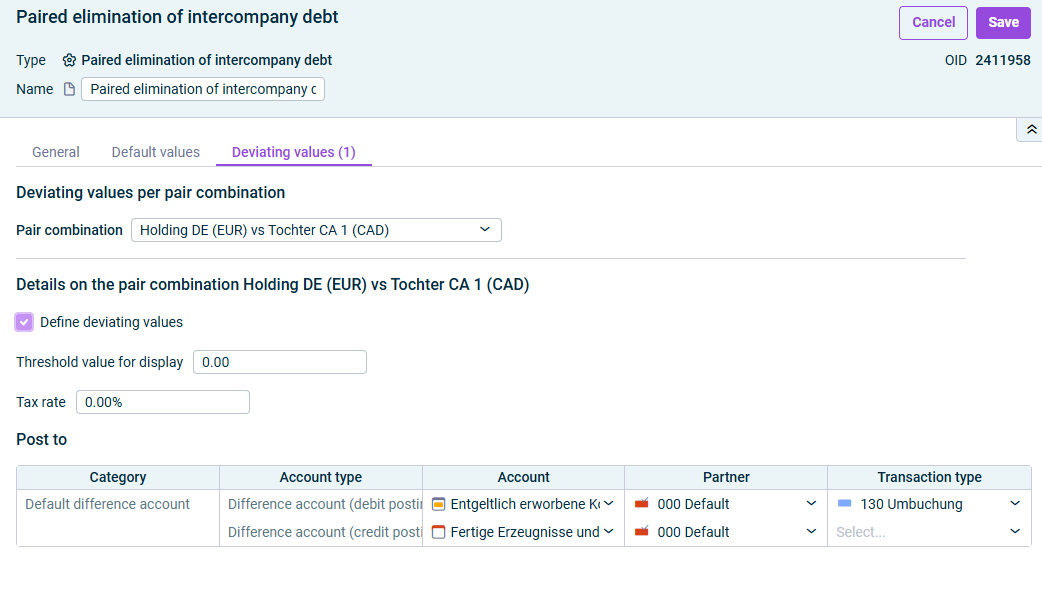
Individual configurations can be created for each pair combination on the Deviating values tab:

Paired elimination of intercompany debt: 'Deviating values'

Area 'Deviating values per pair combination'

  • Pair combination: Select the desired pair combination you want to configure.

Area 'Details on the pair combination'

The following options are available in the Details on the pair combination area:

OptionDescription
Define deviating valuesActivate the check box if deviating values are to be taken into account for the selected pair combination
Threshold value for the displayIf a difference exceeds the value entered for the elimination of intercompany debt, the difference is displayed in a red font.
Tax rate (in percent of the profit/loss)Tax rate for deferred tax. Displayed when the Incorporate deferred tax option is activated.

Area 'Post to'

The following categories are available in the Post to area:

CategoryDescription
Default difference accountDefault difference accounts to be used to clear the arising differences for the selected pair combinations.
Deferred taxAccounts on which the deferred taxes are to be presented. The Deferred taxes row is displayed when the option Incorporate deferred tax is activated.

If necessary, add Partners and Transaction types for each category for the postings.

Transaction types can only be selected for schedule-relevant accounts or items.

The configuration for the lump sum elimination of intercompany debt is displayed as follows, for example:

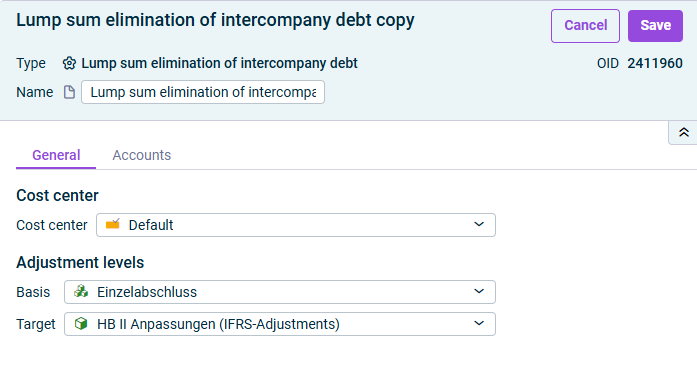
Lump sum elimination of intercompany debt: 'General' tab

The following options must be configured:

Name of the configuration

In the General area, edit the general properties of the lump sum elimination of intercompany debt:

OptionDescription
Cost centerCost center for the postings

Note: Cost centers can be created for the individual consolidation steps below the consolidation reporting entity (see section Creating a Consolidation Reporting Entity).
BasisAdjustment level with the data for the generation of the consolidation postings
TargetAdjustment level on which postings are to be made

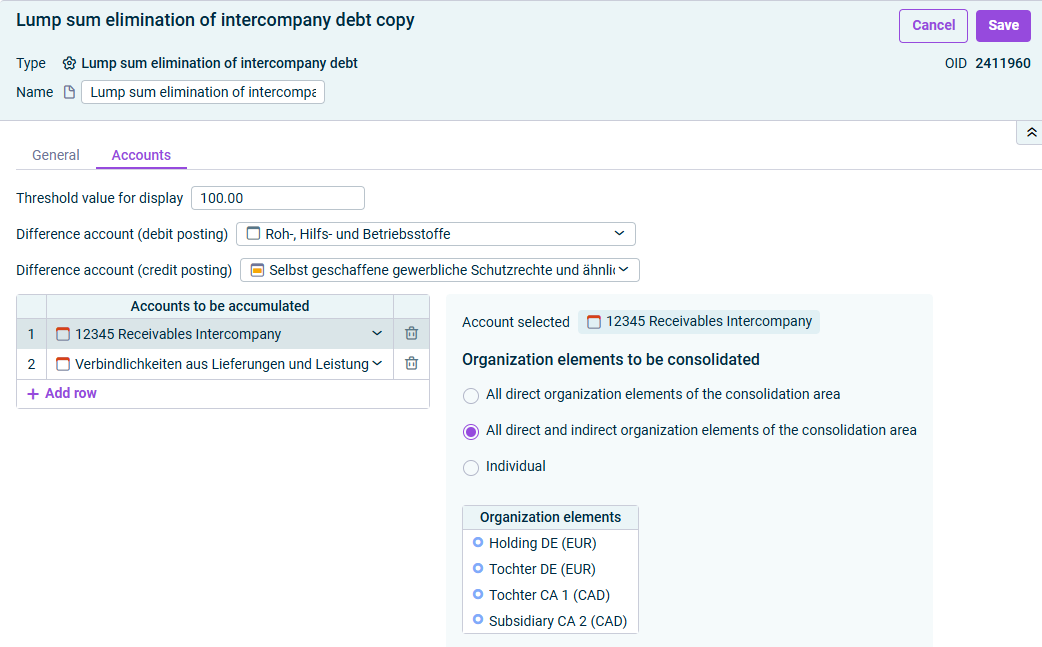
The default configuration for all pair combinations of the consolidation area is performed on the Accounts tab:

Lump sum elimination of intercompany debt: 'Accounts' tab
OptionDescription
Threshold value for displayIf a difference exceeds the entered value, the difference is displayed in red.
Difference account (debit posting/credit posting)Accounts for postings in debit and credit to which any arising differences are to be posted
Accounts to be accumulatedSelect an account to be accumulated and specify the organization elements to be consolidated in the details window. The following options are available:
- All direct organization elements of the consolidation area, to consolidate only those consolidation units that are directly assigned to the consolidation area (excluding sub-groups).
- All direct and indirect organization elements of the consolidation area, to consolidate also consolidation units in subordinate consolidation areas (including sub-groups; see section Creating and Configuring Consolidation Areas).
- Individual, to compile the consolidation units to be consolidated in the Organization elements list.

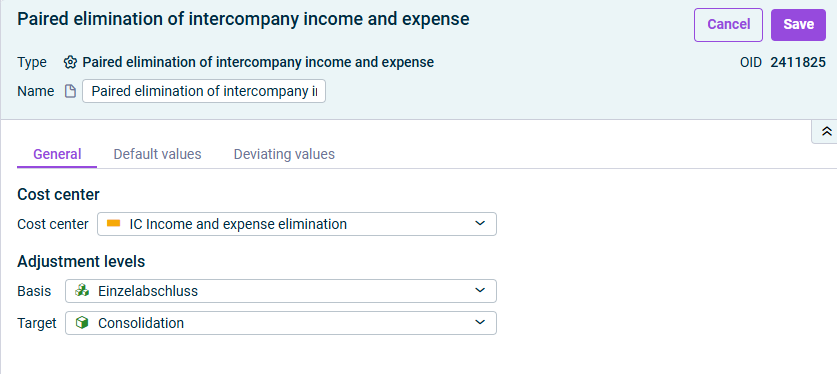
The configuration for the paired elimination of intercompany income and expense is displayed as follows, for example:

Paired elimination of intercompany income and expense: 'General' tab

The following options must be configured:

Name of the configuration

In the General area, edit the general properties of the paired elimination of intercompany income and expense:

OptionDescription
Cost centerCost center for the postings

Note: Cost centers can be created for the individual consolidation steps below the consolidation reporting entity (see section Creating a Consolidation Reporting Entity).
BasisAdjustment level with the data for the generation of the consolidation postings.
TargetAdjustment level on which postings are to be made

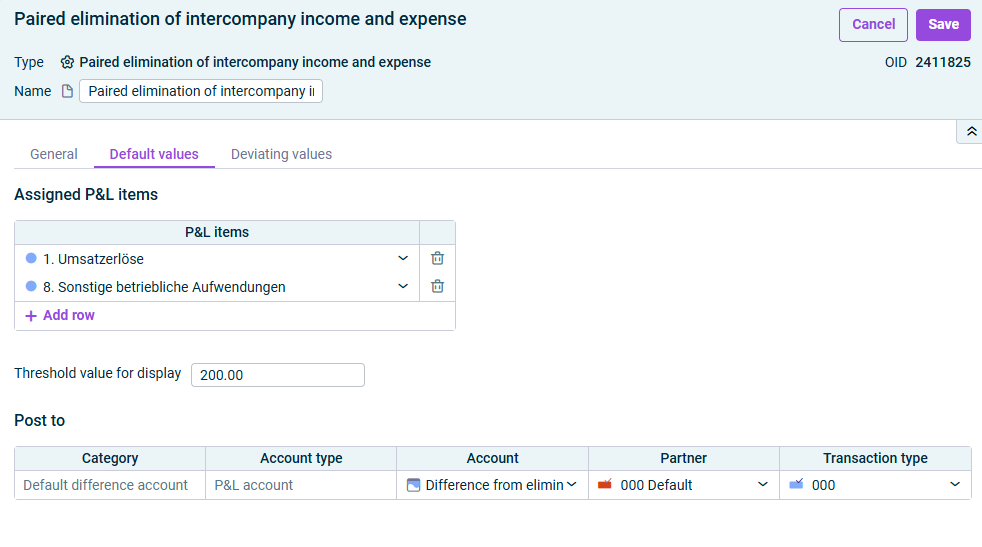
The default configuration for all pair combinations of the consolidation area is performed on the Default values tab:

Paired elimination of intercompany income and expense: 'Default values' tab

Area 'Assigned P&L items'

The following options are available in the Assigned P&L items area:

OptionDescription
P&L itemsP&L items to be consolidated. Click + Add row to add P&L items
Threshold value for displayIf a difference exceeds the entered value, the difference is displayed in red.

Area 'Post to'

In the Account column, specify the default difference account to which any differences should be posted. Add Partner and Transaction type if necessary.

Transaction types can only be selected for schedule-relevant accounts or items.

Individual configurations can be created for each pair combination on the Deviating values tab:

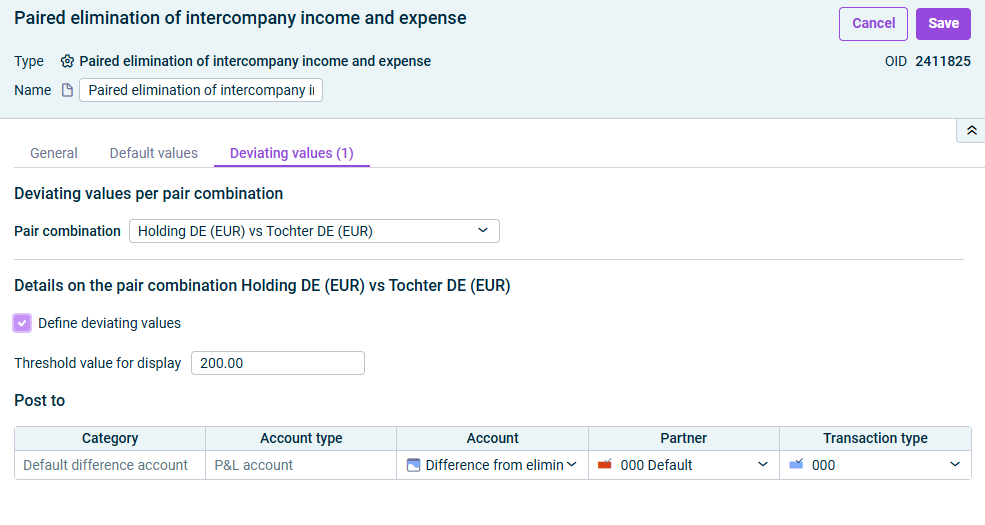
Paired elimination of intercompany income and expense: 'Deviating values' tab

Area 'Deviating values per pair combination'

  • Pair combination: Select the desired pair combination you want to configure.

Area 'Details on the pair combination'

The following options are available in the Details on the pair combination area:

OptionDescription
Define deviating valuesActivate the check box if deviating values are to be taken into account for the selected pair combination
Threshold valueThreshold value for the display. If a difference exceeds the value entered for the elimination of intercompany income and expense, the difference is displayed in a red font.
Tax rate (in percent of the profit/loss)Tax rate for deferred tax. Displayed when the Incorporate deferred tax option is activated.

Area 'Post to'

In the Account column, specify a deviating default difference account for the selected pair combination. Add Partner and Transaction type if necessary.

Transaction types can only be selected for schedule-relevant accounts or items.

The configuration for the lump sum elimination of intercompany income and expense is displayed as follows, for example:

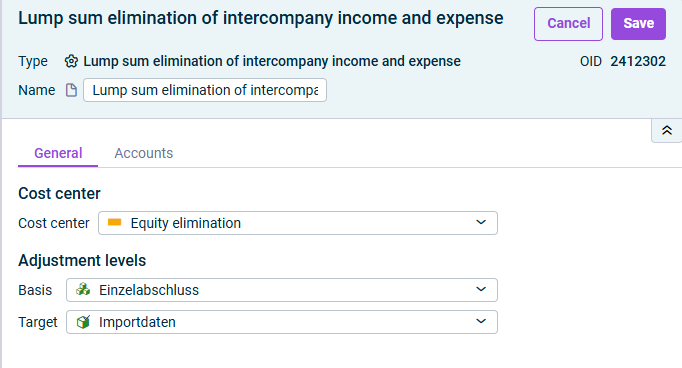
Lump sum elimination of intercompany income and expense: 'General' tab

The following options must be configured:

Name of the configuration

In the General area, edit the general properties of the lump sum elimination of intercompany income and expense:

OptionDescription
Cost centerCost center for the postings

Note: Cost centers can be created for the individual consolidation steps below the consolidation reporting entity (see section Creating a Consolidation Reporting Entity).
BasisAdjustment level with the data for the generation of the consolidation postings
TargetAdjustment level on which postings are to be made

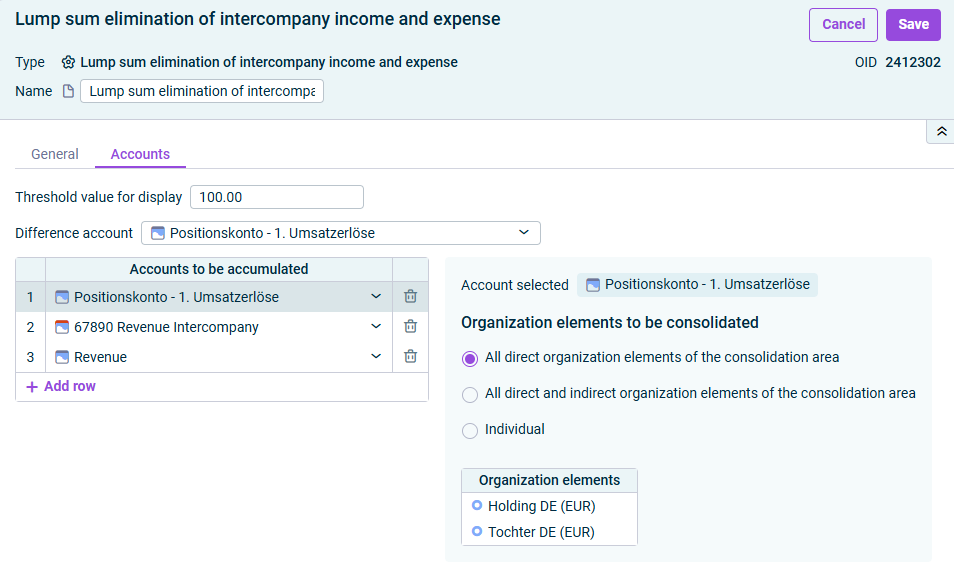
On the Accounts tab, specify the accounts to be accumulated:

Lump sum elimination of intercompany income and expense: 'Accounts' tab
OptionDescription
Threshold value for displayIf a difference exceeds the entered value, the difference is displayed in red.
Difference accountAccount to which the arising differences are to be posted
Accounts to be accumulatedSelect an account to be accumulated and specify the organization elements to be consolidated in the details window. The following options are available:
- All direct organization elements of the consolidation area, to consolidate only those consolidation units that are directly assigned to the consolidation area (excluding sub-groups).
- All direct and indirect organization elements of the consolidation area, to consolidate also consolidation units in subordinate consolidation areas (including sub-groups; see section Creating and Configuring Consolidation Areas).
- Individual, to compile the consolidation units to be consolidated in the Organization elements list.

The configuration for the elimination of intercompany income and expense based on group-internal revenue is displayed, for example, as follows:

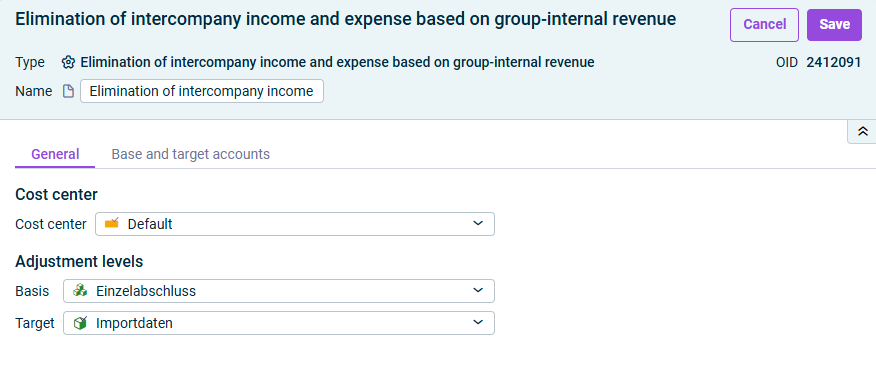
Elimination of intercompany income and expense based on group-internal revenue: 'General' tab

For elimination of intercompany income and expense based on group-internal revenue, the following options must be configured:

Name of the configuration

In the General area, edit the general properties of the elimination of intercompany income and expense based on group-internal revenue:

OptionDescription
Cost centerCost center for the postings

Note: Cost centers can be created for the individual consolidation steps below the consolidation reporting entity (see section Creating a Consolidation Reporting Entity).
BasisAdjustment level with the data for the generation of the consolidation postings
TargetAdjustment level on which postings are to be made

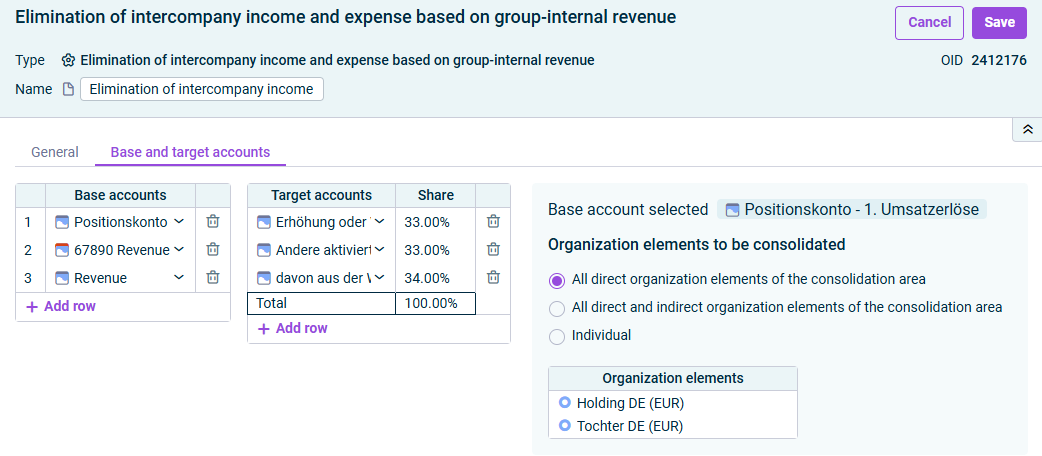
On the Base and target accounts tab, specify the accounts for reporting the group-internal revenue (base accounts) and the contra accounts (target accounts). Define the share in percent of the target account.

elimination of intercompany income and expense based on group-internal revenue: 'Base and target accounts' tab
OptionDescription
Base accountsAccounts for the calculation of group-internal revenue
Target accountsAccounts for the contra entry
SharePercentage share of the target account

Organization elements to be consolidated

You must specify the organization elements to be consolidated for each base account. As soon as you select a base account, more options are displayed:

OptionDescription
All direct organization elements of the consolidation areaOnly those consolidation units that are directly assigned to the consolidation area (excluding sub-groups) are consolidated.
All direct and indirect organization elements of the consolidation areaConsolidation units in subordinate consolidation areas are also consolidated (including sub-groups; see Creating and Configuring Consolidation Areas).
IndividualIndividual selection of the consolidation units in the Organization elements list.

The configuration for inventory consolidation is displayed as follows, for example:

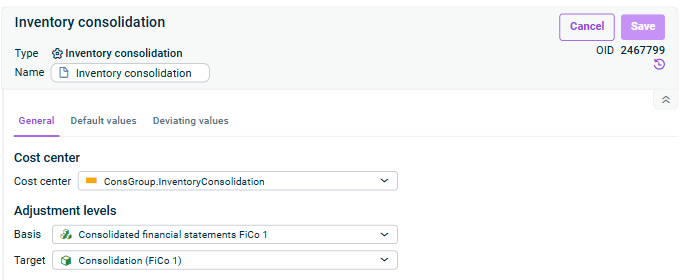
Inventory consolidation: 'General' tab

The following options must be configured:

Name of the configuration

In the General area, edit the general properties of the inventory consolidation:

OptionDescription
Cost centerCost center for the postings

Note: Cost centers can be created for the individual consolidation steps below the consolidation reporting entity (see section Creating a Consolidation Reporting Entity).
BasisAdjustment level with the data for the generation of the consolidation postings
TargetAdjustment level on which postings are to be made

The default configuration for all pair combinations of the consolidation area is performed on the Default values tab:

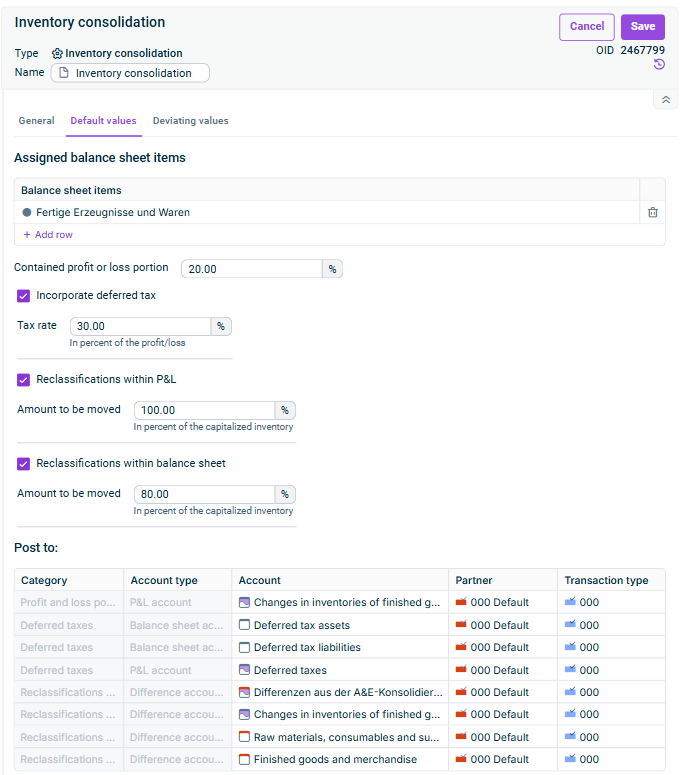
Inventory consolidation: 'Default values' tab

Area 'Assigned balance sheet items'

The following options are available in the Assigned balance sheet items area:

OptionDescription
Balance sheet itemsBalance sheet items to be consolidated.

Click + Add row to add balance sheet items.
Contained profit or loss portionPercentage of the assigned balance sheet items that contains intercompany profit or loss (negative values are also permitted).
Incorporate deferred taxActivate the check box if deferred tax should be incorporated.
Tax rateTax rate for deferred tax, in percent of the profit/loss. Displayed when the Incorporate deferred tax check box is activated.
Reclassifications within P&LActivate the check box if the eliminated profit or loss should be reclassified within the profit and loss statement. Amount to be moved, in percent of the capitalized inventory, is displayed when the check box is activated.
Reclassifications within balance sheetActivate the check box if the eliminated profit or loss should be reclassified within the balance sheet. Amount to be moved, in percent of the capitalized inventory, is displayed when the check box is activated.

Area 'Post to'

The following categories are available in the Post to area:

CategoryDescription
Profit and loss portionP&L account to which the eliminated profit or loss is posted.
Deferred taxesBalance sheet accounts (debit posting and credit posting) and a P&L account on which the deferred taxes are to be presented. Only displayed when the check box Incorporate deferred tax is activated.
Reclassification within the P&LDifference accounts (debit posting and credit posting) for the reclassification within the P&L. Only displayed when Reclassifications within P&L is activated.
Reclassifications within the balance sheetDifference accounts (debit posting and credit posting) for the reclassification within the balance sheet. Only displayed when Reclassifications within balance sheet is activated.

If necessary, add Partners and Transaction types for each category for the postings.

Transaction types can only be selected for schedule-relevant accounts or items.

Individual configurations can be created for each pair combination on the Deviating values tab:

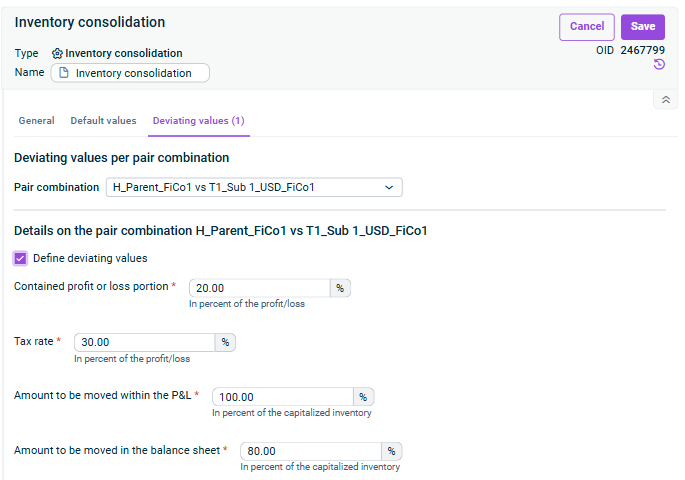
Inventory consolidation: 'Deviating values' tab

Area 'Deviating values per pair combination'

  • Pair combination: Select the desired pair combination you want to configure.

Area 'Details on the pair combination'

The following options are available in the Details on the pair combination area:

OptionDescription
Define deviating valuesActivate the check box if deviating values are to be taken into account for the selected pair combination. The current settings from the Default values tab are applied as the starting values.
Contained profit or loss portionPercentage for the selected pair combination (negative values are also permitted).
Tax rateTax rate for deferred tax, in percent of the profit/loss. Displayed when the Incorporate deferred tax option is activated on the Default values tab.
Amount to be moved within the P&LIn percent of the capitalized inventory. Displayed when Reclassifications within P&L is activated on the Default values tab.
Amount to be moved in the balance sheetIn percent of the capitalized inventory. Displayed when Reclassifications within balance sheet is activated on the Default values tab.

Pair combinations for which deviating values have already been configured are displayed in bold in the drop-down list, and the number of pair combinations with configured deviating values is displayed in the tab name. Subsequent changes to the Default values tab do not affect pair combinations for which deviating values have already been configured.