In the following tables you will find functions that you can use in xP&A formulas.

The following functions are available for formulas in Lucanet xP&A:

FunctionDescription
absThe absolute value of a number
avgThe arithmetic mean (average) of the inputs. Can also be used as avgif. Example: avg(1, 2, 3) = 2avg(if Var[all] % 2 = 0 then Var[all] else none = avg of all even values
first_nonzero_valueThe first value that is not zero or empty Example: first_nonzero_value(0,none,4,6) = 4
logNatural logarithm (base e) Example: log(e^2) = 2
log10Common logarithm (base 10) Example: log10(100) = 2
maxThe highest of the given values Example: max(1, 2, 3) = 3; max([1, 2, 3]) = 3
minThe lowest of the given values Example: min(1, 2, 3) = 1; min([1, 2, 3]) = 1
modThe remainder of a division.You can also use mod as "%" Example: mod(5, 2) = 15 % 2 = 1reccurence every 4 months: if timeStep % 4 = 0 then 1 else 0
reverseReverses the order of an array. Example: reverse([1, 2]) = [2, 1]
roundRounds the number to the closest integer. Optionally, you can specify the decimal places as the second argument. Example: round(2.3) = 2, round(2.5) = 3, round(2.26, 1) = 2.3
rounddownRounds the number down, toward 0. Optionally, you can specify the decimal places as the second argument. Example: rounddown(2.8) = 2, rounddown(-2.8) = -2, rounddown(2.88, 1) = 2.8
roundupRounds the number up, away from 0. Optionally, you can specify the decimal places as the second argument. Example: roundup(2.2) = 3, roundup(-2.2) = -3, roundup(2.22, 1) = 2.3
signchangeTimestep on which the first sign change occurs Example: signchange​(Var[all])
spreadSpreads a value over a time period. Example: spread(New Customers[0:t], Payments[0:t]) For a more detailed example, see Examples for Functions.
sqrtSquare root of a value Example: sqrt(4) = 2
sumThe sum of the inputs. Can also be used as sumif or countif. Example: sum(1, 2, 3) = 6. sum(if Var[all] % 2 = 0 then Var[all] else 0) = sum of all even values
sumproductMultiplies two or more arrays together and returns the sum of products. Example: sumproduct(Var1[all], Var2[all])
expExponential function Example: exp(2) = e^2
FunctionDescription
dateThe timestep number of a date. Timesteps start with 0. Example: date(2021,12,24) = 11 in a monthly model that starts in Jan 2021
month_from_dateExtracts the month of a date or timestep. Example: month_from_date( date(2021,12,24) ) = 12
year_from_dateExtracts the year of a date or timestep. Example: year_from_date( date(2021,12,24) ) = 2021
FunctionDescription
cumipmtCumulative interest paid. Example: cumipmt(rate, periods, value, start, end, type)
finance.AMAmortization Example: finance.AM(principal, rate, period, yearOrMonth, payAtBeginning)
finance.CAGRCompound annual growth rate Example: finance.CAGR(beginning value, ending value, number of periods)
finance.CICompound interest Example: finance.CI(rate, compoundings per period, principal, number of periods)
finance.DFDiscount factor (returns an array; must index array to obtain values -- to see all values of array, see working example above). Example: finance.DF(rate, number of periods)[index]
finance.FVFuture value Example: finance.FV(rate, nper, pmt, pv, type)
finance.IARInflation-adjusted return Example: finance.IAR(investment return, inflation rate)
finance.irrInternal rate of return. Example: finance.IRR(Cashflows[all], [guess]) For a more detailed example, see Examples for Functions.
finance.LRLeverage ratio Example: finance.LR(total liabilities, total debts, total income)
finance.NPVNet present value Example: finance.NPV(rate, initial investment, cash flows[all]) For a more detailed example, see Examples for Functions.
finance.PIProfitability index Example: finance.PI(rate, initial investment, cash flows[all])
finance.PMTPayment for a loan based on constant payments and a constant interest rate Example: finance.PMT(fractional interest rate, number of payments, principal)
finance.PPPayback period Example: finance.PP(number of periods, cash flows[all])
finance.PVPresent value Example: finance.PV(rate, nper, pmt, [fv], [type])
finance.R72Rule of 72 Example: finance.R72(rate)
finance.roiReturn on investment Example: finance.ROI(Cashflows[all])
finance.WACCWeighted average cost of capital Example: finance.WACC(market value of equity, market value of debt, cost of equity, cost of debt, tax rate)
finance.xirrInternal rate of return for a schedule of cash flows Example: finance.xirr([-10,11], [0,12], 12) = 10% For a more detailed example, see Examples for Functions.
fvFuture value Example: v(rate, nper, pmt, pv, [type])
fvifaFuture value interest factor of an annuity Example: fvifa(rate, nper)
ipmtInterest portion of a given loan payment Example: ipmt(rate, per, nper, pv, [fv], [type])
pmtPeriodic payment for a loan Example: pmt(rate, nper, pv, [fv], [type])
ppmtPrincipal portion of a given loan payment Example: ppmt(rate, per, nper, pv, [fv], [type])
pvPresent value Example: pv(rate, nper, pmt, fv, [type])
pvifPresent value interest factor Example: pvif(rate, nper)
rateInterest rate per period of an annuity Example: rate(nper, pmt, pv, [fv], [type], [guess])
FunctionDescription
betaBeta distribution Example: beta(alpha, beta)
binominalBinomial distribution Example: binomial(n, p)
cauchyCauchy distribution Example: cauchy(local, scale)
chisqChi-squared distribution Example: chisq(k)
exponentialExponential distribution Example: exponential(rate)
gammaGamma distribution Example: gamma(shape, scale)
invgammaInverse-gamma distribution Example: invgamma(shape, scale)
lognormalLog-normal distribution Example: lognormal(μ, σ^2)
lognormal_fromLog-normal distribution Example: finance.LR(total liabilities, total debts, total income)
normalNet Present Value Example: finance.NPV(rate, initial investment, cash flows[all])
normal_fromLog-normal distribution Example: lognormal_from_interval​ (from, to, confidence_percent)
paretoPareto distribution Example: pareto(min, alpha)
poissonPoisson distribution Example: poisson(λ)
stdevThe standard deviation of an array Example: stdev(Var[all])
triangleTriangle distribution Example: triangle(from, to, confidence_percent)
uniformUniform distribution Example: uniform(from, to)
varianceThe variance of an array Example: variance(Var[all])

Error to assert an invalid state

Example: error()

Forecasts cohort data without the cohort dimension.

Example: flat_cohort_forecast​(oldCohorts[all],​ newCohorts[all], retentionRates[all],​ lastDataDate, t, [additionalChurn])

Forecasts your future inputs based on historical data using AI.

Example: forecast(timestep, past_values, growth_rate), where timestep is t and past_values references the variable with values.

Notes:

  • Make sure you select a time period that has at least 13 inputs for the most accurate results, e.g. 13 months of data.
  • growth_rate is optional.

Ramps up a value over a time period in the shape of a gaussian bell curve.

Example: gaussian_ramp​(timestep,date(2022,10), 2, 100)

If the first argument evaluates to an invalid number error, we return the second argument. Otherwise, we return the first argument.

Example: if_error(Y/X, Z) - useful where the denominator X is 0, and so the first argument would result in a divided by 0 (invalid number error)

Evaluates to 1 if argument is derived from a datasource, and otherwise to 0.

Example: is_data(Variable[all])

Evaluates to 1 if argument is a locked dimension item, and otherwise to 0.

Example: is_locked​(dimensionitem)

Returns the last timestep that is derived from a datasource.

Example:last_data_​timestep​(Var[all])

Ramps up a value over a time period in an S-shape (logistic function).

Example: logistic_ramp​(timestep, date(2022,1),​ date(2022,10), 1.8, 100, 200)

Ramps up a value quadratically over a time period.

Example: quadratic_ramp​(timestep,date(2022,1),​ date(2022,10) [startValue],​ [endValue])

Ramps up a value linearly over a time period.

Example: ramp(timestep, date(2022,1), date(2022,10), 100, 200)

A ramp with the cumulative sum of 1. Useful for distributing a fixed value over a time period.

Example: ramp_normalized​(timestep, date(2022,1),​ date(2022,10)

The following table provides some practical examples for selected functions:

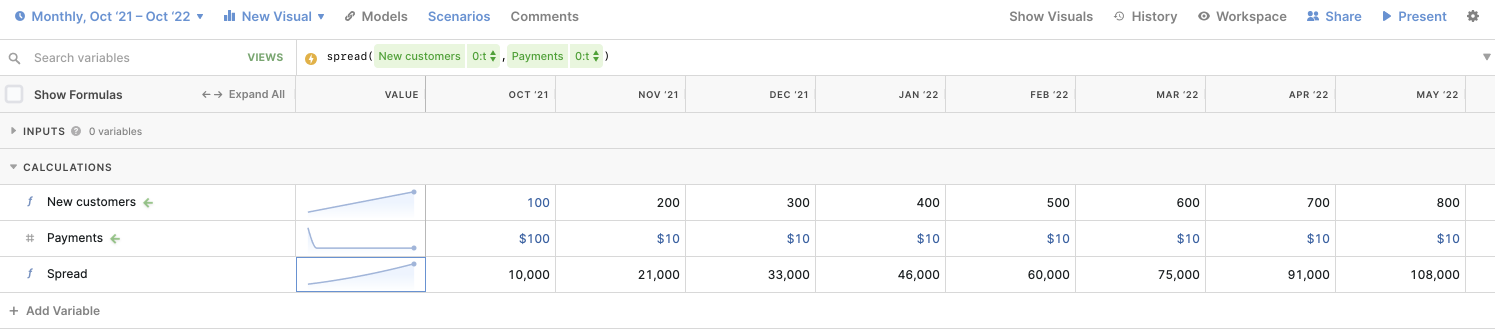
Spread is a powerful and flexible xP&A function. It allows you to spread a value, or a set of values, over a time period. You can think of it as similar in functionality to sumproduct in Excel, but more intuitive (and of course, more powerful).

Spread has two arguments:

  • x - the value or set of values
  • y - the amount you are spreading x by

If all new customers have to pay a $100 sign-up fee in their first month, and from the second month onwards they pay $10 per month for their subscription - you could calculate your monthly revenue using spread.

In this instance, your x would be your new customers each month, and the y amount you are spreading it by would be that payment structure.

In xP&A, this would look as follows:

xP&A has lots of finance functions that you might know from Excel or Google Sheets - and they work very similar.

If you have a Cash Flows variable where the first value is the initial investment and the following values are the returns, you can calculate the IRR like this:

Example for 'finance.irr' function

XIRR is used when the cash flows are not periodic. That's why XIRR needs three arguments:

  • The cashflows
  • The time steps at which they occur
  • The granularity (how many time steps fit into one year).

If you invest $10 in the first month and have a return of $6 after 10 months and another $6 after 12 months, your formula would look like this:

Example for 'finance.xirr' function

Net Present Value (NPV) compares the money received in the future to an amount of money received today, while accounting for time and interest. The arguments of the function are:

  • Rate in percent
  • Cash flows

Example:

For a discount rate of 10%, an initial investment of 500 and cashflows of 200, 300 and 200 you can use the function like this: finance.npv(10, -500, 200, 300, 200).

Usually the cashflows are in a time series variable, in this case you can use the variable in the function:

Example for 'finance.npv' function