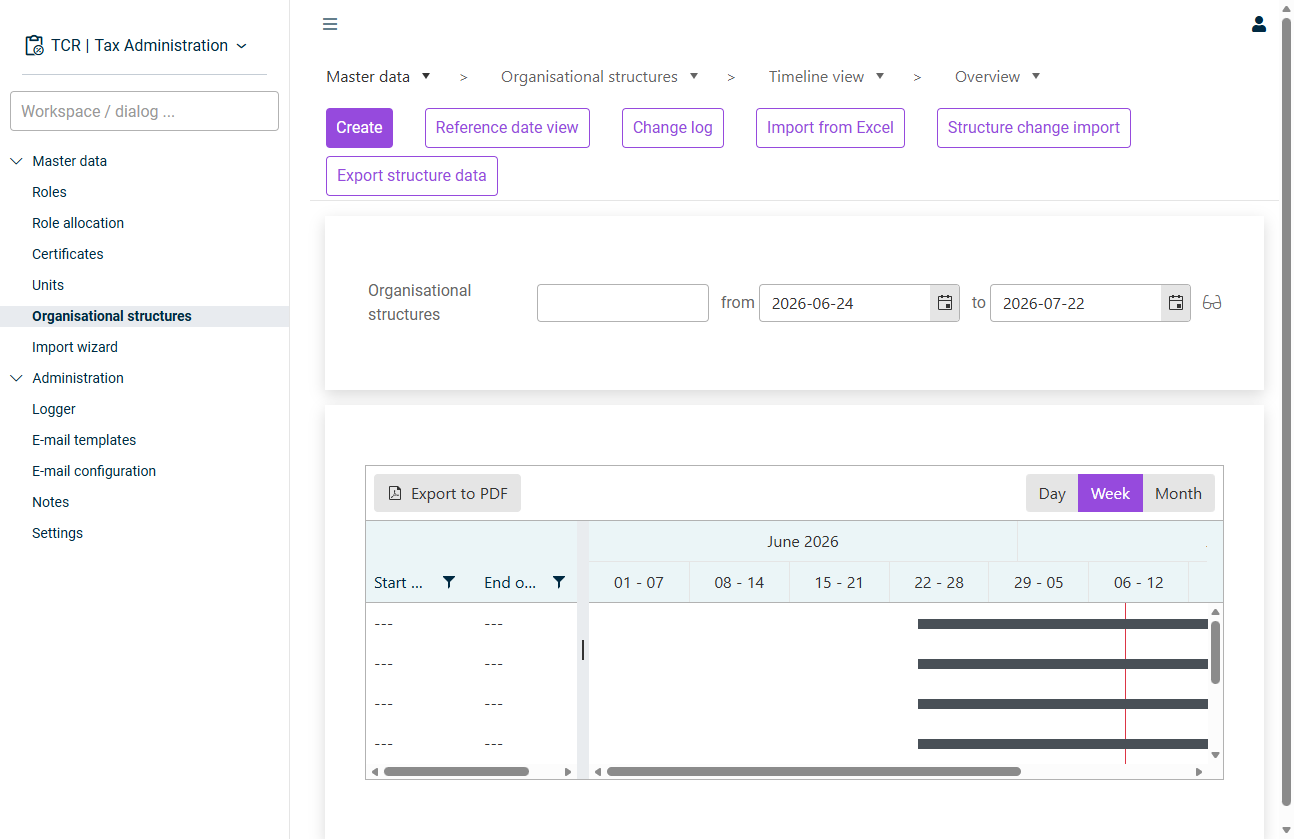
In the Organisational structures workspace, you maintain the time-dependent structures that group the units defined in the Units workspace — the tax groups and (sub-)group structures that the Pillar 2 and CbCR sub-modules rely on. Each structure has a validity period; the workspace lets you inspect, create, edit, import, and export structures and visualize their validity on a timeline.

There are three types of structure, created from the Create menu (see Structure Types below).

The type of a sub-group, i.e. joint venture, investment entity, minority-owned, stateless, and so on, is not set on the structure itself, but is driven by each unit's GloBE Status, which you maintain in the Units workspace. A Company structure - Subgroup is the container that groups those units so they can carry their own jurisdictional elections and be blended separately in the calculation. Once created, a sub-group is selectable in Pillar 2 — for example in Jurisdictional Elections, where you can pick a Subgroup alongside the jurisdiction. Investment entities are an exception: they are not maintained as individual sub-groups — per jurisdiction, all investment entities automatically form a single aggregation group.

The Organisational structures workspace can be found in the Master data folder of the Tax Administration module and is displayed in the Timeline view by default.

Organisational structures workspace in Timeline view with the Create, Reference date view, Change log, Import from Excel, Structure change import and Export structure data buttons, a structure filter with a from/to date range, and a Gantt-style timeline of the structures' validity
'Organisational structures' workspace in 'Timeline view'

Create is a menu that lets you add three types of structure:

TypeDescription
Tax group structureA tax group or fiscal-unity structure, e.g. a corporate-income-tax group.
Company structureThe group structure of the units.
Company structure - SubgroupA sub-group within the company structure — e.g. a joint-venture or minority-owned sub-group — that can carry its own jurisdictional elections and blending.

The following actions are available at the top of the workspace:

ActionDescription
CreateOpen the menu to add a Tax group structure, Company structure, or Company structure - Subgroup.
Reference date viewSwitch from the timeline to a table view that lists structures valid on a single date.
Change logOpen the change history for all organizational-structure changes.
Import from ExcelImport structures from an Excel file.
Structure change importImport structure changes (for example new time states) from Excel.
Export structure dataExport the current structure data to Excel.

The filter row above the timeline lets you filter by structure name and by a from / to date range.

The workspace offers two views of the same data:

  • Timeline view — a Gantt-style chart showing each structure as a horizontal bar across its validity period. Use the Day / Week / Month toggle to change the granularity and Export to PDF to export the chart. When you select a structure, the toolbar additionally offers Add (add a new validity period / time state) and Terminate (end the structure's validity).
  • Reference date view — a table that lists all structures valid on a selected reference date. Useful for comparing structure master data side by side at a specific point in time.

Click Reference date view to switch to the table; the same control then offers Timeline view to switch back.

To create an organizational structure, proceed as follows:

1

Click Create and choose the structure type (Tax group structure, Company structure, or Company structure - Subgroup).

2

Enter the Name of the structure and an optional Comment.

3

Set the Start of validity.

4

Click Save.

Once created, a structure appears on the timeline, where you can add further validity periods (Add) or end its validity (Terminate).

When you open a company structure — in the Reference date view, select a reference date, choose the structure, and open its details — each unit it contains is listed with:

  • Participation amount — the ownership percentage held in that unit (for example 100 % for a wholly owned entity or 50 % for a jointly held one).
  • Consolidation — whether the unit is activated or deactivated in the structure.

Maintain these values when you import or edit the structure (see Import from Excel below), so the structure reflects the actual ownership. Because structures are time-dependent, several structural states can run side by side; use the Timeline view to see which one applied when.

  • Validity periods should overlap only when explicitly intended. Use the timeline to verify that two competing structures do not unintentionally overlap.
  • Changes are recorded in the change log. Use the Change log button to open the history.
  • Use Import from Excel to bulk-load structures, Structure change import to load structure changes, and Export structure data to export the current state (which also serves as an import template).