Validation rules help ensure data accuracy and consistency during data collection. Two types of validation rules are available, determined by the rule scope:

  • Regular – General validations applied to the data collected by a single reporting entity. Regular rules can validate relationships:

    • Within a single form template (intra-form) – Validate relationships between elements in the same form, such as ensuring that assets = liabilities + equity in a balance sheet
    • Between multiple form templates (inter-form) – Validate relationships across different forms, such as ensuring consistency between the balance sheet and P&L statement
  • Intercompany – Validations for balances between related reporting entities, such as subsidiaries or group companies. Intercompany rules compare aggregated values across entity pairs using group or transaction currency.

Validation rules are applied at the individual reporting entity level during data collection.

To create a validation rule:

1

Navigate to Data Collection | Validation rules.

2

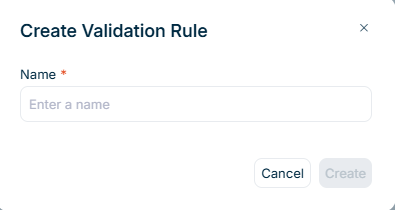
Click Create validation rule in the top right. The Create Validation Rule dialog is displayed.

The 'Create Validation Rule' dialog is displayed.
'Create Validation Rule' dialog
3

Enter a unique Name for your validation rule.

4

Click Create. You can now configure the newly created validation rule (see the following section).

After creating a validation rule as described in the previous section, the validation rule detail view opens. The first step is to select a rule scope: Regular or Intercompany. The options available for configuration depend on the selected scope and are described below.

Changing the rule scope after you have already configured fields permanently removes all configurations for the current scope. This action cannot be undone.

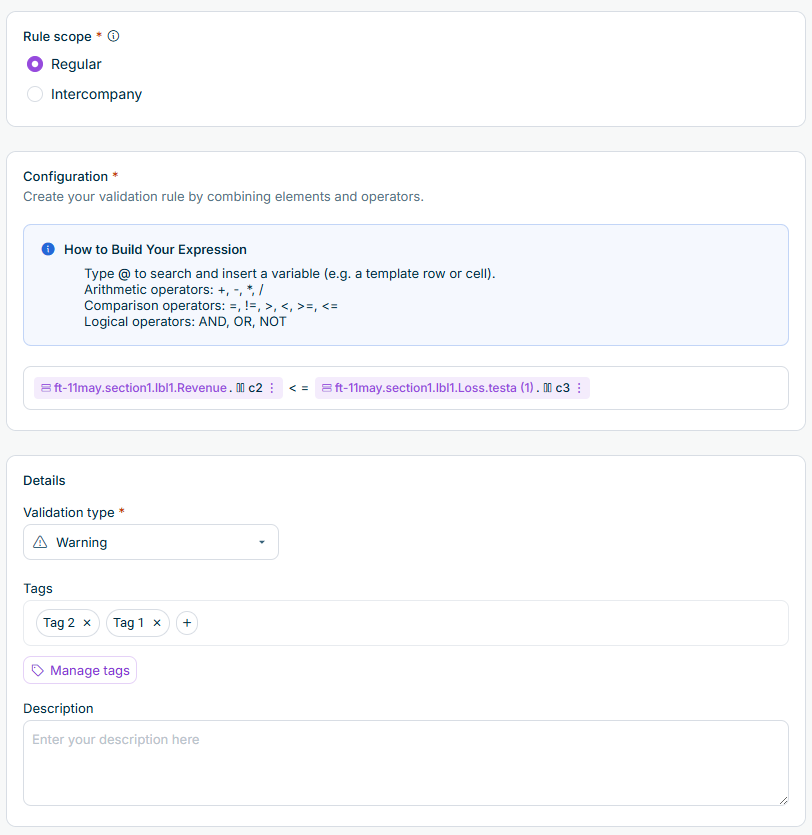
Regular validation rules apply to the data collected by a single reporting entity. The following options are available:

The Detail view of a regular validation rule is displayed.
Detail view of a regular validation rule

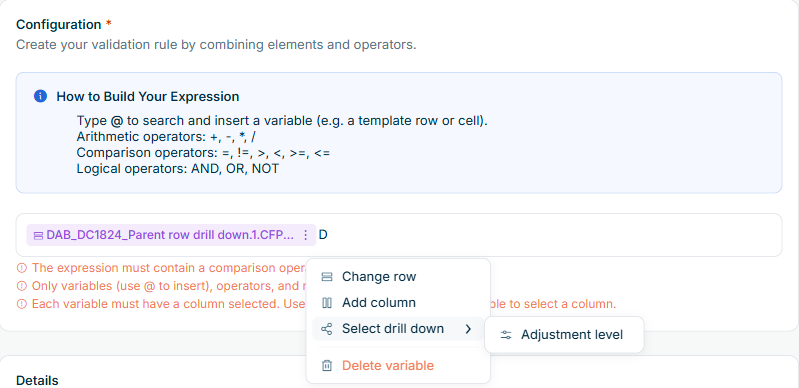
Text area for building the validation rule by combining elements and operators. The system provides autocomplete with available elements grouped by form template. Elements are referenced using their business names (e.g., BalanceSheet.Assets.EndingBalance).

Supported operators include:

  • Comparison operators (=, !=, >, <, >=, <=)
  • Arithmetic operators (+, -, *, /)

Defines the behavior when the validation fails. The following options are available:

  • Blocking: Data collectors cannot submit their data if the validation fails.
  • Warning: Shows a warning but allows data collectors to continue and submit their data.

Optional text field to explain the purpose of the validation rule. Helps other administrators understand the business logic behind the rule.

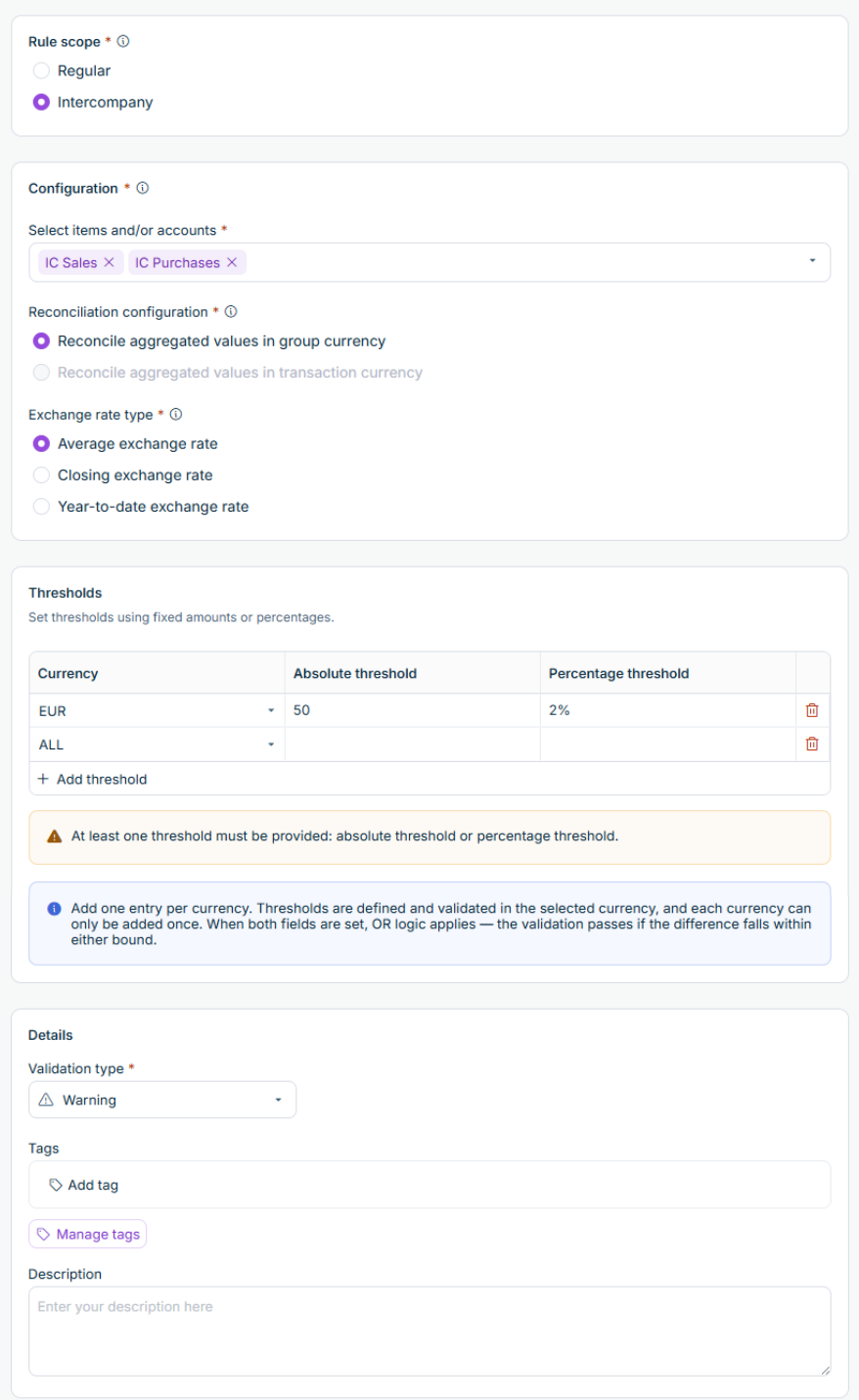
Intercompany validation rules compare values between related reporting entities, such as subsidiaries or group companies. The following options are available:

The Detail view of an intercompany validation rule is displayed.
Detail view of an intercompany validation rule

Multi-select drop-down list for choosing one or more items and/or accounts to be reconciled. Items or accounts are organized in a hierarchical tree by form template and table.

Single-select drop-down list for specifying the column to use for reconciliation. This field appears only if one or more items and/or accounts are selected and the form template configuration requires a column to be specified.

Currency mode used for reconciliation:

  • Reconcile aggregated values in group currency – Reconciles values after converting them to group currency
  • Reconcile aggregated values in transaction currency – Reconciles values in their original transaction currency without conversion

Exchange rate type used when converting values to group currency. Options include:

  • Average exchange rate
  • Closing exchange rate
  • Year-to-Date exchange rate

Pre-configured as Warning for intercompany validation rules. Shows a warning when a discrepancy is detected but allows data collectors to continue.

Optional text field to explain the purpose of the validation rule. Helps other administrators understand the business logic behind the rule.

Once you have finished configuring the validation rule, it must be Published before it can be applied to data collection processes. For more information, see Publishing a Validation Rule.

The validation rules list displays all configured rules with the following information:

The Validation rules list is displayed.
Validation rules list

Name of the validation rule

Current state of the validation rule:

  • Draft
  • Published

Scope of the rule:

  • Regular
  • Intercompany

Creation date

Date of the most recent modification

To edit an existing validation rule, click the three-dot menu at the end of the row and select Edit.

When first created, a validation rule is automatically in Draft state. While in this state, it can undergo any number of modifications. Once its configuration is finalized, the validation rule must be Published before it can be applied to ongoing or future data collection processes.

To publish a validation rule, click Publish in the top right of the validation rule detail view.

A published validation rule can only be edited if it is not actively being executed against ongoing data collection processes. Editing a published validation rule automatically brings it back to Draft state.

To delete a validation rule, click the three-dot menu at the end of the row and select Delete. In the confirmation dialog, click Yes, delete.

Validation rules that apply to forms linked to ongoing data collection processes cannot be deleted.