External accounting documents represent expected account movements that you want to record in addition to the cash forecasts planned in Lucanet Banking & Cash Management (BCM). External accounting documents supplement the current balances and advice transactions with planned inflows and outflows and are thus included in the liquidity calculation and in the automatic reconciliation.

Each external accounting document carries a unique Document number and references a one-time due date. BCM does not support intervals for external accounting documents — for regularly recurring expected account movements, use cash forecasts.

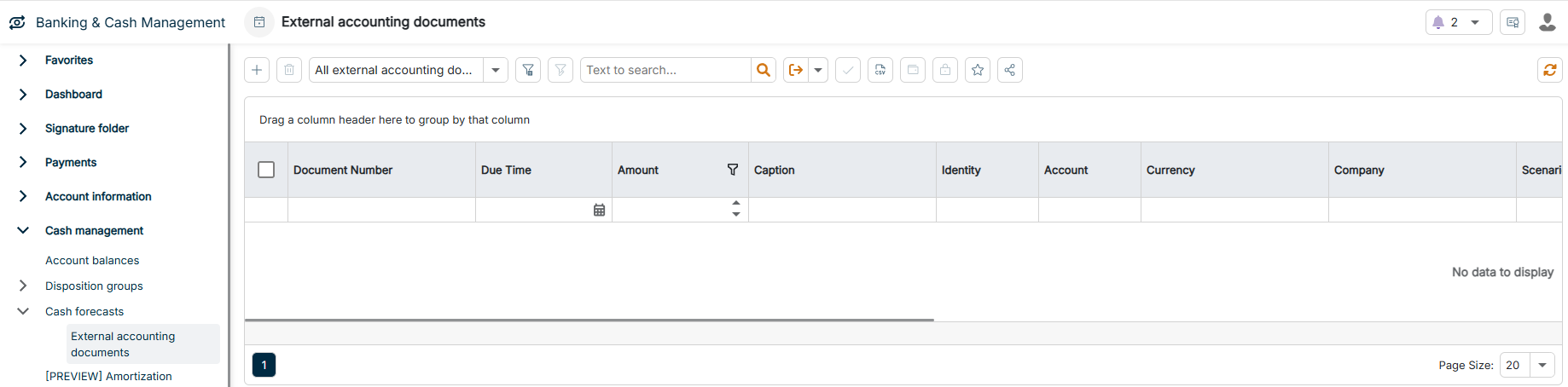
The External accounting documents workspace can be found under Banking & Cash Management | Cash management | Cash forecasts | External accounting documents:

The External accounting documents workspace is highlighted in the menu navigation.
'External accounting documents' workspace in the menu navigation

To create an external accounting document:

1

Navigate to Cash management | Cash forecasts | External accounting documents.

2

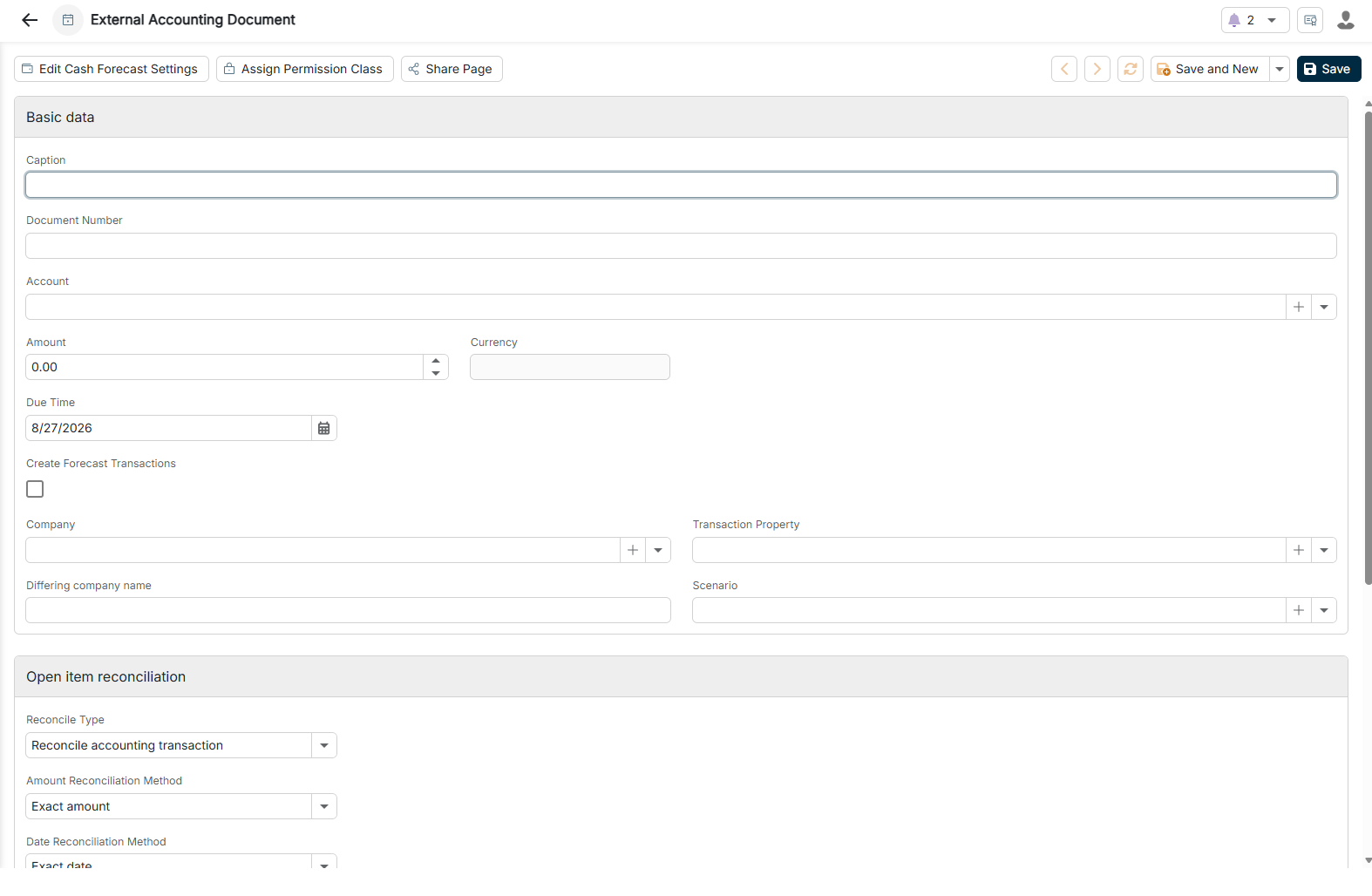
Click the Plus icon in the upper left corner. The configuration of an external accounting document is displayed as follows:

The configuration options for an external accounting document are displayed.
Configuring an external accounting document
3

Configure the external accounting document according to your requirements. For more information, see Configuring External Accounting Documents.

The configuration options of an external accounting document are divided into two areas: Basic data and Open item reconciliation. At the end of the configuration area, you also assign a permission class to the external accounting document.

The Basic data area contains the following options:

OptionDescription
CaptionUnique name or description that identifies the external accounting document
Document numberUnique document number, for example, an invoice or order number, that identifies the external accounting document in BCM
AccountBank account on which the expected account movement will take place. Used to calculate the liquidity development.
AmountExpected amount of the account movement
CurrencyCurrency of the expected payment. Taken over automatically from the selected account and cannot be changed manually.
Due timeDate on which the payment is expected. The default value is today's date. The due date serves as the basis for time-based liquidity calculations and for the reconciliation.
Create forecast transactionsIf activated, BCM automatically creates forecast transactions from the external accounting document, which are visible in the transaction overviews. The check box is deactivated by default. Under System | Configuration | Cash on the Forecasts tab, you can add external accounting documents as a type and activate the Create forecast transactions option — the check box is then activated automatically for all new external accounting documents.
CompanyReference to a company stored in BCM. Enables precise assignment and automatic completion of payment information for internal payments.

You create new companies via the Plus icon or under Master data | Companies and contacts | Companies.
Transaction propertyCategorization of the transaction for reporting and analysis. You can assign transaction properties manually or automatically. Via the Plus icon, you create new properties with the following details:
- Caption: name of the property
- Default: check box for automatic assignment
- Filter: logical operators — and, or, not and, not or — based on criteria such as IBAN, amount, or remittance information
Differing company nameFree text that records a differing name for the company of this payment, for example, for third-party payments or payments via collective accounts. Serves solely as display and search information and does not overwrite the stored company. BCM does not consider this field when reconciling with accounting transactions — for name-based reconciliation, use the Additional filter. For more information, see Open Item Reconciliation.
ScenarioOptional assignment to planning scenarios for scenario analyses and strategic liquidity planning. Via the Plus icon, you can create new scenarios with the following fields:
- Caption: name of the scenario
- Description: explanation of the scenario
- Include in account balances: controls whether the scenario is included in the balance calculation

The Open item reconciliation area contains the following options:

OptionDescription
Reconciliation typeDetermines the type of reconciliation. Options:
- Reconcile accounting transaction: reconciliation against actual postings on the account
- Mark due time as done at due day: automatic closing on the due date without checking transactions
- Mark due time as done at day after due day: automatic closing one day after the due date
- No reconciliation: manual management without automatic reconciliation
Amount reconciliation methodDefines the precision of the amount reconciliation. Options:
- Exact amount: only for a 100% match
- Percental tolerance: deviations in percent are permitted
- Amount range: deviations within absolute amounts are permitted
Date reconciliation methodDefines the period for the date reconciliation. Only available if Reconciliation type = Reconcile accounting transaction. Options:
- Exact date (default value): only for an identical date.
- Date range: with a configurable tolerance via the Days to subtract and Days to add fields. Example: 0/3 means that the reconciliation can take place on the due date and up to 3 calendar days afterwards.
Additional filterLogical filter for additional reconciliation criteria, for example, to prevent incorrect assignments when there are several similar payments. BCM evaluates the filter criteria against the fields of an imported accounting transaction — typical fields are IBAN, Bank reference, End-to-end reference, Customer reference, and Remittance information.

Via the Advanced Mode check box, you switch to an advanced mode in which you can enter more complex filter expressions directly.

With a Permission class, you control the visibility of the external accounting document. You can select an existing permission class from the drop-down list or create a new one via the Plus icon — the external accounting document is then displayed only to users to whom this permission class is assigned. Users without the corresponding permission class do not see the record, even if their permissions otherwise grant access. When you create a permission class, you enter a Caption, a Description, and the assigned Users.

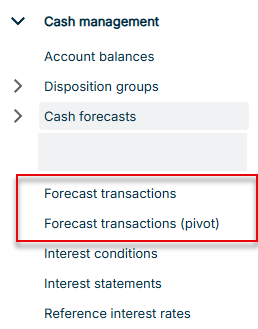
If the Create forecast transactions check box is activated in the basic data of the external accounting document, BCM displays all created external accounting documents in two additional workspaces:

  • Forecast transactions: List view of all individual forecast transactions with detailed information
  • Forecast transactions (pivot): Pivot view of the same data for flexible grouping, filtering, and analysis
The workspaces for forecast transactions are displayed in the menu navigation.
Workspaces for forecast transactions

Both workspaces display the same data — the information entered during creation, such as account, company, amount, and due date — in different forms of presentation.

BCM automatically reconciles open external accounting documents with the actual account movements. Alternatively, you mark external accounting documents as done manually.

After each successful retrieval of advice transactions or account information, BCM compares the retrieved advice transactions and accounting transactions with the open external accounting documents. How BCM compares them is determined by the options that you have configured for each external accounting document in the Open item reconciliation area — the reconciliation type, the methods for amount and date reconciliation, and the additional filter.

If there is a successful match, BCM automatically marks the external accounting document as done and removes it from the list.

To perform a manual reconciliation:

1

Navigate to Cash management | Cash forecasts | External accounting documents.

2

Select the records to be reconciled.

3

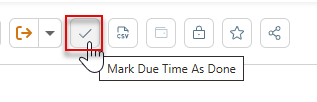
In the toolbar, click Mark Due Time as Done. BCM deletes the external accounting document.

The button for marking the due date as done is displayed.
Marking the due date as done

BCM permanently deletes reconciled external accounting documents — they cannot be restored. If a Forecast transaction exists for the external accounting document, BCM deletes it as well.