You can export your model(s) out of xP&A into a variety of formats and file types. This is useful for a variety of situations, for example:

  • Sharing your model with people outside of xP&A
  • For using the model data or outputs in systems outside of xP&A
  • Saving a local or offline copy of your model and its data

To export a model:

1

Click the Settings button and navigate to the Export and download section.

2

Click + to create a new export. The New export dialog is displayed.

3

Configure the Export definition, Target, and Content steps as described below. Click Next to move from one step to the next.

4

Once all three steps are configured, click Create export.

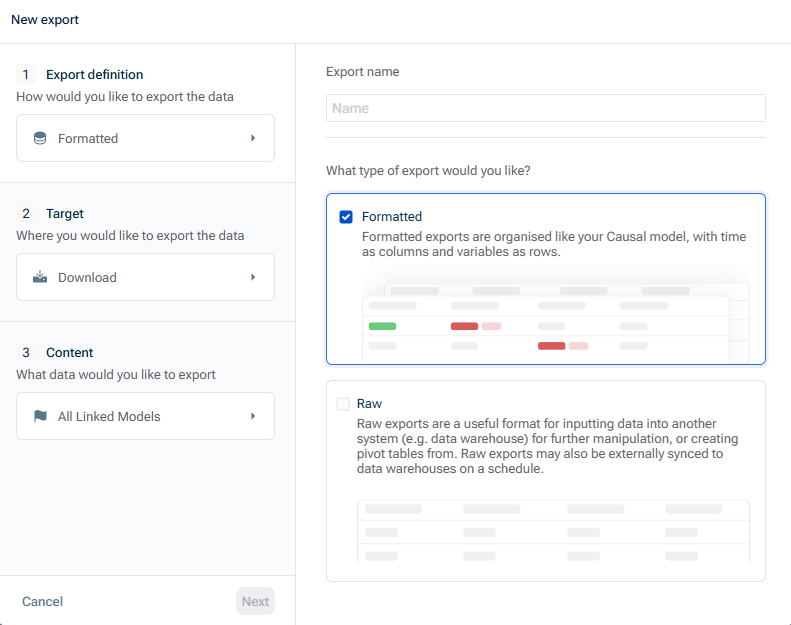
View of the 'Export definition' step in the 'New export' dialog

The following options must be configured in the Export definition step:

OptionDescription
NameName of your export
Export definitionRaw values: This format is useful for inputting into another system (e.g. data warehouse) for further manipulation, or creating pivot tables from.
Formatted values: This format is organized like your xP&A model, with time as columns and variables as rows.
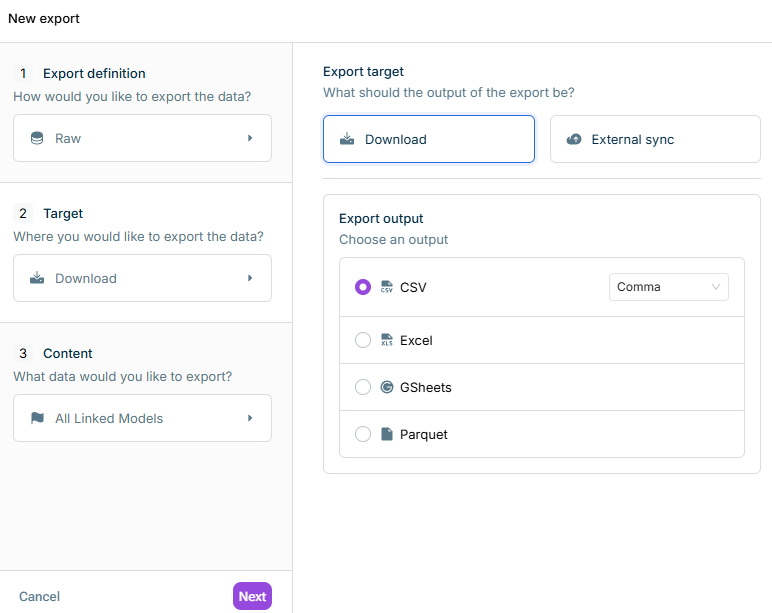
View of the 'Target' step in the 'New export' dialog

The following options must be configured in the Target step:

OptionDescription
DownloadUse this option to export a download file and choose the file format. If you export formatted values, the output format is always an Excel file. If you export raw values, you can choose between CSV, Excel, Google Sheets, or Parquet (a compressed file format designed for fast querying and efficient storage, especially for big data volumes).
External syncUse this option if you want the export to be synced with an external system and choose the target system and the parameters for the synchronization. In addition, specify the export schedule, i.e. if you want to sync the export one-time only or regularly on a specific day and time.

Note: The External sync option is only available for raw value exports and for the following target systems: BigQuery, Databricks, MySQL, Redshift, Postgres and Snowflake.
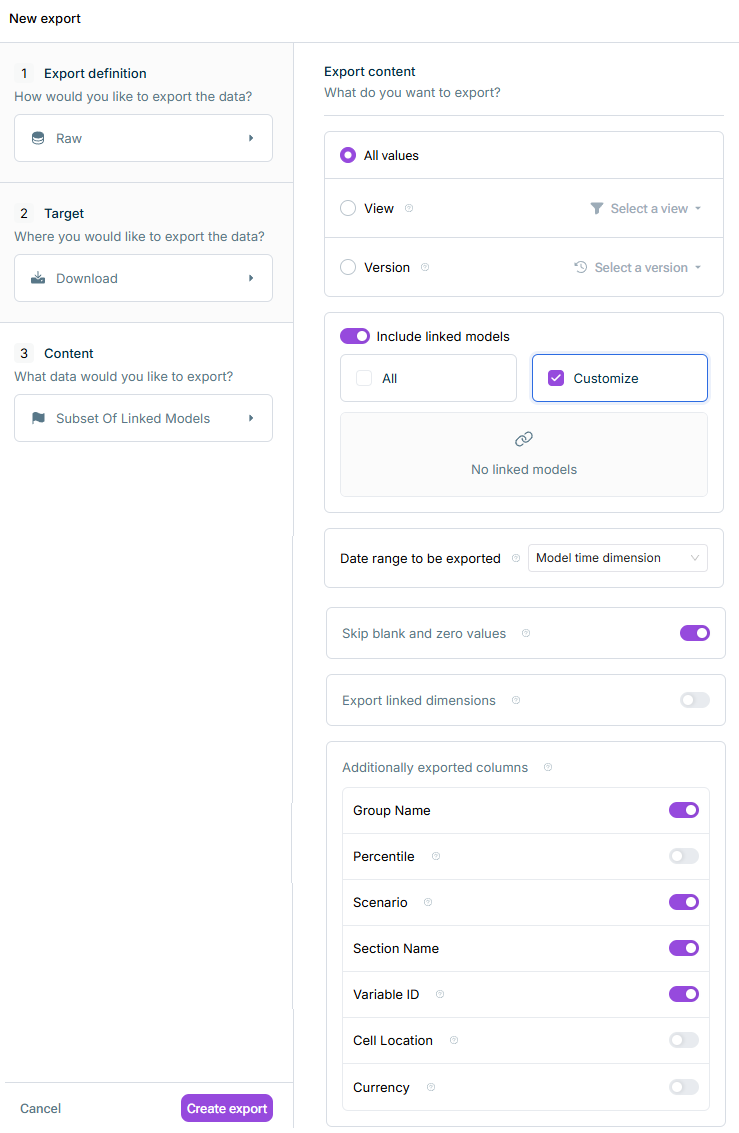
View of the 'Content' step in the 'New export' dialog

The following options must be configured in the Content step:

OptionDescription
ContentChoose the content to be exported:
All values: Export all values.
View: Filter values via a view (you will need to exit the export modal if you need to create a view).
Version: Choose a specific version to be exported.
Include linked modelsChoose if you want to include linked models in the export:
All: All linked models are exported.
Customize: Choose the linked models you want to export.
Date rangeChoose the date range to export:
Model time dimension: Will export all dates in the model.
Model time filter: Will limit the exported dates to the currently selected time filter.
Skip blank and zero valuesExclude blank values and values close to zero (smaller than 1E-6) from the export.
Export linked dimensionsChoose if you want to include the model's linked dimensions in the export.

Note: This option is only available for raw value exports and is disabled if the model has no linked dimensions to export.
Additionally exported columnsAdditional columns to include in your export. By default, values, variable names, and dates are exported.
Group Name: Includes the name of the group the variable belongs to.
Percentile: Activate this option if you use values with uncertainty (e.g. "10 to 30") in your models and want to see the full distribution for each variable in the export.
Scenario: If you disable this column, only values from the default scenario are exported.
Section Name: Includes the name of the section the variable belongs to.
Variable ID: Represents xP&A's internal ID of the variable. While a variable's name can be changed throughout the lifetime of a model, its variable ID remains constant.
Cell Location: Provides URLs linking each exported data point to its origin cell.
Currency: Includes the currency ISO code associated with the variable (if the variable is formatted as a currency).